

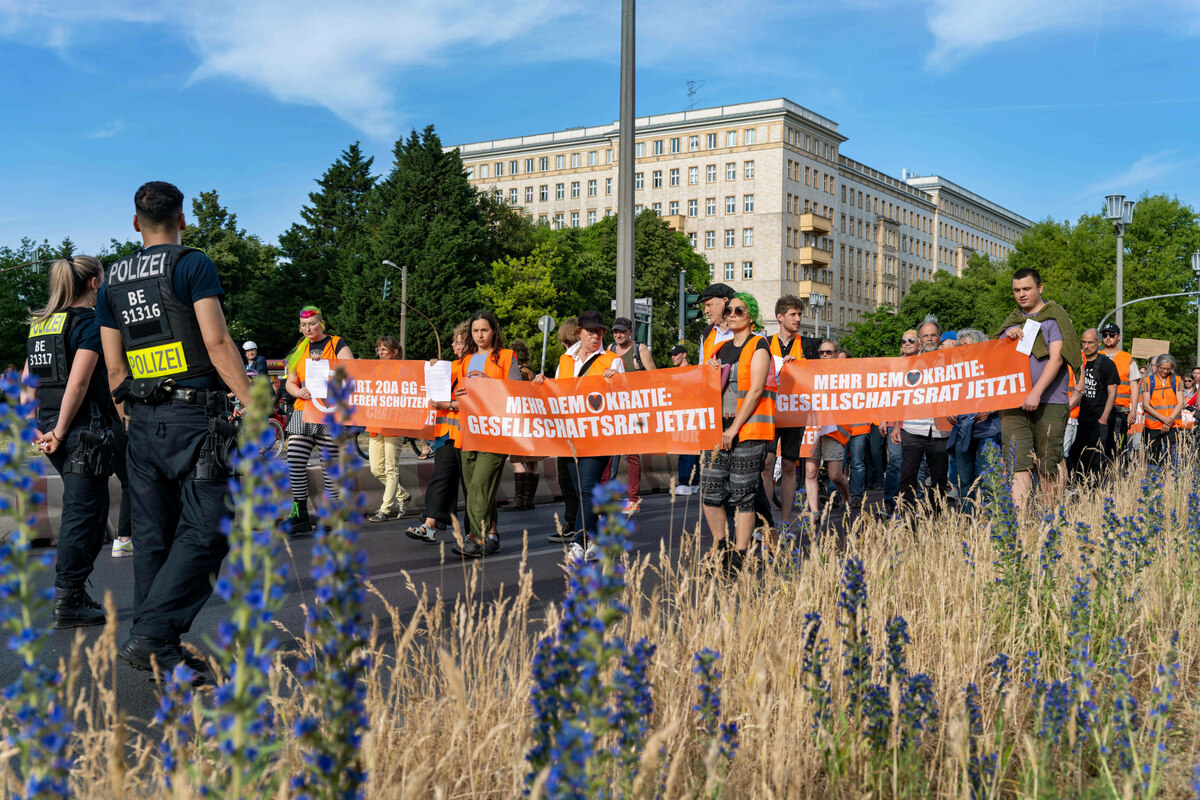
The Potsdam Regional Court has opened legal proceedings against the climate activists from the now disbanded Last Generation climate group. The group announced this on Monday morning. Accordingly, five members now have to face the accusation in court of being members of a criminal organization. The corresponding letter from the Potsdam regional court is available to the taz, but the court could not initially be reached upon request.
Potsdam is the first court to actually bring the accusation before a judge. At the same time, the public prosecutors in Flensburg and Munich also brought charges under paragraph 129. The paragraph is actually intended to take action against organized crime, such as mafia structures. However, because this allows the police to carry out extensive surveillance measures at a fairly low threshold The accusation was also repeatedly made against political groups. Charges rarely arise.
But now the lead public prosecutor’s office in Neuruppin is actually seeking a conviction against the Last Generation. She therefore sees it as proven that the group’s purpose was to commit crimes.
It is a “breaking point,” said Carla Hinrichs, the group’s former spokeswoman, to the taz on Monday. Hinrichs himself is accused in the Munich trial. The fact that “such a popular group with such an open group structure” is being charged under Section 129, which criminalizes the formation of criminal organizations, shows “where the rule of law is developing.” If convicted, anyone who has ever donated 5 euros could face prosecution as a supporter of a criminal organization.
Civil disobedience with mashed potatoes
The last generation had above all drew attention to itself with numerous civil disobedience actions between 2022 and 2023. This caused a stir across the country in particular Road blockades in Berlinin which activists stuck themselves to the road. In addition, the activists repeatedly appeared in public with museum campaigns, for example with one Mashed potato litter on a Monet painting – secured under glass – in the Barberini Museum in Potsdam in October 2022. The goal: to build political pressure to get the federal government to act on the climate crisis.
Is that enough to accuse the group of committing crimes? In the past, the Berlin Public Prosecutor’s Office has repeatedly rejected the classification as a criminal organization. In Brandenburg, however, there are also allegations that are considered a higher criminal offense than coercion in traffic or damage to property. Activists had that too Taxiways at BER airport blocked and were in the PCK refinery in Schwedt invadedto close the adjusting wheels on an oil pipeline.
Apparently the prosecution is targeting a random handful of people in order to criminalize the entire organization
Carla Hinrichs, former LG spokeswoman
According to the group, the five activists who have now been charged have little in common. “It is completely arbitrary who was hit here,” Hinrichs told the taz. Among the defendants is the activist Mirjam Herrmann, who became known for throwing mashed potatoes, and the activist Henning Jeschke, who took part in road blockades. Hinrich’s assessment: “Apparently the public prosecutor’s office is taking action against a random handful of people in order to criminalize the entire organization.”
Hinrichs described the accusation itself as a “complete reversal of causality”. The last generation wanted to use the democratic means of civil disobedience to point out to the state “its own violation of the law by lacking climate protection”. “I can put my hand in the fire that none of us had the goal of committing crimes,” said Hinrichs.
From the beginning, the Brandenburg authorities had distinguished themselves with their zeal to persecute the last generation. Raids took place on activists as early as December 2022 at the request of the Neuruppin public prosecutor’s office. As a result, hundreds of people registered there to make a self-report for supporting a criminal organization. The group’s phones were monitored, including the press phone taz journalists were also affected were.
The persecution zeal had repeatedly triggered the debate about the extent to which authorities were pressured to deliver results by the spring press and politicians. The then Federal Interior Minister Nancy Faeser (SPD) had said that the constitutional state would not allow itself to be “danced around on its face,” and after the mashed potato campaign, an SPD politician drew Taliban comparisons. The then Brandenburg Justice Minister Susanne Hoffmann (CDU) published a newspaper article in which she argued for prosecution under Paragraph 129.
“The intimidation has already taken place”
“It is clear to us that this is a political procedure that was initiated against us because of public pressure,” says Hinrichs. She believes that this pressure has limited the civil society process. “The intimidation has already happened,” she says. She sees a “democracy problem” not only in the current court case, but also in the “executive intimidation” during the movement’s peak phase.
The Last Generation disbanded at the end of 2024. Two groups emerged from it: the “New Generation”, which primarily relies on the establishment of social councils, and the “Resistance Collective”, which carries out civil disobedience closer to the goals of the old group. The proceedings are not directed against either of the two new groups.
A date for the start of the trial has not yet been set. However, it is expected that the process will start this year. Especially if it goes through the courts, it could take years before a verdict is reached.