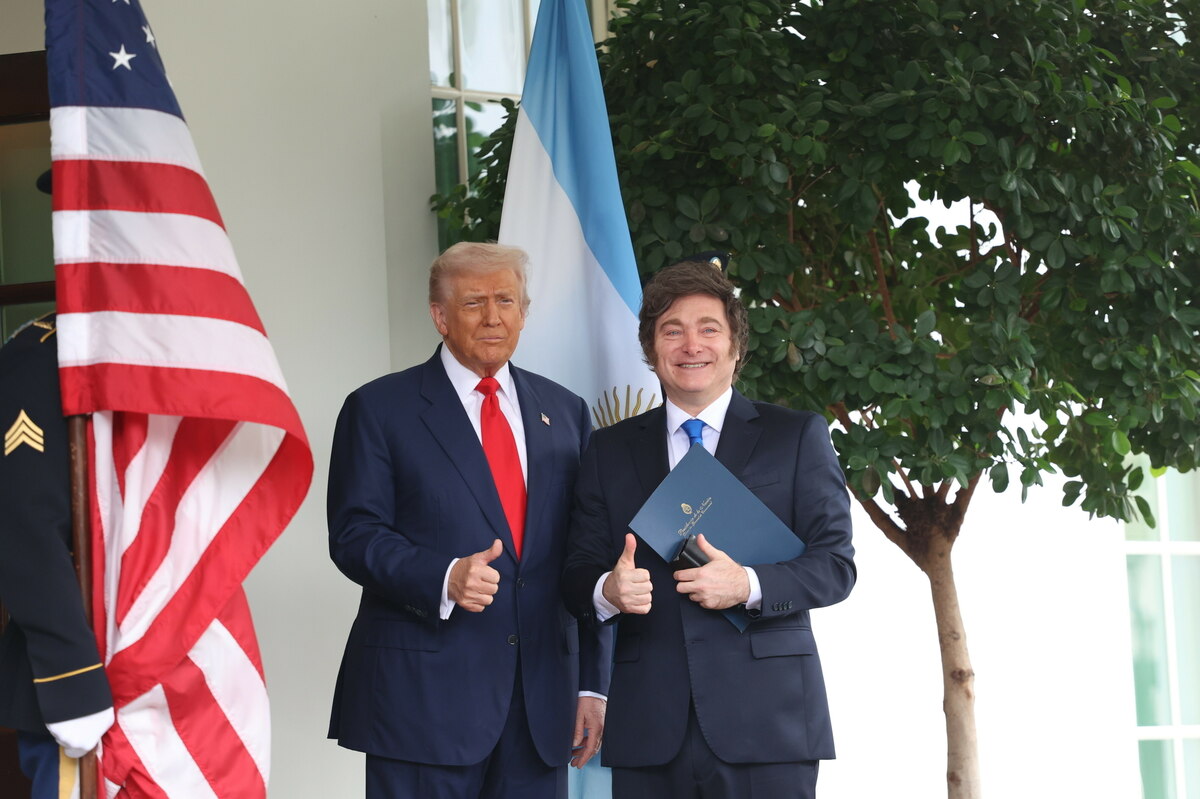
D Argentine President Milei is Donald Trump’s bridgehead in South America. Milei is intended to push China back and secure access to natural resources. Milei has always been an unconditional supporter of the US President, but since October last year he has also been dependent on the US government’s financial drip.
With a 20 billion dollar swap (exchange of payment obligations, editor’s note), Donald Trump saved Milei from financial collapse, but forced it into financial dependence. If Trump were to take away this financial protection, Milei would be in serious trouble. Even his electoral successes that demonstrate his supposed strength do not change that.
Milei is currently working on forming an as-yet-unnamed bloc of ten right-wing Latin American governments. In doing so, the right-libertarian wants to underline his regional leadership claim in the right-wing camp and secure preferential treatment from the US President. So far, these include the presidents of Bolivia, Paraguay, Peru, Ecuador and, from March, Chile. Their lowest common denominator is the Donroe Doctrine: It is a combination of the Monroe Doctrine, according to which the USA rejects any non-American interference in the area it defines as its area of interest, and its revival by Donald Trump.

Then in early December, the official confirmation: “After years of neglect, the United States will reassert and enforce the Monroe Doctrine to restore America’s primacy in the Western Hemisphere and protect our homeland and our access to key geographic areas throughout the region,” it says at the beginning of the “United States of America National Security Strategy.” The 33-page paper is posted on the White House website.
Nostalgics will wistfully remember the year 2009, when twelve heads of state and government of the Union of South American Nations (Unasur) spoke publicly questioned the US security strategy for the region at the time. For years there has not been an institution in which Latin American governments come together to formulate and announce common positions.
The US military action in Venezuela could accelerate and even expand the right-wing bloc formation process
The recent US military action in Venezuela could accelerate and even expand the right-wing bloc formation process. Currently it acts like a magnifying glass for the political fragmentation of Latin America. A joint declaration by the 33 Celac states (Community of Latin American and Caribbean States) failed, as did a joint resolution on Venezuela at the Mercosur summit last December.
The security strategy paper clearly identifies China as the main intruder in the US area of interest. “China’s state-run and state-backed enterprises excel at building physical and digital infrastructure, and China has converted about $1.3 trillion of its trade surpluses into loans to its trading partners,” the paper said. In fact, China now has more rather than less of an economic and financial presence in every Latin American country.
Even Argentine President Milei had repeatedly reiterated his cooperation with Beijing. “I will not break off trade relations with China. In fact, the United States also has trade relations with China,” he said on January 7. The US document also has a definition for this. “However, many governments are not ideologically aligned with foreign powers, but are drawn to doing business with them for other reasons, including low costs and fewer regulatory hurdles,” the strategy paper says.
Penalties for Brazil
Milei is not only the bridgehead to push back the foreign power China, but also to contain the regional hegemonic power Brazil. Brazil is by far the economic and political heavyweight in Latin America. Trump openly regretted that his Brazilian friend Jair Bolsonaro is in prison and not in the presidential palace. Instead, the left-wing politician Lula da Silva is in power, whom Trump holds partly responsible for the conviction of Bolsonaro, which is why he imposed particularly high punitive tariffs on Brazil.
Brazilian President Lula reacted relatively moderately to the US military action in Venezuela. He did not mention Trump or the captured Nicolás Maduro by name and limited himself to condemning the use of force, as he did when Maduro threatened to attack neighboring Guyana over a territorial dispute. And it was Lula who rejected Maduro’s participation in the Brics summit in Rio de Janeiro last July.
In addition to the namesakes Brazil, Russia, India, China and South Africa, the Brics states have also included Egypt, Ethiopia, Indonesia, Iran, Saudi Arabia and the United Arab Emirates since 2023. It is the most important association of economically strong states in the so-called Global South. For Donald Trump, this merger is an open gateway into the US sphere of interest that will not be easy to close.
“Some foreign influences will be difficult to reverse given the political alliances between certain Latin American governments and certain foreign actors,” the strategy paper states. And with surprising candor it continues: “America and its allies have not yet formulated a common plan for the so-called ‘Global South’, let alone implemented it. But together they have enormous resources.” Milei and his right-wing bloc are part of a plan currently taking shape in South America.