

Iya Kiva Aus Lwow
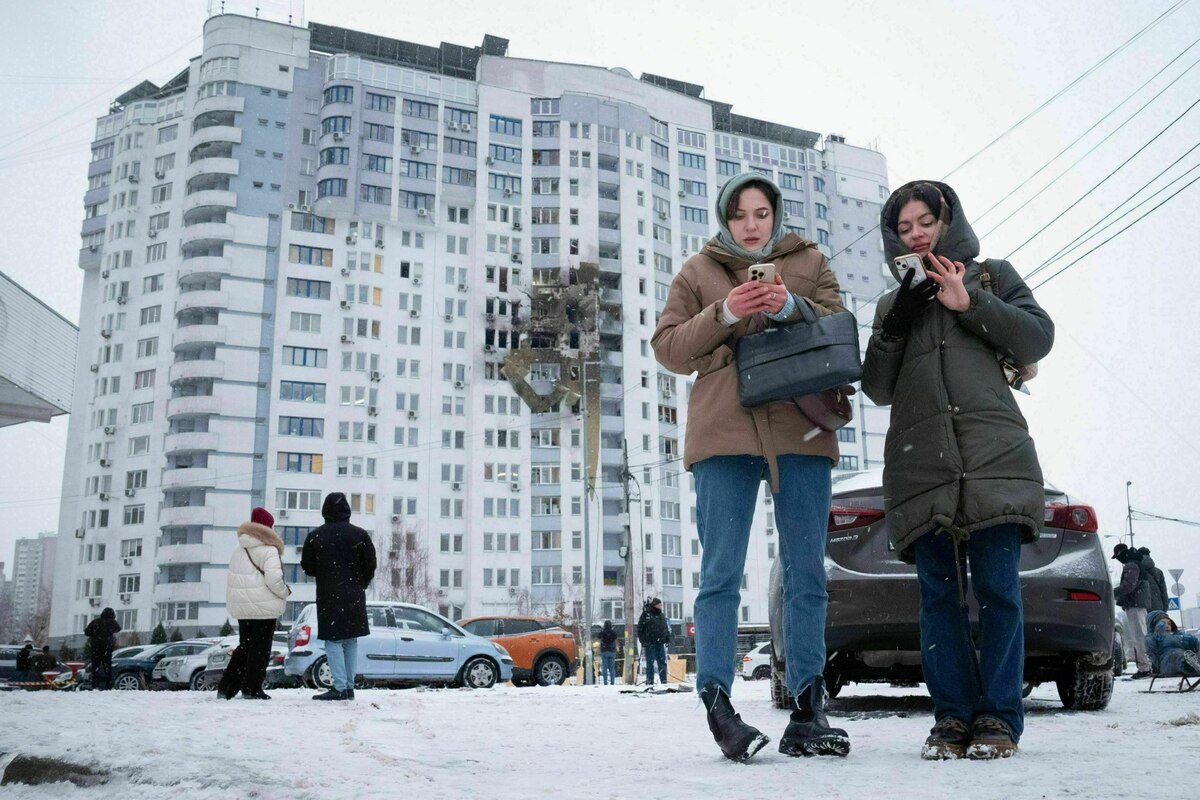
Winter in Ukraine this year is magical, like in my childhood im Donbass. Frost, snow and lots and lots of snow. If it weren’t for Russia’s military aggression, Ukrainians would now be spending their time outside building snowmen. They would create skating rinks in their courtyards like those in Pieter Bruegel’s paintings, have snowball fights and drag their children through the streets on sleighs.
But while our neighbors in Europe have the right to a fairy tale, protected by NATO’s nuclear shield, Ukrainians have the absolute right to hell – the icy hell of Russia’s attempt to humiliate us with cold and fear and to freeze to death. Over the past four years, Russia has targeted the civilian critical infrastructure that supplies people with basic things such as electricity, heat, water and gas in their homes. Without these basic amenities of civilization, our homes are just concrete and brick boxes.
Iya Kiva (*1984) is a poet and translator from Donetsk. After Russia occupied her hometown in 2014, she moved to Kyiv and now lives in Lviv. Her poems have been translated into more than 35 languages.
Iryna Tsylyk (*1982) is a writer and film director. For her documentary “The Earth Is Blue as an Orange” (2020), about a family from Donbass living near the front, she received the Sundance Film Festival Directing Award and the Taras Shevchenko Prize, Ukraine’s most important cultural award.
Translation of both texts: Yelizaveta Landenberger
The Ukrainians who chose to stay in Ukraine after the Russo-Ukrainian war entered a full-scale phase in February 2022 have chosen to stay at home despite the constant threat of death from the air – because at home even the walls help, as they say.
But now this old folk wisdom no longer works. The frozen and cooled walls in Kyiv, Kharkiv, Dnipro, Odesa and many other places in Ukraine no longer offer protection, but have become the last refuge for dignity, freedom and humanity.
In the Ukrainian mindset, everything touched by the loving gaze of care is alive. Especially after the 20th century, with all its wars, the Stalinist and Nazi occupations, the genocides and deportations, the repressions and terror that swept like a storm across the Ukrainian land. Especially after 2014, when Russia turned me and millions of other Ukrainians from Donetsk, Luhansk and Crimea into war refugees within the country. A home for Ukrainians does not mean comfort, a home for Ukrainians means the right to space for love.
Russia cannot destroy Ukrainian love. It does not have missiles capable of doing this. But Russia repeatedly brings the war from the combat zone into the homes of civilians with the cynicism of a predator. Because where international law ends, barbarism begins.
What is happening in Ukraine, where people in many cities have been living without heating, electricity, gas and water for almost two weeks in one of the harshest winters of war? Owners of cafes and supermarkets set up places for stray animals. People open neighborhood chats and invite acquaintances and complete strangers to their home, as long as they have water, heat and electricity at home so that they can wash and warm themselves there. People share their recipes for survival in inhumane conditions, pass on warm clothes to those who need them more than they do.
Ukrainian resilience is a cultural hallmark. However, I would like our European neighbors to become aware of the price of this. The experiences we are currently having will lead to chronic illnesses that will only become noticeable later.
Not all Ukrainian children will survive this winter because their weak immune systems have not yet learned to resist Russian aggression. Not all old people, people with disabilities and just lonely people will survive this winter. Not all houses, even if they remain externally undamaged, can be restored to a habitable condition. Not to mention what is happening in hospitals, operating rooms and intensive care units due to power outages.
The human casualties caused by the cold wave can hardly be quantified. Not every death caused by Russia’s actions this winter will be the subject of a trial in The Hague or even appear in the news. But we Ukrainians are still being killed. We still need humanitarian volunteers and generators, but above all weapons and air defense. Because where the Ukrainian front line ends, the usual banality of evil begins. This year it is icier than ever.
Iryna Tsylyk from Kyjiw
I’m writing this text on a laptop with an almost empty battery – my Ecoflow battery has finally run out and with it the ability to charge something. Candles flicker comfortably in the dark room, I’m wrapped like a cabbage in several layers of clothing and sitting under two blankets because the heating has also been out for some time. This description probably paints a pretty apocalyptic picture, but no – there is water and gas in my house today! Believe me, I’m one of the lucky ones.
I live in Kyiv and I have to admit that this winter is very difficult. In recent years, the Russians have also tried their best to destroy Ukrainian thermal power plants in order to demoralize the Ukrainian civilian population. But the mild European winters played into our hands. Now everything is different. I can’t remember the last time we had such a snowy and breathtakingly beautiful, but also frosty winter.
Kyiv is a city of millions whose rhythm and lifestyle, despite the war, are not so different from those of many other capitals. But when the outside temperature remains at -15 to -20 degrees for a long time and thousands of residential buildings are without heating, electricity and sometimes even water supply, this becomes a serious problem: pipes burst, walls freeze. The city streets sound like endless symphonies of generators, people buy cannon stoves and portable gas stoves, and houses with fireplaces become a special treasure.
Of course, the Ukrainian capital is too big to be homogeneous. Here is all very different. Sometimes it seems like having certain advantages is just a matter of luck. Not so long ago, there were power schedules, and it was convenient – you could prepare and plan your daily routine. But now you never know how the cards will be shuffled every day and who will get water, electricity and heat. A royal flush all at once rarely occurs.
There were many encouraging videos on social media showing Kyiv residents holding picnics and open-air parties in their snowy courtyards. That’s inspiring. But it is very important to remember the people who remain hidden – the old and lonely, the pregnant women, parents with babies, palliative patients who rely on the work of oxygen concentrators.
All young and healthy people will put on thermal underwear, set up new warm-up points, build an even more perfect system of mutual support, survive this winter and emerge from it even angrier, more stubborn and stronger. But will the weakest survive until spring?
This question is painful. Never before have I followed the long-term weather forecast as closely as I do now. And I have a lot of mixed feelings. Recently I was at a concert in the unheated Kyiv Philharmonic Hall, where all the guests were wrapped in winter jackets and even gloves. Several sirens interrupted the concert, but no one left. I sat there listening to the beautiful music of Borys Lyatoshynskyj and cried.
Suddenly I felt so sorry for all of our fate. But at the same time, I also felt great gratitude – both to the people around me and to all the other Ukrainians outside the room.
I have no doubt that most of us will survive. And who knows what world we will find ourselves in in the spring. The world order is changing all too quickly, the law of the strongest is coming into force and a widespread avalanche of violence is approaching. But it seems that nothing can surprise us Ukrainians anymore. And then, once we have recharged our devices a little, we will share our complex experiences of constant survival and resistance with the others.