

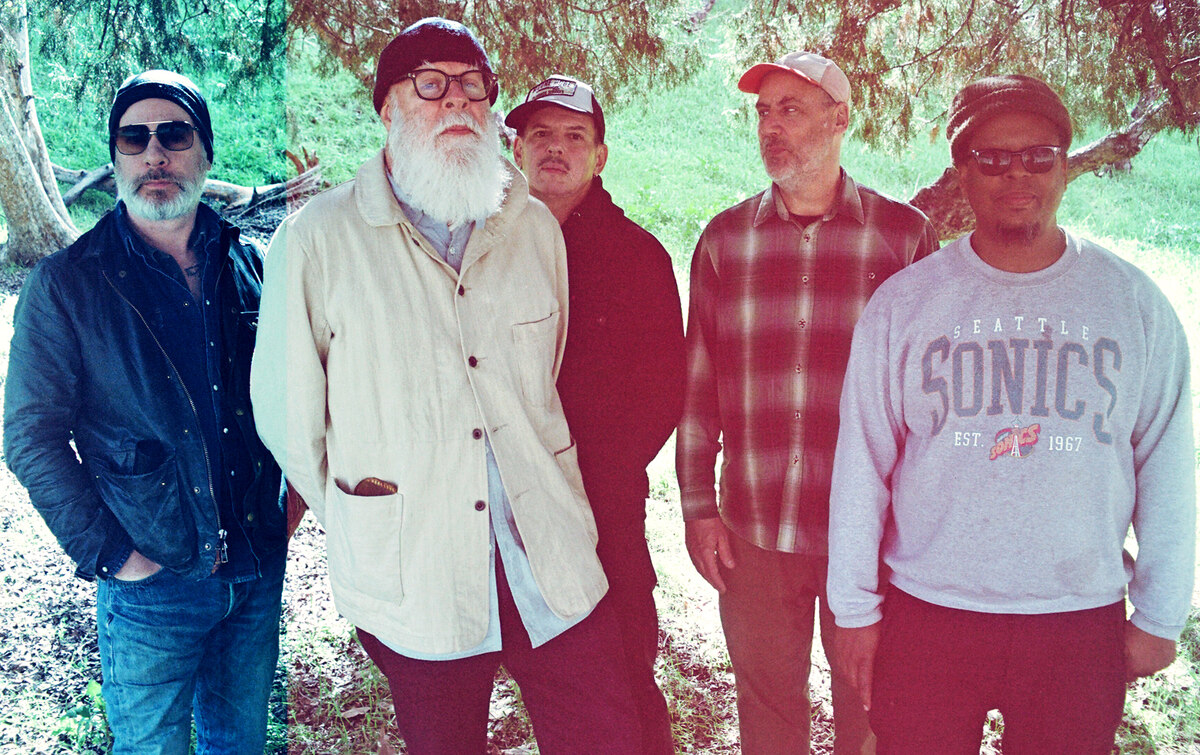
taz: John McEntire and Doug McCombs, your new album is called “Touch”. The association that comes to mind is the Covid pandemic, in which people were forced to keep their distance. With serious effects on social relationships as a whole. Keeping in touch with each other was complicated. That certainly rubbed off on making music.
John McEntire: Her interpretation defines the album title well. The Covid pandemic and all the decisions that were made because of it still reverberate today. “Touch” as a title is deliberately kept vague in order to awaken further associations. We also remember Morton Subotnick and his album “Touch”, which he composed in 1969 with a Buchla synthesizer.
taz: The collage for the cover comes from the Norwegian artist Paw Grabowski. In the background the mask of a female face can be seen, half superimposed on the torso of a scorpion.
McEntire: My father made the scorpion sculpture in the 1980s. Johnny Herndon saw it and had the brilliant idea for the cover. He commissioned Paw Grabowski to do a collage. We liked his first draft best and stuck with it.
taz: The scorpion plays an important role in superstition, but also in pop culture. Some consider it a harbinger of the apocalypse. For others as a symbol of rebellion, see Kenneth Anger’s queer film “Scorpio Rising,” or Dennis Coffey’s blaxploitation funk song “Scorpio.”
McEntire: Kenneth Anger is on the right track, which is an interesting comparison. And at the same time the scorpion is a greeting to my father, who is now very frail.
Im Interview: Tortoise
The band: Tortoise, founded in Chicago in 1992, are an American experimental band for whom the post-rock genre was invented. Beyond the conventions between jazz, rock, dub and electronic music, a third stream emerges in free play. Mix, improvisation and a sense of flow characterize the music. The band has existed since 1999 with the current line-up of Jeff Parker, Johnny Herndon, Dan Bitney, Doug McCombs and John McEntire.
The album: “Touch” (International Anthem/Nonesuch/Warner), first new work since 2016.
Die Tour: 22.1. “Tollhaus” Karlsruhe, January 26th “Zoom” Frankfurt, January 27th “Canteen” Cologne, January 29th “Large broadcasting hall RBB/Haus des Rundfunks” Berlin, January 30th. “Beatpol” Dresden, further dates in April
taz: Immediately with the opening song “Vexations” a gothic sound atmosphere sets in, alienation effects envelop the music like a nightmare. It doesn’t sound like the sound you’re used to from Tortoise.
McEntire: In the beginning there was just a riff from Jeff Parker, and the more we got into his guitar melody, the more we zeroed in on Jeff’s sketch with drones and other V-effects. It was important that we not simply rely on compositional tricks that we had already used before.
taz: And then suddenly handclaps start. This may be the first time that a repetitive piece of atonal music entitled “Vexations” is given a disco percussion effect.
Doug McCombs: There have been handclaps elsewhere. As far as the drums are concerned, we recorded different versions for “Vexations”, but in the end John Herndon came out on top with a beat that rushes straight forward. My preference was for the beat to be syncopated, but then he convinced me otherwise.
taz: Jeff Parker’s hooklines guitar expands after a minute and a half. A little later one comes Variation der Extension added. This is neither with the verse-chorus-verse scheme still related to traditional agreements von freer Improvisation. Can you talk about the geometry of “Vexations”?
McEntire: The song structure is relatively linear. We were guided by the feel of the guitar riff. The melody forms the basic motif of the song, but as it varies, we shortened certain elements and lengthened others. The melodic arc dictated which instrument sections were brought together.
McCombs: At first the guitar melody was just a placeholder. I straddle with another hook line in between. In the end, John Herndon added the original guitar track back and it suddenly made sense where none had before.
McEntire: Are you dealing with it better now?
McCombs: Now I’m coming to terms with it, I felt uncomfortable recording it at first.
taz: When does the work on the mixing desk begin and does it subsequently change the shape of the music? Is this a constant process?
McCombs: Some songs are based on free improvisations. We took passages from this and developed them further.
McEntire: Song number three, “Works and Days,” is based on an improv session. We recorded everything and then filtered the best ideas from the material.
taz: The melody of “Works and Days” starts late in the song, before that an offbeat determines the musical action.
McCombs: The music starts with a strange offbeat that came about when we were improvising over the melody. We just changed the chronology.
McEntire: Dan Bitney improvised the hook and we left it true to the original for “Works and Days,” with everything else added later.
taz: Voices are heard at the end of the song. Where do they come from?
McEntire: They are from a field recording by the US ethnologist Tucker Martine. He recorded the voices on a street in Morocco. They contribute to the enigmatic character of the music.
taz: How do you actually manage to contain your egos and appear as a unit?
McCombs: We still function as a group because we respect each other and our creative achievements. It’s an advantage if we stay out of each other’s way in between and take long breaks from art. Up to now it has always been the case that the results achieved together have been fruitful. Even if it takes an eternity for something to happen again. There will be moments of frustration along the way. Nevertheless, an album like “Touch” is impressive. There is no reason to stop yet.
taz: When we last spoke, in 2016, the era of Trump as US President was just beginning. The title of your album “The Catastrophist” was taken from a novel that took place in the early noughties, at the time of Bush Jr. What is it like in the USA today?
McEntire: It’s getting worse day by day. The Trump administration is making life unbearable for the vast majority.
McCombs: If I had the choice, I would prefer to go back to Bush Junior.
McEntire: Really? It’s bad.
McCombs: Compared to Trump, Bush Junior seems downright benevolent.
taz: That means what?
McCombs: Things are going downhill rapidly in the USA.
taz: ICE paramilitaries have indiscriminately arrested and mistreated people in US cities such as Chicago and Minneapolis in recent months. How do you feel about that?
McCombs: It’s terrible. There is only one term that comes to mind from behavioralism: the extinction burst phenomenon.
taz: Now talk about learning theory
?
McCombs: In this specific case, a certain behavior slowly creeps out, and at the very end (extinction) there is an accumulation of unwanted behavior patterns that prolong the process unnecessarily. I hold out hope that white supremacy posturing falls into the Extinction Burst category. Then it jerks back into place.
McEntire: There will be a reset, but not in the way the right-wingers imagine.
taz: The music of “Touch” feels eerie at times. Dthe social abyss, the brutal stress of everyday life, all of it hat Found its way into the album, right?
McEntire: Normally we protect ourselves well from the outside, but this time it was different…
McCombs: … the madness trickled through the unconscious into the recordings. Even if we hold back on direct comments.
taz: When you call a song “Axial Seamount,” is the choice of title influenced by the atmosphere of the song or a metaphor for something else?
McEntire: The title comes at the end. We have a long list of potential song titles. A title is chosen by democratic vote, and we usually agree. “Axial Seamount” is a strange song title, admittedly.
taz: The axis-shaped seamount is a natural wonder. What does the title tell you?
McEntire: I heard news on the radio. One report was that seamounts off the Pacific coast of Oregon will disappear over the next 20 years due to global warming.
McCombs: The music for the song sounds very nautical.
taz: Then a counter-intuitive noise comes along and spins freely. The band picks it up again later.
McEntire: It is a noise that John Herndon chased through the granular sampler “Microgranny”.
taz: How do you choose between the variety of digital sound generators, dem Recording process at the mixer and the use of analogue instruments a balance?
McEntire: We use the computer as a key design tool in the composition process. A good example is “Layered Presence”. The song is based on a chord progression introduced by Johnny Herndon. We then went through countless iterationshave repeatedly created different virtual song structures. For us, songwriting is more of a place between two goals liminal Space. Something unexpected and new often emerges from this transition phase.
taz: And then there’s a solo in “Layered Presence” that doesn’t actually belong there.
McCombs: A gap opened up and something had to happen. No matter what the song is doing, it needed an event. So I soloed on the six-string bass.
McEntire: And that was the event.
taz: At the end, “Layered Presence” fades away in slow motion.
McEntire: How else would we have let it end?
McCombs: A great finale!
taz: What do you like about slow motion?
McEntire: I deliberately slowed down “Layered Presence” to create digital glitches, which even created moments of silence.
taz: Slow motion makes it easier to see details in a film image. What does slow motion create in music?
McEntire: Exactly the opposite, everything blurs.