

Denmark’s head of government criticizes Trump’s comments on Afghanistan
Denmark’s Prime Minister Mette Frederiksen has clearly criticized US President Donald Trump’s statements about NATO soldiers in Afghanistan. “It is unacceptable that the US President questions the commitment of allied soldiers in Afghanistan,” said Frederiksen on Saturday on the online service Facebook. The head of government emphasized that Denmark was one of the NATO countries with the highest losses in the international Afghanistan mission after the attacks on September 11th.
“My thoughts are with the veterans, your families and loved ones who in no way deserve this,” Frederiksen added, referring to Trump’s comments.
The Danish Veterans Association said it was at a loss for words. “Denmark has always stood by the United States and whenever the United States has asked us to, we have been deployed in crisis areas around the world,” the association continued. (afp)
Pistorius defends the Bundeswehr against Trump’s criticism of NATO
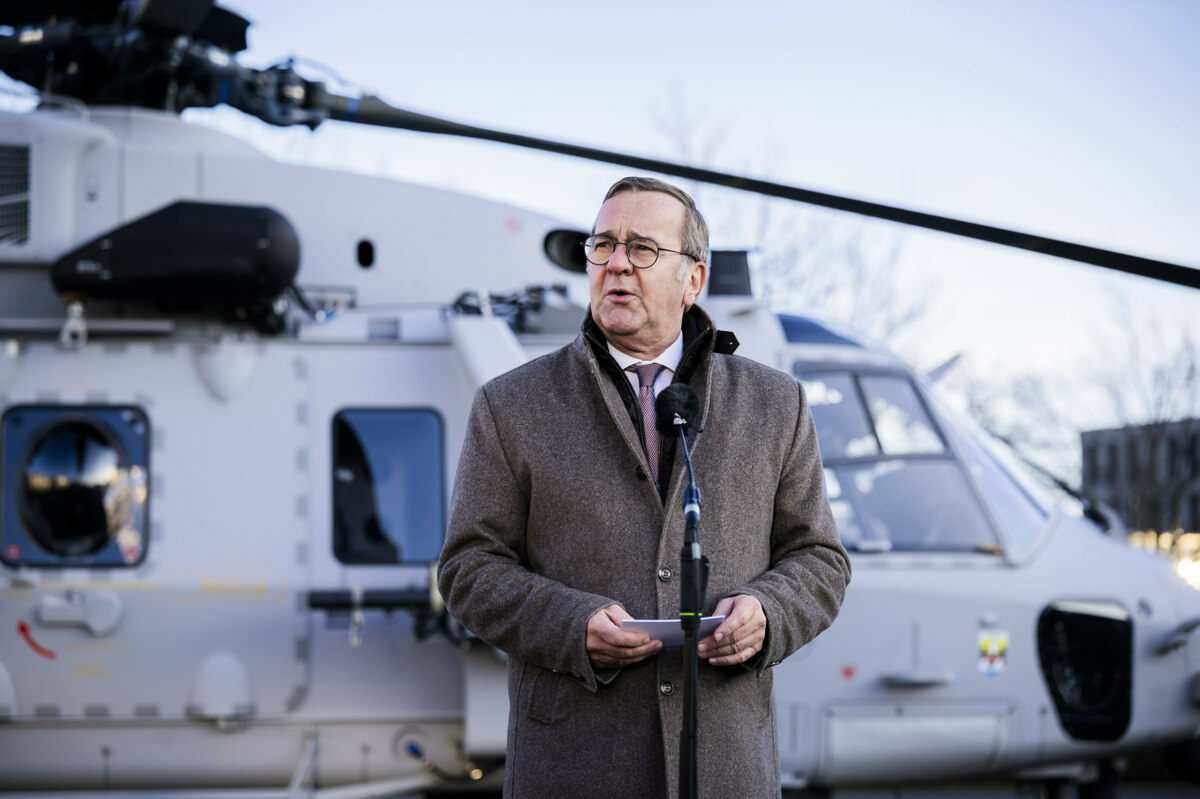
Defense Minister Boris Pistorius defended the Bundeswehr against allegations made by US President Donald Trump in connection with the Afghanistan mission. “Our Bundeswehr stood ready when our American allies asked for support after the Islamist terrorist attack in 2001,” said the SPD politician Bild. “Germany is very grateful to our Bundeswehr for this courage and highly professional commitment.”
Trump once again claimed on Fox News that the USA never needed NATO. Although several other NATO countries sent troops to Afghanistan after September 11, 2001, they remained “a little bit” behind, “a little bit away from the front lines,” said Trump.
Pistorius, however, emphasized that German soldiers had been deployed in Afghanistan for 19 years. “They fulfilled their mission at great risk to life and limb and under extreme conditions.” Germany paid a high price for this: “59 soldiers and three police officers died in battles, attacks or accidents. Numerous wounded people still suffer from the injuries from this time to this day.” (dpa)
Bundesbank President condemns action against head of the US Federal Reserve
Bundesbank President Joachim Nagel has that Action by the US government against the head of the Federal Reserve (Fed), Jerome Powellcondemned. “That’s an absurdity,” Nagel told the “Tagesspiegel”. “The way it is being approached politically shakes me to the core.” It was the USA that taught Germany the importance of independent central banks after the Second World War. “In 1948, you laid the foundation for the Deutsche Bundesbank with the Bank of German States in Frankfurt am Main.”
US President Donald Trump has been targeting Powell for months with a mixture of public pressure, personal insults and legal threats. Prosecutors in Washington are investigating Powell in connection with the costly renovation of the Federal Reserve building.
Critics of the approach see it as an attack on the independence of the Federal Reserve – with the aim of implementing interest rate cuts demanded by Trump. The central bankers have so far only lowered interest rates slowly so as not to trigger a resurgence of inflation. Nagel said he knows Powell well and respects him very much. “He continues to pursue very good monetary policy for the USA and is fundamentally decent.” (dpa)
California defies Trump by cooperating with the WHO network
The US state of California wants that Collaboration with the World Health Organization (WHO) even after the USA leaves continue demonstratively. Democratic Governor Gavin Newsom, an opponent of President Donald Trump, announced participation in a network of institutions to quickly identify and combat health threats of international concern. The WHO coordinates this network called GOARN (Global Outbreak Alert and Response Network).
Newsom is sending another signal in his opposition to Trump. However, what exactly the California government plans to do is unclear. Because specialist institutes and organizations are represented in the network, not states or governments. “Participation in GOARN is open to nonprofits and organizations worldwide and at all levels that have an interest in advancing the GOARN vision and the ability to contribute to warning and response efforts to public health emergencies,” the website states. (dpa)
Trump announces Vance’s visit to Armenia and Azerbaijan
Six months after the signing of an agreement between Armenia and Azerbaijan to end the Nagorno-Karakh conflict, US President Donald Trump has scheduled a visit to Vice President JD Vance announced in both countries. Vance will visit both Caucasus states to continue the US’s “peace efforts” and advance the “Trump route for international peace and prosperity,” Trump wrote on his Truth Social online service on Friday (local time).
Trump was referring to a road and rail connection known as the “Trump Road for International Peace and Prosperity” (TRIPP for short). It is intended to run across the territory of Armenia to connect the heartland of Azerbaijan with the Nakhichevan exclave.
The transport connection is part of the agreement that Armenian Prime Minister Nikol Pashinyan and Azerbaijani President Ilham Aliyev concluded at the White House last August to end the decades-long conflict between the neighboring countries. This gives the USA the right to develop three quarters of the connection.
In his message for Vance’s upcoming visit, Trump also wrote of further economic agreements between Washington and the two countries. With regard to Azerbaijan, he wrote about contracts with US manufacturers of semiconductors and the sale of US-made defense equipment such as body armor and boats. The US President also spoke of a “wonderful agreement” with Armenia on the peaceful use of nuclear power. (afp)
US defense strategy: Europe must defend itself more strongly
The US military should pay more attention to America and the Indo-Pacific, the European allies must defend themselves more strongly: In its new defense strategy, the US government has confirmed the change in strategy pushed by President Donald Trump. “As U.S. forces focus on defending their own territory and the Indo-Pacific region, our allies and partners in other regions will assume primary responsibility for their own defense,” said the document released by the Pentagon on Friday (local time).
“In Europe and other theaters, Allies will take the lead in combating threats that are less serious to us but more serious to them, receiving critical but more limited support from the United States,” the defense strategy continued.
The tone of the strategy paper for which US Secretary of Defense Pete Hegseth is responsible differs significantly from the defense strategy published in 2022 under Trump’s predecessor Joe Biden. In the document at the time, the threats from China and Russia were formulated in a much sharper tone. “The Trump administration is now placing a significantly greater focus on U.S. domestic security and irregular migration – and on U.S. allies’ commitments to do more to defend themselves.”
The paper says that Europe remains important, but has a “smaller and shrinking share of global economic power”. From this it follows that the USA “is committed to Europe and will continue to do so, must and will give priority to the defense of US territory and the deterrence of China”.
Washington will “honestly but clearly remind” its allies in Europe and other regions of the world that they urgently need to do their part and that it is in their own interest to do so immediately.
In the 20-page document, the Pentagon describes the threat from Russia as “persistent but manageable” – which also primarily affects NATO’s eastern partners. Moscow is “not in a position to strive for dominance in Europe” and the European NATO allies “fortunately overshadow Russia in terms of economic performance, population and thus also latent military power”.
The Europeans are “significantly more powerful than Russia,” the US defense strategy continues. “The German economy alone puts Russia in the shade,” it also says. It is also pointed out that the NATO allies “under Trump’s leadership” have committed to defense spending totaling five percent of their annual economic output.
Regarding the Ukraine war, NATO was “unable to prevent” or “respond effectively to” the “Russian invasion of Ukraine” because the US government under Trump’s predecessor Joe Biden “effectively encouraged” NATO allies to “behave as free riders.”
According to the US, the US strives for “respectful relations” with China. US-allied Taiwan, whose territory the People’s Republic claims, is not explicitly mentioned once in the document. In Biden’s 2022 defense strategy, China was still the most important challenge for Washington and Russia was described as an “acute threat”.
How US President Donald Trump’s national security strategy published in December also puts Latin America defense strategy high on the agenda: The Pentagon “will restore U.S. military dominance in the Western Hemisphere. We will use it to protect our homeland and our access to key areas throughout the region,” the paper says.
As in the security strategy, the US strategy for the American double continent is described in the paper as a “Trump derivation from the Monroe Doctrine”.
Climate change, which the Biden administration had described as an “emerging threat,” no longer features in Trump’s security strategy.
In the document, however, irregular immigration is now described as a significant danger, which the military is also responsible for combating. “Border protection is national security,” it says, and the Pentagon will therefore “prioritize actions to secure our borders, deter multiple types of invasion, and deport illegal immigrants.” (afp)