

The warning strike in local transport and several accidents at the beginning of the week tested the patience of many drivers in rush hour traffic. The number of traffic jams and the length of traffic jams in the morning were at a similar level to at the beginning of the previous week. “However, people are stuck in traffic jams for longer,” said ADAC spokesman Thomas Müther. “The warning strike is particularly noticeable in metropolitan areas.”
According to the data of ADAC On Monday morning shortly before 8 a.m. there were more than 500 kilometers of traffic jams and slow-moving traffic on the highways in North Rhine-Westphalia. In individual cases the loss of time was up to an hour. The ADAC spokesman also referred to accidents such as those on the A3 between Leverkusen and the Hilden intersection and on the A40. Accidents have a particularly big impact in morning rush hour traffic.
On the Overview According to the NRW Ministry of Transport, around 8:00 a.m., many red numbers could be seen, especially in the metropolitan areas, which represent the loss of time.
Local public transport has come to a standstill in large parts of North Rhine-Westphalia due to a warning strike. Buses and trains remained in the depots of numerous large transport companies when operations began. “All entrances and exits are symbolically blocked,” said Frank-Michael Munkler from the Verdi union about the situation at the Cologne transport company KVB. All-day work stoppages were also to begin at the same time in Bonn, Leverkusen and Bergisch Gladbach.
Buses and trains remained in the depots, said Linda Malolepszy, who is responsible for the Rheinbahn in Düsseldorf at Verdi, among other things. The union has called on employees in around 30 municipal transport companies in North Rhine-Westphalia to stop work. These include almost all of the country’s major local transport companies such as DSW21 in Dortmund or the Münster public works transport company. Aseag in Aachen is one of the few exceptions that are not affected.
In view of the warning strike, the ADAC advises to avoid trips during peak times between 7 a.m. and 9 a.m. and 4 p.m. to 6 p.m. if possible. According to the ADAC, the extent to which the warning strike in local public transport affects the traffic situation depends crucially on how many employees are prepared for the strike and, if necessary, able to work from home.
The German Weather Service (DWD) said the roads could still be slippery on the morning of the warning strike. Freezing rain is expected until the morning, especially in the north and northeast, but the risk of severe weather remains low. In the high altitudes of the Eifel as well as in Münsterland and Sauerland, road users should be prepared for freezing wet conditions and the associated slippery roads. New snow may also fall in the morning at altitudes of more than 500 meters.
The NRW Ministry of Education has pointed out that school attendance is compulsory. “In the event of events announced in advance, such as a public transport strike, the obligation to attend classes continues to apply,” the ministry explained on the Facebook platform. Parents must therefore ensure that their children come to school. If, in an individual case, it is not reasonable for a student to travel to school, these are excused absences, it was said.
The first round of negotiations for the approximately 30,000 employees in around 30 municipal transport companies in North Rhine-Westphalia on January 21st remained without result. Verdi NRW wants to shorten the weekly working time from 39 hours with full wage compensation. The rest period between two shifts should be increased from 10 to 11 hours. The surcharge for Sunday work should increase from 25 percent of hourly wages to at least 40 percent, demands Verdi NRW.
The North Rhine-Westphalia Municipal Employers’ Association accuses Verdi of turning a blind eye to the dismal financial situation of the municipal transport companies. The tariff and wage conditions have already improved significantly, so that local transport already offers attractive jobs. If the demands were to be met, more thought would probably have to be given in many places to the discontinuation of routes, longer cycle times and the awarding of transport to the private bus industry. (dpa/lnw)
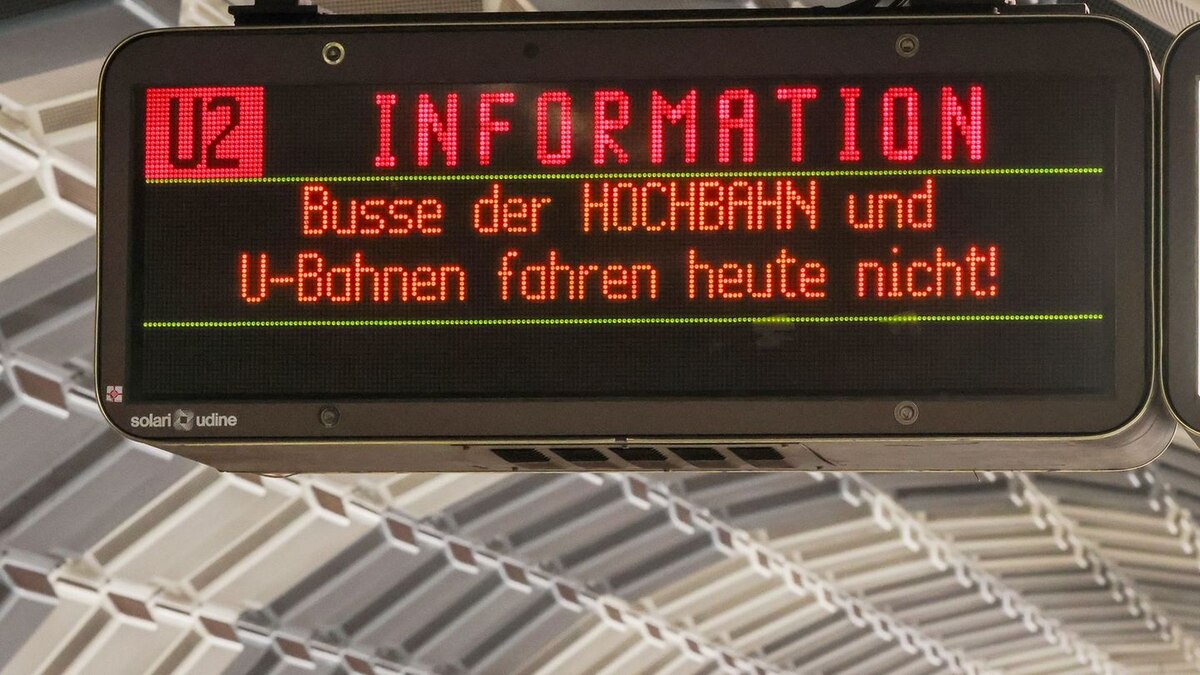
Warning strike in Hamburg – No subways and buses
For many commuters in Hamburg, today is a particular challenge given the 24-hour warning strike on public transport. According to our knowledge, no buses have left the farms so far, a spokesman for the Verdi union told the German Press Agency (dpa). “Everything is there.” The situation is similar with the subways. They are very satisfied with how the warning strike got off to a start.
The Hamburger Hochbahn had already announced in advance that because of the warning strike there would probably be no subways running and that most buses would remain in the depots. The situation is similar with the Hamburg-Holstein transport company (VHH). According to the information, the S-Bahn and the Hadag ferries are not affected by the 24-hour warning strike.
“Operations are supposed to come to a standstill today,” a Hochbahn bus driver told dpa. People go on strike for more money and better working conditions. “We also have to pay rent, we also have to feed our children. And that’s no longer so easy in the city of Hamburg.”
Verdi is calling for, among other things, a wage increase of 7.5 percent for Hochbahn employees in conjunction with a social component for the lower pay groups, an increase in trainee pay by 7.5 percent and the introduction of a rental subsidy of 200 euros per month for trainees. According to Verdi, Hochbahn employers did not submit an offer during the first round of negotiations on Friday. In addition, a new collective agreement is currently being negotiated at VHH.
A rally is planned at the Hochbahn bus depot in Harburg in the morning. According to Verdi, a demonstration march leads from there to Harburg’s town hall square. The joint strike rally by employees of Hochbahn, VHH and the state public sector is scheduled to take place there at 10:30 a.m. (dpa/lno)
BVG condemns strike as “disproportionate escalation”
The Berlin public transport company (BVG) have criticized the all-day warning strike by the Verdi union. “The BVG condemns the disproportionate escalation in the collective bargaining negotiations that have just begun,” said the state-owned company this morning. “The employer side calls on the Verdi union to work together at the negotiating table to find realistic solutions to further improve the working conditions of employees in the long term.”
The Berlin subway, tram and most bus lines have been at a standstill since Monday morning at 3 a.m. Many commuters therefore have problems getting to work in freezing temperatures and slippery sidewalks. The warning strike is scheduled to last until the end of operations on Tuesday night. The S-Bahn, which is operated by Deutsche Bahn, is running as planned and has announced that it will slightly expand its services due to the strike at the BVG.
The Verdi union defended the warning strike at the Berliner Verkehrsbetriebe (BVG) that began this morning as a necessary step. “Our priority is to make progress at the negotiating table,” Verdi negotiator Serat Canyurt told the German Press Agency this morning. “Our colleagues can think of better things than going on strike in this weather.”
But during collective bargaining for better working conditions at the BVG, the employer has so far refused to really deal with the union’s demands, which have been in place for two months. “We have no other choice.”
Participation in the warning strike was already good in the morning, said Canyurt. There are pickets at bus or tram depots, in subway depots, at workshops or at the BVG headquarters. The employees are determined to stand up for their demands and increase the pressure on the employer.
Due to a nationwide warning strike by the Verdi union, there are now significant restrictions on public transport in many places all day long. Buses, trams and subways remain in the depots of many municipal transport companies as a result of the industrial action. Almost all 16 federal states are affected, as Verdi announced.
According to the information, only Lower Saxony is initially excluded. The peace obligation still applies to the approximately 5,000 employees there.
It’s likely to be stressful for millions of employees – they still have to show up at work on time. And for parents too: Students can’t just stay at home either. Then there’s the weather: According to forecasts from the German Weather Service (DWD), there is still a risk of freezing rain and slippery roads in some regions.
Deutsche Bahn’s regional and S-Bahn trains are currently running without restrictions. “The S-Bahn in Berlin, Hamburg, Munich, Stuttgart, Cologne, Nuremberg, Rhine-Main and the DB regional and long-distance transport are not represented as companies by Verdi and are therefore not affected by the strike,” said the federally owned company.
In the collective bargaining negotiations, which are mostly conducted with local employers’ associations in all 16 federal states, Verdi is demanding significantly better working conditions – for example through shorter weekly working hours and shift times, longer rest periods, but also through higher bonuses for work at night and on weekends.
According to the union, higher wages and salaries are also being negotiated in Bavaria, Brandenburg, Saarland, Thuringia and at the Hamburger Hochbahn.
In principle, employees are responsible for arriving at the company on time; they bear the so-called “travel risk”. This applies to strikes as well as to snow and slippery conditions. This means: Even if buses and trains are not running, employees are not allowed to simply be late. Volker Görzel from the Association of German Labor Lawyers draws attention to this. If working from home is not a solution, employees must look for reasonable alternatives.
If the school bus is canceled, this is not an excuse for the child not to show up at school. “The strike in local transport does not change compulsory schooling,” says Wilhelm Achelpöhler, an administrative law lawyer. The lawyer suspects that school officials are unlikely to make a problem of a single day. “But strictly speaking, it is an administrative offense for which a fine could theoretically be imposed. That is a matter of discretion.”
In the event of a strike, parents not only have to think about how they can get to work on time, but also find a solution so that their children arrive at school on time. (dpa/bb)