

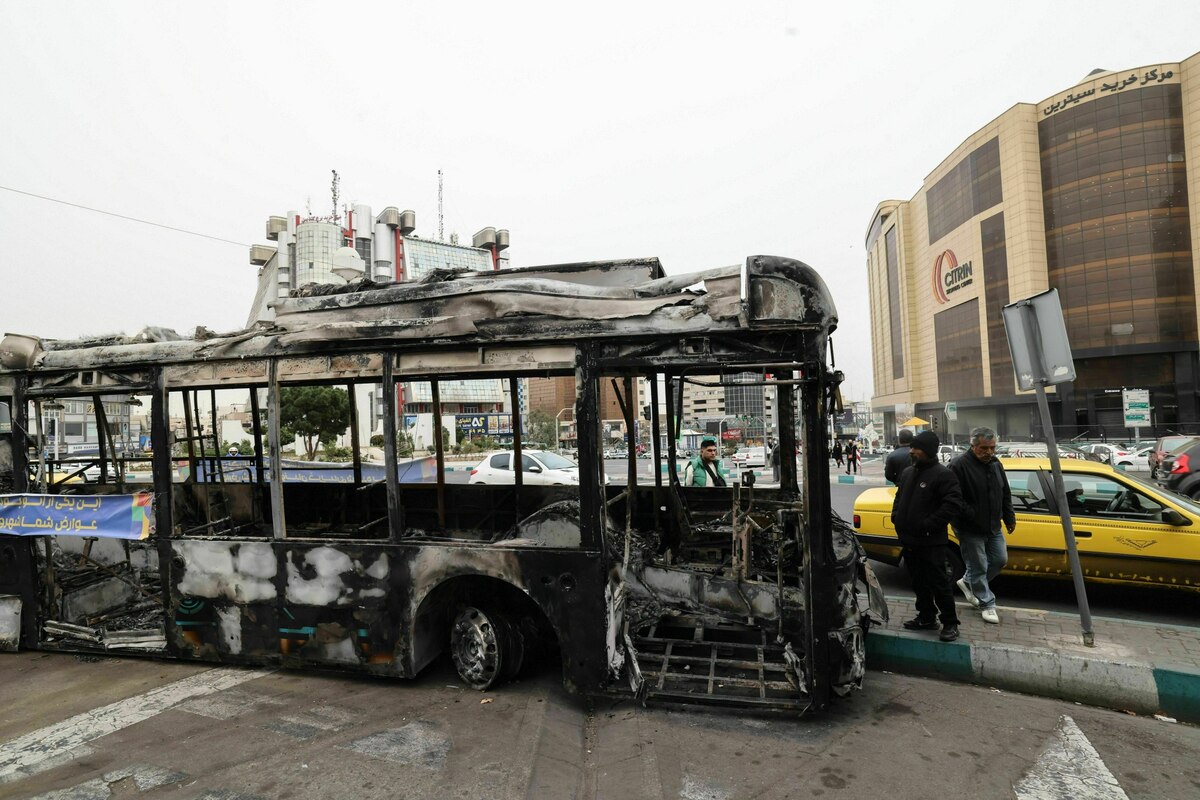
Every family has experienced what has happened in Iran in the last few days differently – and yet the same words are used again and again to describe the horror. There is talk of “blood-soaked streets” and of “mass killings of unimaginable proportions” – and: “Is the rest of the world talking about what is happening in Iran? Is help finally coming?”
The human rights group Hrana has confirmed 2,677 deaths so far. The number cannot be verified, but there are many indications that it could be even higher. In the shadows an ongoing total internet shutdown The actual extent of the violence remains hidden, as does the current mood in the country.
Nevertheless, international calls from Iran have been possible again since Tuesday. That’s why in the past few days mothers, fathers and siblings have been able to tell their worried relatives abroad for the first time how they are doing – and how they experienced the days of violence.
Dozens of audio recordings of these calls, some of them shocking, are currently circulating on the Iranian diaspora’s social networks. The taz was able to speak to exiled Iranians who have been in contact with their relatives in Iran in the last few days.
“Don’t kill them, don’t kill them!”
One of them is Mahsa, a 30-year-old Iranian designer from Tehran who now lives in Germany. Mahsa is a pseudonym – her name has been changed to protect her and her family. After five days of no news from her family, her smartphone finally rang on Tuesday and “Maman” was on the line.
What her mother described largely corresponds to eyewitness reports that are also shared online by the Iranian diaspora. The regime demands that grieving relatives pay back the cost of the ammunition used to kill demonstrators – usually the equivalent of several thousand euros. If payment is not made, the security forces will keep the bodies.
“First they murder us, then they make a business model out of it,” her mother said on the phone, Mahsa says. Her mother, who lives as a housewife in Tehran and looks after her elderly grandmother, is doing well. She only observed the protests from the balcony of her apartment, which is on a main street with several government offices. Mahsa wrote down what her mother said:
“The protests became really intense from 9 p.m. Demonstrators flooded the street. At first the security forces held back. As the crowd approached the government buildings, clashes broke out. The demonstrators overpowered an agent, beat him and tore his clothes off – then they let him go.
A few minutes later, the regime agents returned and fired directly into the crowd. I heard screams. Together with the neighbors I shouted out the window: ‘Don’t kill her, don’t kill her!’ But the agents kept shooting. Once in the direction of our house.”
The regime is trying to downplay the number of victims
A neighbor who was on the street that evening was – as Mahsa’s mother later learned – killed by a shot in the head. Shortly afterwards, his family was contacted by security forces. If they wanted the son’s body, they would have to pay for the ammunition. They then demanded the equivalent of almost 10,000 euros to return the body – and ordered that there should be no funeral service.
Alternatively, the family could have explained that their son was a Basiji – a member of militias loyal to the regime that are responsible for suppressing protests. In this way, the Iranian regime is deliberately trying to inflate the number of security forces killed and downplay the number of protesters killed, it said Boroumand Center for Human Rights in Iran on Wednesday.
Eyewitness reports agree that things are now quiet again on Iran’s streets, but only at first glance. Current images from Tehran show masked fighters driving through the city on pick-up trucks with machine guns. “Iran is currently effectively under martial law,” comments Iranian-born photojournalist Afshin Ismaeli.
“Some people are at their wits’ end”
„After the mass killings “People are now afraid to go out on the streets,” says Arezoo, who lives as an architect in Basel. She learned this from several friends in Iran with whom she is in contact by telephone. Without access to the Internet, state propaganda is currently the only remaining source of information: there, demonstrators are called “terrorists”, executions are called for and forced confessions are broadcast – all day long.
“Some are at their wits’ end. They have seen people shot in front of their eyes,” says Arezoo. It actually has a different name too. “Others are still full of fighting spirit, they are planning strikes and hoping that help will soon come from the West. Many took to the streets because they believed Trump would come to their aid“, says Arezoo. However, a military strike by the USA now seems less likely.
Not everyone wanted to talk about the protests on the phone for fear of being overheard, says Arezoo. When she was on the phone with her parents and mentioned the protests, they interrupted her: “They’re monitoring everything right now. Please don’t say anything, we just wanted to hear your voice.”
Pressure on grieving relatives, gun violence, surveillance and a persistent internet blockade – this is how the regime of the Islamic Republic is currently managing to control the streets and, for the time being, the narrative.