

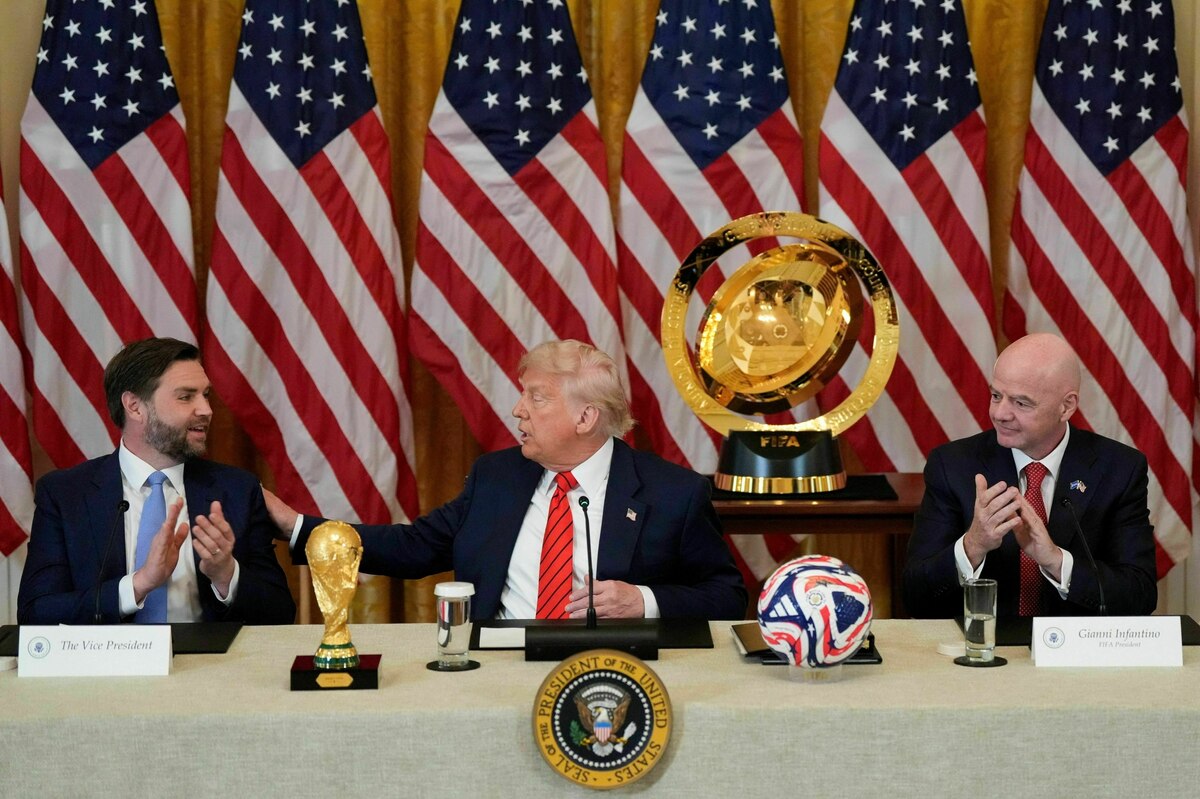
A tough threat probably looks different. “At best as a last resort,” a boycott of the men’s World Cup in the USA, Mexico and Canada is an option, said Jürgen Hardt, foreign policy spokesman for the CDU/CSU parliamentary group Bild-Newspaper. However, he is “confident that we will achieve a better common understanding of security within NATO on the Greenland issue.” Nevertheless, this calculated move was enough to spark a small boycott discussion in Germany, especially via the tabloids. In an Insa survey, a narrow majority is in favor of boycotting the 2026 World Cup if US President Donald Trump actually annexes Greenland.
Now there are good reasons for a boycott of the tournament, and not just since yesterday: The horrific ICE deportationsthe escalating MAGA fascism, the virtual takeover of the most powerful state in the world by billionaires, the targeted Acceleration of climate collapsethe military operation in Venezuela that violates international lawthe murders in the Caribbean, the financing of the alleged genocide in Gaza, the disgusting Trump-Infantino axis in FIFA or the possible exclusion of foreign fans from 39 countries – the list of why you really shouldn’t go to this tournament is long.
What is significant, however, is that none of these crimes gave rise to a broader boycott debate in Germany. They hardly bothered anyone, because it (supposedly) affected others. So it’s as it always is with human rights in sport: What’s at stake in Greenland is not some international law, which never applied to the stronger anyway, but rather about imperial self-interest. The super-rich want to destroy the world? They should. Are you endangering the geopolitical interests of European elites? Wait, that’s a red line. At least a small, dashed one. The hypocrisy with which people are now portraying themselves as friends of international law in Greenland is unbearable.

The exciting question is not whether a tournament boycott would be morally justifiable, because it undoubtedly is. The question is: Who benefits when countries do the right thing for the wrong reasons? And how likely is a European boycott anyway?
The second question is answered more quickly: currently unlikely. Especially among Union party colleagues, a relevant part is clinging to the last fragments of the transatlantic alliance, even though it has long been in shambles. The federal government wants to prevent a conflict with the supposed protecting power at all costs. The boycott threat fulfills more of the eponymous function, namely a threat. If the USA annexes Greenland tomorrow, a boycott of the World Cup six months later would be relatively effective.
Dissatisfaction in the associations
However, there is a second exciting player, UEFA. It is already in a constant quarrel with FIFA and has recently appeared less and less amused by Infantino’s dependence on Trump. Even in FIFA, the discontent is said to be so great that an anonymous high-ranking member told the British on Sunday Guardian spoke of “deep embarrassment” among FIFA people over Trump’s peace prize and described the US World Cup as “very sensitive”. That doesn’t sound like closed ranks.
UEFA also has massive financial interests in the USA, and European football has become enormously dependent on US private equity, especially since the pandemic. Here too, a boycott is initially unlikely, especially since Mexico and Canada would innocently suffer. But if the European football associations get the impression that the only thing that helps them is to flee forward and that FIFA is smearing them intolerably, a real dynamic could arise. And that is certainly a powerful means of pressure against Trump.
But would weak states benefit from this? In recent years of growing global political tensions, the sports boycott has increasingly been seen as an all-purpose weapon. Historically, he has almost never had an impact; Among other things, because this requires a long-term and widespread isolation of a country, which hardly ever works, and in view of all the wars of aggression, genocides and annexations, if used seriously, one could forget about a common world sport.
A debate is overdue
If the sports associations and the CAS sports court took their own words regarding Russia seriously, they would have had to block the USA after the attack on Venezuela at the latest. In fact, there is neither a power-political interest nor an institution capable of enforcing such punishments. As long as the interpretation is so arbitrary, a Greenland-inspired World Cup boycott will never serve international law. It’s just imperialism in different colors.
Anyone who doesn’t just want to put pressure on the USA based on the weather shouldn’t rely on imperial nation states and profit-oriented associations to do so. An honest civil society debate about how to deal with this tournament is urgently overdue. And the spectrum of US imperialism and MAGA fascism belongs in this discussion, not just Greenland – and not Trump as the supposed root of all evil. Because the problem is not a single nation state, it is the capitalist and imperial structures. The idea of the last decade to make the world better by putting pressure on the Federal Republic and the DFB through sports boycotts has failed. It probably needs a new one.