

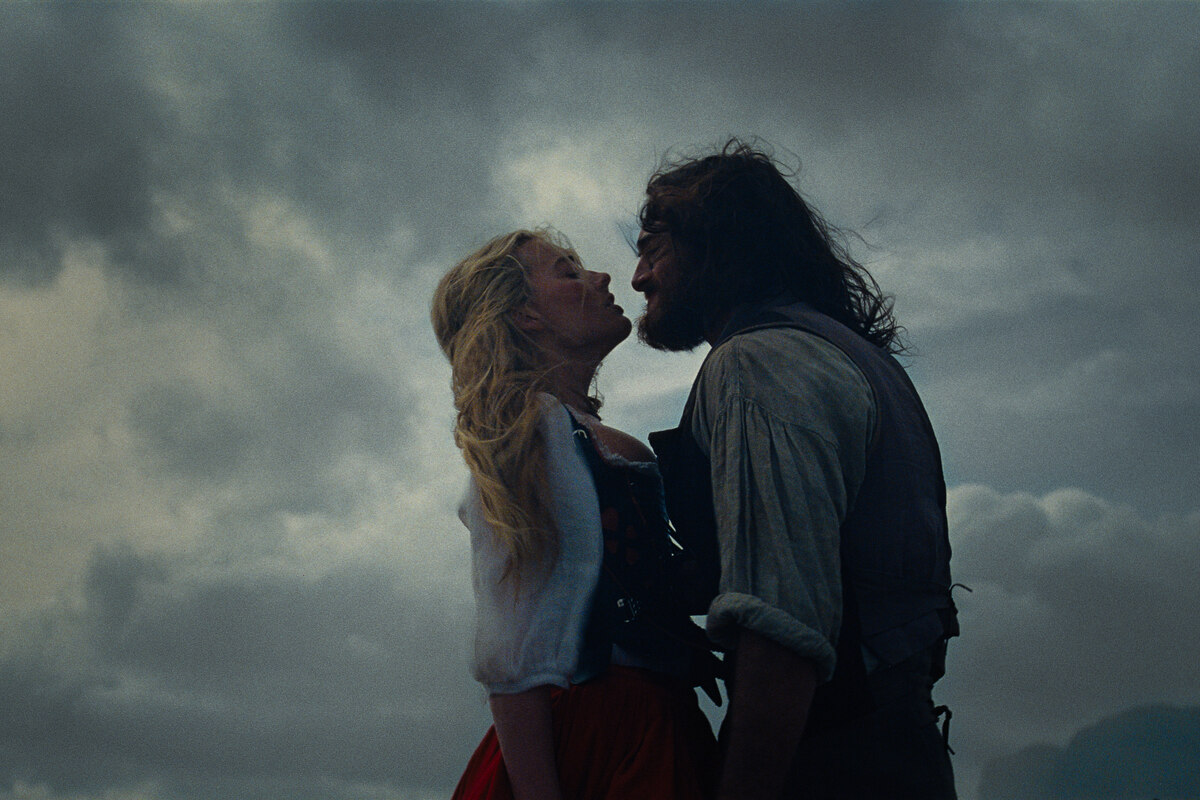
When a literary classic finds its way onto the screen, the question inevitably arises as to why it is being remembered again now. It’s a thought that of course also arises in view of Emerald Fennells new film “Wuthering Heights”.
In the case of Emily Brontë’s only novel (German: “Wuthering Heights”), the mere fact that it was made into a film again hardly allows any conclusions to be drawn about the zeitgeist. After all, every decade since the early days of film has seen at least one, and usually several, cinema and TV adaptations of the work, which was first published in 1847.
Something more interesting opens up if you understand “Wuthering Heights” as a “Gothic novel” and realize how many classics of this genre are currently being reinterpreted – by Robert Eggers’ „Nosferatu“ bis Guillermo del Toros „Frankenstein“. This accumulation is often explained by the fact that horror films become more popular in times of crisis, as the genre acts as a resonance chamber for collective fears.
Longing for the other
But perhaps this reading alone falls short in the context of the “Gothic Novel”. Perhaps the horror literature and its cinematic adaptations reflect this not just the fear, but also the longings of their time. If you look behind the horror facade of “Nosferatu”, “Frankenstein” or “Wuthering Heights”, stories of almost mythical gravity reveal themselves.
All of them are shot through with tragedy, of course, but a tragedy that carries meaning within itself: Ultimately, love is also hidden under the mask of horror – embedded in stories that still promise existential weight in a present of constant digital sound, in which much remains in the mode of the superficial.
What is striking is how much films like “Nosferatu” and “Frankenstein” – although they bear the names of their male title characters – derive their emotional gravity from the actions of the female characters. They are women who feel isolated, feel alienated in their surroundings, whose desire for a different life pushes them to the edge of the social norm – until they meet the creature and recognize an echo of their own alienation in its loneliness.
“Wuthering Heights” does not know any creature in the true sense, and yet the constellation is related: here, too, the desire is directed towards a figure who is denied social acceptance. The love of Catherine, who belongs to the lower English landed gentry, for Heathcliff, who once joined the family as a foundling, transcends the boundaries of class and origin.
The promised break
But the women’s closeness to each other does not remain without consequences and even ends in their death. Of course, by modern standards this can easily be described as “toxic” – and in the case of “Wuthering Heights” this is clearly the case later on. But when Emerald Fennell, of all people, reinterprets this material for our present, it almost inevitably carries with it the promise of a new emphasis.
“Wuthering Heights.” Director: Emerald Fennell. With Margot Robbie, Jacob Elordi and others USA/UK 2026, 136 min.
Finally, the British filmmaker is making her feature film debut “Promising Young Woman” (2020), a revenge thriller about a young woman who hunts down sexually assaultive mensuddenly gained international fame. And thus with a work that, in retrospect, is the most formative of the #MeToo-Don’t can be understood.
One could also expect from “Wuthering Heights” if not a break with the romanticized female victim, then at least a second level.
A house under auspices
The opening suggests such a reading. Catherine is introduced as a child (Charlotte Mellington) who witnesses an execution – her obvious dismay at the sight is acknowledged by the housekeeper with a casual “Men do cruel things,” as if such violence were not an aberration but just the background noise of this world.
In any case, the “Wuthering Heights” is surrounded by all sorts of misogyny: The father, Mr Earnshaw (Martin Clunes), feels bothered by the “chatter of the women”, when it is the women who keep the estate running, while the master of the house not only drinks his own wits, but also the family property.
We would like to show you external content here. You decide whether you also want to see this element:

It could almost be said that it was a rare act of kindness when one day he brings along Heathcliff (Owen Cooper), who had previously been mistreated on the street – if it weren’t for the women to take care of him and continue to manage with the already scarce resources, which are further dwindling due to Earnshaw’s gambling addiction.
Feminism the “Bridgerton” way
In a few sketches, Emerald Fennell traces the close bond that develops between Catherine and Heathcliff despite the power imbalance. Even then, it is still carried by a childlike impartiality when Catherine and Heathcliff, now embodied by Margot Robbie and Jacob Elordi, have long since grown up.
The first clear reinterpretation of their relationship occurs all the more suddenly when Catherine observes two domestic workers playing sexual dominance games. What she sees not only initiates her own sexual awakening, but also turns her almost sibling-like closeness to Heathcliff into physical desire.
When he catches her in this voyeuristic moment, lies on top of her and first puts his hand over her mouth and then “protectively” over her eyes, the shift in emphasis that Emerald Fennell actually makes with her adaptation is also revealed. And it has more to do with the “feminism” of those who like to call it progressive Historienschmonzette „Bridgerton“ to do with anything other than the soothing anger of her first child.
In other words: women are sometimes allowed to masturbate or read a book, but remain trapped in the patriarchal logic of their time and, above all, have to find a lucrative match and be a mother.
Wuthering Heights is a film with considerable surface appeal – beautiful to look at, but stale
The “Wuthering Heights” text continues unchanged: Catherine marries the wealthy neighbor Edgar Linton (Shazad Latif) out of financial necessity, while Heathcliff initially leaves in a rage, only to return a few years later as a wealthy man.
Low-stimulation eroticism
With this homecoming, the tone of their relationship changes again, becoming resentment and finally passionate obsession. Fennell focuses on extensive sex montages to tell the story – on windswept cliffs, in a velvet carriage and on the kitchen table at home.
Worst of all, however, the eroticism in “Wuthering Heights” turns out to be not only aimless, but above all remarkably unappealing: there is hardly any noticeable chemistry between Margot Robbie and Jacob Elordi, especially as their characters increasingly settle into their cold-heartedness, so that any sense of empathy is nipped in the bud.
Even more so than Catherine, it is Heathcliff, whose hurt feelings quickly turn into cruelty: When she finally ends the liaison, he marries Isabella (Alison Oliver), the ward of Catherine’s husband, out of revenge, humiliates her and even puts her in chains. The film observes this violence remarkably uncritically, almost intoxicated by its own images.
A contemporary adaptation?
More than on an interpretive level, however, “Wuthering Heights” is convincing on a visual level: a modernly curated soundtrack that integrates several tracks by Charlie XCX meets costumes that are less reminiscent of a classic historical drama than of Madonna’s “Erotica” era. But the moral remains the same: the woman dies – regardless of whether she defies the conventions or ultimately bows to them.
Ultimately, “Wuthering Heights” is interesting neither as a feminist reinterpretation, as a carrier of the existential gravity of Gothic literature, nor somewhere in between. What remains is a film with considerable surface effect – nice to look at, but stale. One could cynically say: It is an extremely zeitgeisty adaptation.