First of all: The Green Party did not give it its name because it didn’t even exist 100 years ago. Rather, it is said to have been the farmers’ green loden coats “Green Week” gave the memorable name when it opened in 1926.
“Green clothing conspicuously shaped the image of the city for a week” – at least that is the narrative that the state-owned Berlin Trade Fair Association is spreading on the anniversary of its most important event. What is now the world’s largest agricultural and food exhibition starts on Friday on the exhibition grounds under the radio tower, where over 300,000 visitors are expected until January 25th.
More than 1,400 exhibitors from around 60 countries present over 100,000 agricultural products in 27 exhibition halls. More than 70 agriculture ministers from around the world are expected to attend the Global Forum for Food and Agriculture (GFFA). A specialist program with around 300 events accompanies the ten days of the trade fair.
Strictly speaking, the fair still has ten years to go before it can really celebrate the “100”. So far it has only taken place 90 times – the Second World War, post-war reconstruction and foot-and-mouth disease in 1938 caused cancellations.
Despite all the continuity in the name and location, a deeper look into history shows what fundamental changes the production conditions in agriculture and the eating habits of consumers have undergone within a century. A consistent trend, however, is the ongoing mechanization of the agricultural sector, starting with the latest tractor generations 100 years ago to the field robots and inspection drones of today.
Order in the wild
The Green Week began, so to speak, with a gardening act: wild growth became order. In the 1920s, a number of parallel events developed around the Berlin winter meetings of the German Agricultural Society (DLG): riding and driving tournaments, small animal exhibitions, seed markets and hunting shows, which were scattered all over the city. In 1926, at the suggestion of the tourist office, all organizers presented themselves compactly for the first time in a hall on Kaiserdamm, which attracted more than 50,000 visitors.
In the 1920s, a variety of parallel events developed around the Agricultural Society meetings: riding and driving tournaments, small animal exhibitions, seed markets and hunting shows
Even back then, a four meter high iron-tired universal tractor with 100 hp marked the start as a showcase of the beginning of mechanization. In 1930, a giant egg preservation machine that spun 5,000 eggs in circles showcased the promise of modern preservation technology. “This trade fair shows that agriculture is finally entering the age of machines – and the city is amazed at the country as if it were a stage for the future,” wrote the well-known journalist Theodor Wolff at the time.
According to the trade fair chronicle, the German imperial capital itself still used a fifth of its territory for agriculture and horticulture. 45,000 horses, 25,000 pigs, 21,000 dairy cows and more than half a million poultry lived in the city, and around 200,000 Berliners owned an allotment garden.
Stage of Nazi agricultural policy
In the 1930s, the Green Week was brought into line and used as a stage for Nazi agricultural policy, where “blood and soil” rhetoric merged with modern agricultural technology shows. In these years, the trade fair stood less for innovation than for the propagandistic staging of self-sufficiency and the rural folk myth. In 1934, in the “first Green Week in the new state”, as the Nazis used it at the time, the goal of self-sufficiency for the Reich and the end of food and feed imports were announced – a measure with which foreign currency and resources previously used for imports could be diverted to rearmament.
“Blood and soil” ideologues like the Nazi Agriculture Minister Walther Darré determined the content of the Green Weeks from then on, the trade fair company wrote remarkably self-critically about the years in which the Green Week turned brown. The Nazis completely stamped their ideological stamp on five rounds of the trade fair.
In 1938 the fair was canceled due to rampant foot and mouth disease. “During the last Green Week in 1939, it was proudly announced that the level of self-sufficiency in food was now higher than in 1914,” reports Messe Berlin today. This was already “a clear indication of the next war, which then led to the end of exhibitions on the exhibition grounds”.
Shortage management after the war
After the war, Green Week returned in 1948 and became a symbol of reconstruction and securing supplies in a city of blockade and food shortages. A review from the industry characterizes this phase as a “showcase of shortage management” in which seeds, fertilizers and machines conveyed one message above all: “We have to fill our plates before we think about enjoyment.”
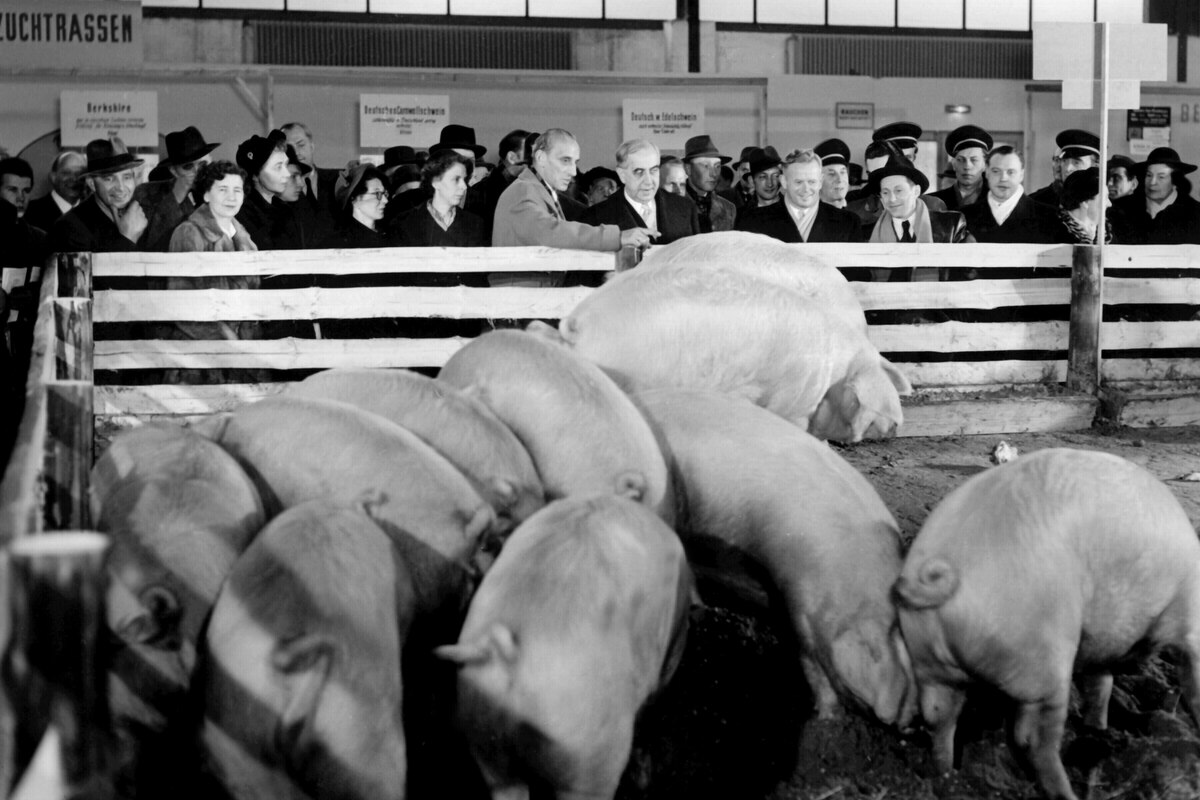
In the 1950s and 1960s, the Green Week became the stage of the West German economic miracle, where more efficient grain varieties and new can milking systems demonstrated how rationalization and specialization were transforming farms. Tractors, crawler tractors and stable technology symbolized an agriculture that looked more like industrial production, while the use of mineral fertilizers and pesticides was hardly questioned.
At the same time, the population’s eating habits changed: more animal products, manufactured goods and branded foods shaped the consumer culture, which was presented as a promise of prosperity and comfort. An industry representative now describes this era as follows: “Fat became a symbol of prosperity on the stands, and the Green Week was the shining showcase of the calorie society.” At that time, the term “eating fair” came into circulation, but the organizers have strictly distanced themselves from it to this day.
During the decades of the Cold War, the Green Week was a place for the Western agricultural and food industry, but at the same time also one of limited East-West contacts. After German reunification in 1990, the trade fair was fully opened to exhibitors and visitors from East Germany for the first time in decades, bringing new product lines – from Thuringian Rostbrätel to Saxon baked goods – to the Berlin stage.
Global market place instead of national agricultural show
With globalization, the Green Week transformed from the national agricultural show into the world’s leading trade fair at which countries presented themselves as tourism and culinary brands. A trade fair manager describes this development as follows: “The farmers’ fair has become a global marketplace in which countries compete for attention – with national dishes, flags and food stories.”
For many years, the ICC congress center, which is now empty, also stood for this departure into a new dimension of internationality. Larger specialist conferences became possible, which also attracted scientists, business representatives and agricultural politicians. The establishment of the “Global Forum for Food and Agriculture” (GFFA), a high-level international conference for agricultural policy and the associated annual meeting of agriculture ministers, was also linked to the vision of creating something like the “Davos of international agricultural policy” in Berlin.
At the same time, Green Week was increasingly influenced by social developments – inside and outside. While industrial meat production, convenience food and global supply chains are presented in the halls, outside alliances such as “We are fed up” are calling for fewer pesticides, more animal welfare and an agricultural turnaround.
Sustainability and alternative proteins gradually came into focus in the exhibition offerings: in 2018, visitors were able to try insect protein for the first time, even before the corresponding products reached retailers, and in 2020, Nestlé presented the vegan “Incredible Bratwurst”. Last year, a media appearance with a plant-based kebab, presented by Governing Mayor Kai Wegner and the then Federal Minister of Agriculture Cem Özdemir, created a symbolic image of “urban, flexitarian Berlin”.
The 2026 anniversary edition of the Green Week is influenced by climate, animal welfare and health debates in which plant-based proteins are described as a “megatrend”. A current report indicates that around a third of Germans have their own Meat consumption wants to reduce, with the environment, animal welfare and health being key motives.
High food prices are currently the dominant topic in the political discussion. Joachim Rukwied, the president of the German Farmers’ Association, described the producer prices for certain products, such as pork, as “disastrous” because the production costs are sometimes higher than the sales revenue. The SPD is calling for a package of measures to reduce food prices and is considering introducing a so-called “Germany basket” to make basic foods more affordable for consumers.