

David Mutwe stands at the entrance to the election office with his arms crossed and looks frustrated at his watch: it shows shortly after 9 a.m. in the morning. The election office in this suburb of Uganda’s capital Kampala was actually supposed to open at 7 a.m. But there are still no voting documents and ballot boxes.
“My boss only gave me three hours this morning to vote – they’re almost over now,” says the 35-year-old, who has to pack Victoria bass for export for a Chinese company at the nearby fish market on the shores of Lake Victoria. “They deliver the voting materials extra late so that we can’t all cast our vote today,” he is certain.
Over 21 million people are eligible to vote in Uganda this Thursday called upon to cast their votes. A new president and a new parliament will be elected. Uganda’s President Yoweri Museveni has been in power for almost 40 years to the day. The now 81-year-old is competing again this time. He had all age restrictions for presidential candidates removed from the constitution in a referendum in 2017.
His direct competitor is 43-year-old music star Robert Kyagulanyi, known by his stage name Bobi Wine. In the last elections in 2021, he won around 35 percent – and this time too he was able to mobilize his supporters in the election campaign. Uganda has one of the youngest populations in the world. More than half of the 52 million Ugandans are younger than 17, more than three quarters are under 40 years old and have never experienced a president other than Museveni.
Under the equatorial sun
“We just want something to change and our lives to be better,” says Mutwe, explaining the reason why he has been waiting in the sweltering equatorial sun for almost three hours to finally cast his vote. “The people in power just want us all to go home early instead of making our cross.”
In the schoolyard of the run-down state primary school in the fishing village Ggaba At the southern tip of the Ugandan capital there are hundreds of people, mostly young fishermen like Mutwe. Most people came extra early with their boats to cast their votes. The fact that they now have to wait causes a lot of frustration. Some open small bottles of liquor to while away the waiting time. The mood is slowly heating up, as are the temperatures in the direct sunshine.

Ugandan opposition presidential candidate Robert Kyagulanyi Ssentamu, known as Bobi Wine (NUP)
Photo:
Brian Inganga/AP/dpa
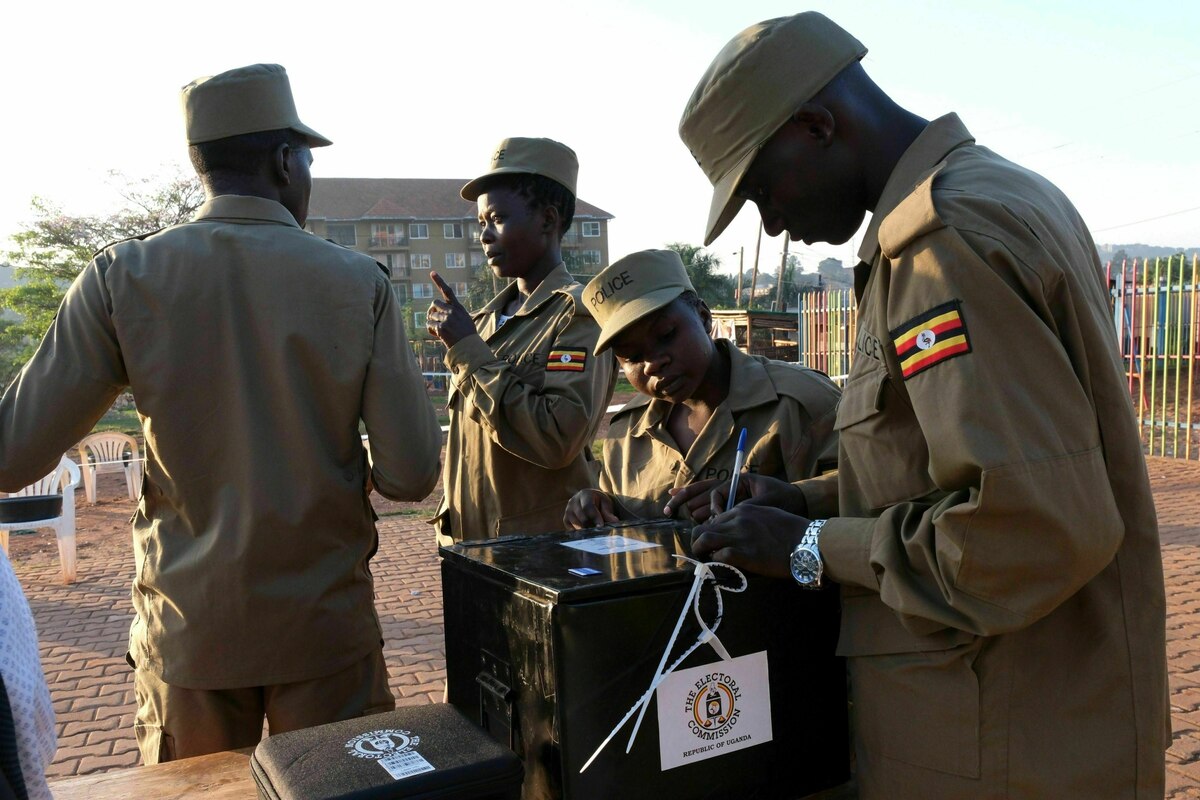
Shortly before 10 a.m. things started to move. Two trucks arrive. Police officers unload black sealed boxes with ballot papers. Hundreds of men and a few older women crowd into the schoolyard, there is pushing and jostling. The few police officers try to create order and sort voters into queues.
A tall, finely dressed man in civilian clothes with a face mask approaches the police chief and tells him in Swahili, the language of the army in Uganda, that he is now taking over command. In Uganda, this means that he works for one of the numerous secret services that report directly to Museveni’s eldest son, Muhoozi Kainerugaba, in his role as army chief.
Just a few hundred meters from the primary school in Ggaba, special army forces set up tents in which they spent the night. They march along the streets in step. Army chief Muhoozi called on the population in advance to go home straight after voting so as not to disrupt the voting process.
Opposition leader Bobi Wine, in turn, called on his supporters to wait in front of the election offices until the votes were counted in the evening so that no one could manipulate the result. Most Ugandans have no confidence in the election process. The delayed delivery of election materials further fuels this distrust.
Voting in the washtub
It takes over an hour for election workers to open the sealed containers, sort the ballot papers and position the ballot boxes in the school yard. The voters then do not make the cross behind a partition in private, but in a washing tub on the floor in which the chained ballpoint pens lie and which offers no privacy protection. Everything seems a bit improvised.
When a poll worker turns on the electronic fingerprint machine, she raises her shoulders in perplexity. Uganda’s government switched off the internet nationwide on Tuesday evening, and no one can get online even using VPN applications. This also means that the electronic devices in the polling stations cannot connect to the election commission server and are therefore unusable.

Voters watch the opening of ballot papers during Uganda’s presidential election
Photo:
Brian Inganga/AP/dpa
Actually, the voters’ identities have to be confirmed by fingerprint comparison before voting – that’s not possible now. At a loss, the election worker packs up the fingerprint machines again and instead pulls out a long list with the names of more than 700 voters who are allowed to cast their votes in this election office today.
David Mutwe is at the front of the queue. He keeps looking at the clock. He reports that his Chinese boss has already called twice asking when he would finally show up for work. Otherwise the fish will go bad.
He tells the poll worker his name. It takes almost 15 minutes for her to find it in the long list and cross it off. Shortly before 12 noon, Mutwe finally casts his vote. A little frustrated, he has his thumb marked with blue waterproof ink to prevent him from voting somewhere else.
Spanking for a song
In the background one of the young men in the queue starts singing a song by Bobi Wine. He is visibly drunk. Numerous young men bawl along loudly. The young opposition leader has many supporters in this poor fishing town.
The tall man with a mask and sunglasses, who introduced himself as a representative of the security apparatus, tries to calm the young men. As the drunk starts the next verse, the man signals to the police. They grab the singer by the arms and forcefully drag him outside. They bludgeon him on the street. The crowd suddenly becomes quiet.
The heat continues to rise. In temperatures of up to 40 degrees in the blazing sun, all the party observers took refuge under the few parasols in the schoolyard. Hardly anyone approaches the tubs in the blazing heat. Only around 50 opposition supporters are still waiting outside to witness the counting of votes in the evening.
But towards the end of election day, soldiers marched in again. They also cast their votes – and their presence makes it clear who will be in charge that evening.