

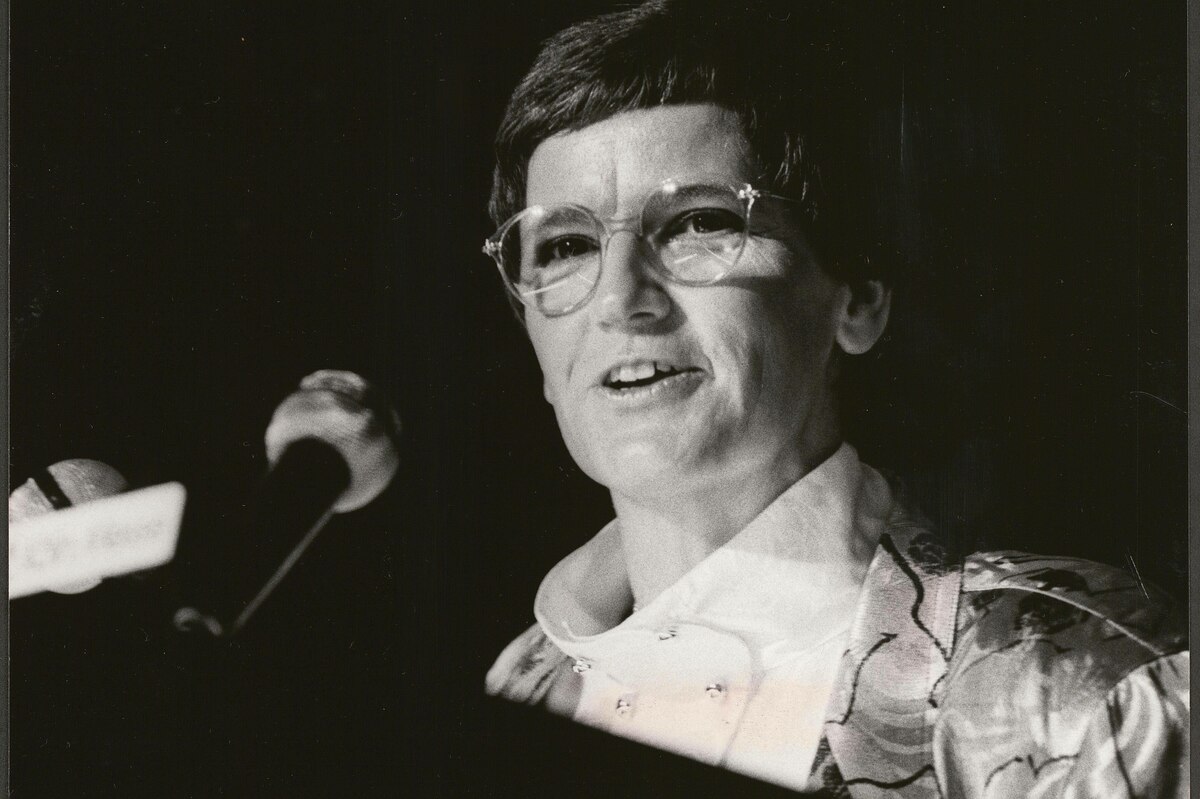
When she became the new Federal Minister for Youth, Family and Health on September 26, 1985, when she took her oath of office in the Bonn Bundestag with the formula “So help me God,” which was unquestionable for the Union, her world was still in order for Federal Chancellor Helmut Kohl, especially for the Union faction: Rita Süssmuth was now the head of a ministry that had a comparatively small budget and did not create any political alarm would. After all, the Kohl government took office at the end of 1982to create a “mental-moral turnaround”.to push back the relaxation of customs and customs, which can only be described too meagerly with the formula “sixty-eight”.
Süssmuth, professor of educational sciences, born in Wuppertal in 1937, daughter of a school superintendent, ambitious and ambitious, inquisitive, Catholic in every respect: values such as mercy, charity and care were central values for her, who later became the most famous politician of her time. Those that also had practical implications for her, a member of the CDU since 1981.
The politically far-sighted Heiner Geißler had his name on the list. He, a modernizer of his party, which (not only) in his opinion had to break away from the patriarchal. But also had to get rid of the image of a female party member who was first and last responsible for the pretty, and also serving, side of a party organization in which there was not even an awareness that women could be more than subservient to men. Süssmuth was a lateral entrant into the political leadership; it was her advantage that her own ideas had not been reduced to provincial standards through years of work in the party mill.
When she began her work as a federal minister, she quickly became a star – because she did not take part in the reactionary rollback that the intellectual and moral turnaround meant. And always friendly, conciliatory, never standing on the barricades for a second, but persistent and wanting to improve conditions, especially for families, step by step, especially with regard to the structural disadvantage of women. Süssmuth knew very well how to secure power; she worked in top positions for the Catholics, she secured herself, she promoted her politics.
She disturbed her party during the AIDS crisis
But what she most lastingly disturbed was her party – and all conservative rollbackers – during the AIDS crisis in the mid-1980s. The infectious disease struck the minority of homosexual men particularly fatally in thousands of cases; the virus had recently reached Europe from North America. Süssmuth did not hear any acrimonious tones from the Union, which fantasized about isolating “the gays” if necessary, or at least punishing them for their sexual behavior, which are associated with names like Peter Gauweiler and Horst Seehofer.
Süssmuth’s dictum that one fights the disease, not the sick, became the guiding principle of a real moral upheaval.
She relied, by no means easily, against the most blatant resistance in her party, on enlightenment, on research, on, how should we say, compassionate charity. Süssmuth’s dictum that one fights the disease, not the sick, became the guiding principle of a real moral upheaval. The minister recognized that the best prevention, even if there was no drug treatment (yet), was sexual education.
In order to ban AIDS, it wasn’t about punishment, but about talking about sexuality. With Süssmuth’s time at the helm of this health policy, words such as “condom”, “sperm”, “anal sex” and “viral load” came into common usage. Sexual shame, especially in gay terms, had not disappeared, but it became possible to talk about sexual precautions.
Rita Süssmuth was annoying
In 1988 it was too much for the male grandees of the Union. Rita Süssmuth was annoying, all commentators agree on this judgment, even in historical retrospect. But she couldn’t go into the silent delivery house for settled fates – she became President of the Bundestag almost overnight, a representative office that she held until the red-green coalition and the end of Kohl’s chancellorship in 1998. Süssmuth’s far-sighted, integrative health policy was retained; the conservatives were unable to do anything to counter the success of the educational campaigns.
She filled her new office politically: long popular across all factions, an idol of anti-polarization in society. She managed the move of the Bundestag from Bonn to Berlin and allowed the art event in which Jeanne and Claude Christo covered the Reichstag in Berlin in 1995 to become a kind of overall representative condom. She worked on numerous boards of trustees and honorary positions and became a voice of Christian democracy, Catholic all-encompassing, without hate, devoid of all resentment.
The fact that her party often literally cursed her was another matter. For example, when Gerhard Schröder’s red-green coalition appointed her to a commission on immigration and she complied with the request, against the express wishes of her party, which was still unable to agree on the factual sentence that Germany is an immigration country.
Better the crooked wood than the straight plank
She did not perceive Rita Süssmuth’s work, which was shocking from the perspective of conservatives and reactionaries, in this way. She did the obvious thing and spoke publicly accordingly. She was free of hatred and cultural warfare; every crooked piece of wood, well Christian, was closer to her than any accurately carved plank. After a long illness, Rita Süssmuth died on February 1st, in Neuss am Rhein, her home.
With it, a piece of modern party history dies: a Union as a party of non-machoism.
From today’s perspective, it is difficult to appreciate what a provocation she was as a person and with her work. With it, a piece of modern party history also dies: a Union as a party of non-machoism, even if only as an idea. Without them, careers like those of Angela Merkel or Ursula von der Leyen would have been unthinkable.
The old Federal Republic had a presenter in her who was not afraid of new times. The gay communities in particular are grieving deeply and deeply; especially for them, she was like a mother who was never prepared to give up her offspring.