

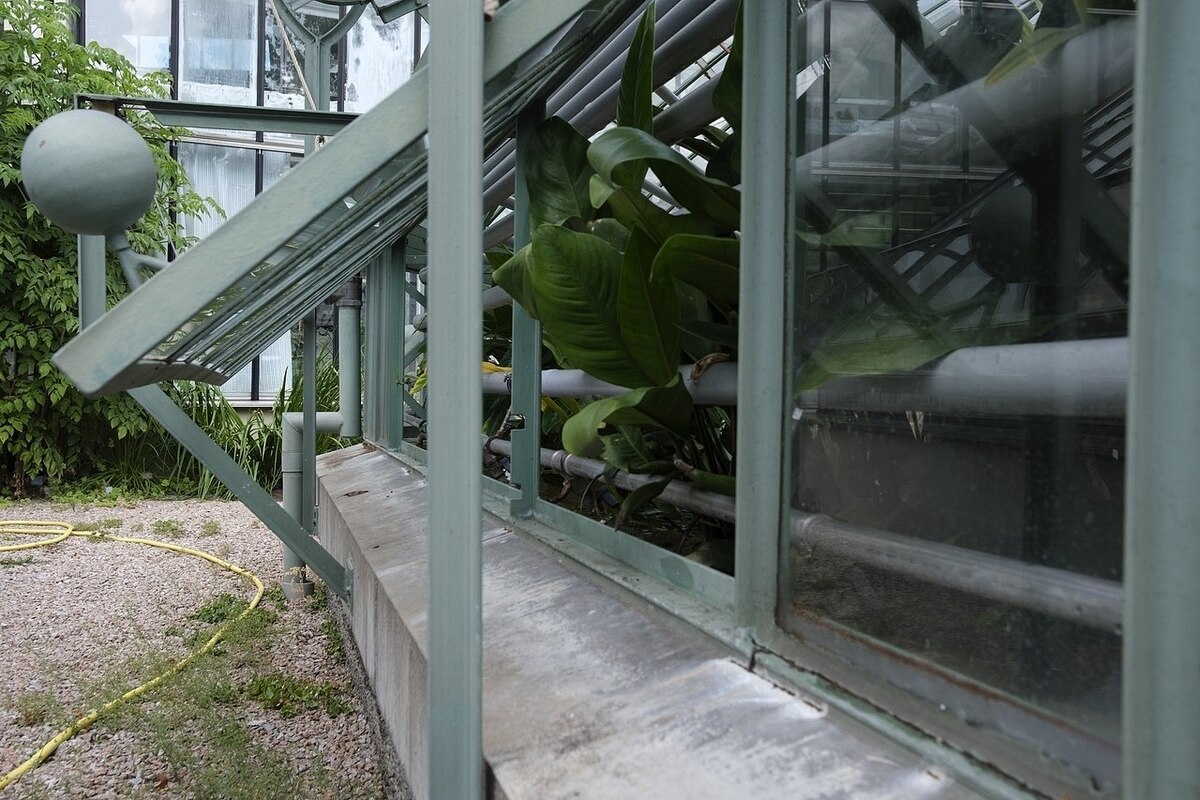
D So this is the vocabulary that immediately comes to mind with Laura J. Padgett’s new photographs: protruding, sticking out, perhaps breaking through, forcing through, overgrowing. The first nature makes its way into the Frankfurt artist’s pictures, which are currently being exhibited at the Peter Sillem Gallery.
Not so brutal, more stable, enclosed in boxes, walls, gardens, greenhouses. But, it becomes clear, unstoppable. Leaves seem to peer out through the half-tilted window of a botanical facility, perhaps with a gray premonition that they will be released there at some point. Of course, this is also a purely human interpretation – like photography per se, which the artist makes no secret of.
Padgett was born in Cambridge, Massachusetts in 1958, studied painting in New York and later at the Städelschule in Frankfurt Peter Kubelka experimental film. Often it is architecture in the broader sense that she brings into the focus of her film or, as is now the case, photo camera.
Laura J. Padgett: „Bliss“. Peter Sillem GalleryFrankfurt am Main, until February 28th. A booklet will be published for the exhibition, 12 euros.
Focus on the designed environment
Private gardens, in England or Jordan, were also included. The artist is not interested in the empty, pristine landscape, but in the environment that is related to people (and more or less designed by them). For the current series “Bliss” she captured urban greenery in Frankfurt, Basel and Brooklyn.
The artist has never completely abandoned the logic of analogue working methods, even if the camera is now digital. She still takes very few pictures. She often visits places several times, sometimes over long periods of time. Given this preparation, the motif itself emerges quickly, in the moment itself. The result is a photograph that defies overwhelm, which can seem downright unspectacular at first glance.
Katharina J. Cichosch
Katharina J. Cichosch, freelance author and art critic, lives in Frankfurt am Main.
In the exhibition space, the large-format (and unframed) sections of green add up to something more than the sum of their individual parts: this is what it obviously looks like, urban botany, and that’s quite a lot.
The view from outside
Padgett’s pictures do not have a romantically exaggerated idea of their subject, but they do not pretend to be too coolly distant either. There is something fantastic in this supposedly sober observation. A focused look at this very nature, man being a part of it and at the same time not, with his ability to see from outside.
In the last corner of the exhibition, this falls on a short video work, recorded in front of a fountain in New York City, in which thesis and antithesis, controlled and uncontrollable natural images coincide: A curtain of artificial waterfall rushes like an unchanging still image until a few sparrows enter the section from the right, linger briefly and fly out again in the middle on the left.