

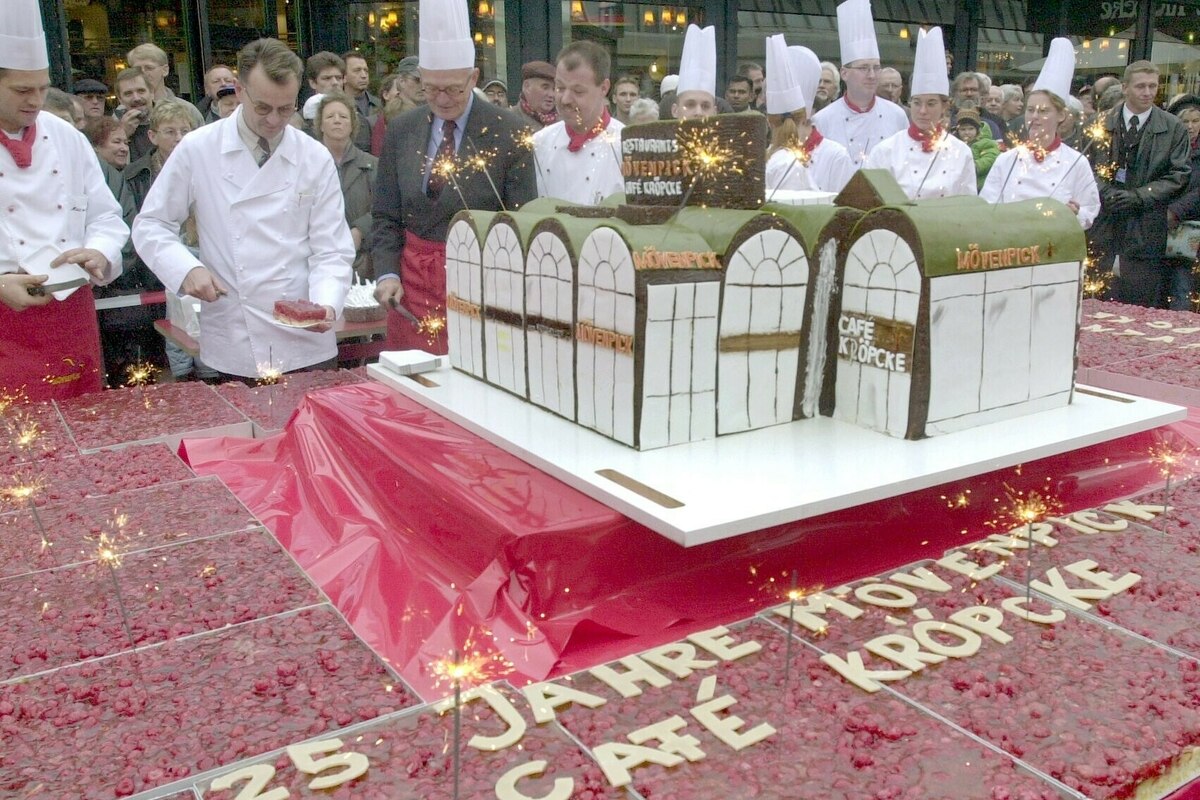
K Can we explain to outsiders what this “Kröpcke” actually is? That’s what I asked myself when… Hannoversche Allgemeine Zeitung Now the shocking news has come around the corner that the Mövenpick Café located there is planning to dilute itself after 50 years.
For the local section, this is of course gold: you can then fill a lot of lines with sentimental memories and ask people what they think of it and what should go in there instead and so on. (“Just no extra sheet” was by far the funniest and cleverest answer.)
What may not be entirely understandable to outsiders is the Café am Kröpcke is more than just any café. It is, so to speak, concentrated city history. It starts with the optics. In the otherwise unfortunately brutally ugly pedestrian zone The small building with its pretty domes and arches and the ornate lettering is a playful ray of hope.
You immediately get the impression of coffee house culture and vague associations with the 1920s, when writers and artists still hung out here. Yes, that used to happen! In Hanover! But it’s been a long time. In any case, Schwitters is said to have been sitting around there.
You immediately get the impression of coffee house culture and vague associations with the 1920s, when writers and artists still hung out here.
Okay, what there was also was Haarmann. The serial killer and sex offender is said to have hung out in the gardens that used to surround Café Kröpcke. The gay hustler scene – which was still highly illegal at the time – was bustling there.
At that time, the area between the main train station and the swampy streets of the old town was swarming with miscreants and crooks. Some people think that this is happening again, but perhaps we should leave such 1920s analogies behind.
In any case, the current café at Kröpcke is already the fourth building, I learned on this occasion. The first one was actually a stroke of genius. The thing was called Café Robby, a pretty oriental-looking pavilion. At that time – in 1869 – people thought that was very chic. And because the newly built main roads intersected here a few years later, it was suddenly in the center of the city.
Bombed away and demolished – but still there
Back then, the horse-drawn tram also stopped here, and there is now a pretty underground labyrinth and the most important transfer station for the light rail network, which is why it’s still easiest to meet at Kröpcke if you want to meet in the city. At the Kröpcke clock, which has its own survival story.
The café was bombed away during the Second World War, temporarily rebuilt, and finally had to give way to the subway construction in the 1960s.
The café was called Kröpcke after the head waiter, who ran it until 1919. However, his descendants did not want to pass on the name simply. They only agreed to this when the city named the entire square after him. That’s how it works here.
Not a huge thing
Today’s Kröpcke is run by a community of 20 Hanoverian families, mostly long-established merchants and entrepreneurs, some in the third generation. They – typically Hanoverian – don’t make such a huge thing out of it. (Take this, fellow Hamburgers. That’s how it works, Mr. Kühne.)
The crude phrase “Nach’n Kröpcke hin” comes from the comedy duo Siggi and Raner (Hannöversch for Rainer) and was part of an attempt to cultivate something like local color. Because people don’t speak a proper dialect in Hanover, the two of them made do with sociolect, a kind of working-class language, grammatically stubborn and with regional peculiarities.
Siggi and Raner’s counter conversations were part of the legendary ffn early Styxradio environment. This was enormously popular in the 90s, with such offshoots and excesses that still populate the comedy landscape today – Oliver Welke (now “heute show”), Oliver Kalkofe (“Kalkofes Mattscheibe”), Günther, the tractor driver, and many others. But that’s another legend.