

AIN
There are country abbreviations at the Olympics that can be quickly deciphered, such as USA, FRA or GER. For others it is a little more difficult. KSA, for example, stands for Saudi Arabia and PRK for North Korea. And then there is the abbreviation under which the athletes compete who are not allowed to compete for their home countries because they have just attacked a neighboring country. AIN stands for “Athletes individuels neutre”, the neutrals. As such, athletes from Russia and Belarus are allowed to compete, unless they are military personnel or have glorified the war against Ukraine. They are not allowed to show national symbols of their home countries.
Anzuggate
A broadcast of ski jumping from Predazzo can hardly do without this word. And the friends of the well-kept Telemark landing (see below) will of course immediately know that this is about the Scandal over manipulated ski jumping suits with which the Norwegians ruined their home World Cup last year. They had stiffened the seams of the suits on the inside so that when they spread their legs in the air they almost formed wings. Of course that shouldn’t be the case. Disqualifications and bans followed.
Change of track
At first glance, this is a seemingly harmless rule from the Olympic discipline of speed skating. The runners have to change lanes every lap, either from the inside lane to the outside or vice versa, on the back straight every lap. By balancing the longer outer and shorter inner lanes, fair conditions are created. became famous a change of track in 2010, when the Dutch speed skating legend Sven Kramer was about to win the gold medal in the 10,000 meter race and changed lanes at the wrong moment after a good 8,000 meters at the behest of coach Gerard Kemkers. His disqualification was the logical consequence. Afterwards, the poor coach had to let the angry Kramer publicly insult him as an “asshole”. So changing lanes is a serious matter. In extreme cases it can lead to the worst possible distortions.
Gundersen method
Nordic combined is on the Olympic elimination list. Fundamental things have been done to make the sport more attractive. At the beginning of the 1980s, ski jumping and cross-country skiing were held independently one after the other and the services were only then billed for. The fact that the man who gasped across the finish line in twelfth place in cross-country skiing despite being dehydrated could still be the overall winner could not be well portrayed either on site or on TV. The Norwegian combined athlete Gunder Gundersen developed the idea of converting the distance between jump distances into seconds. Since then, the best jumper starts the cross-country skiing race first, and depending on their jumping results, the others follow at the calculated distance. Now the first one at the finish was also the overall winner. Even the Gundersen method is probably still too scientific for the IOC.
Hammer
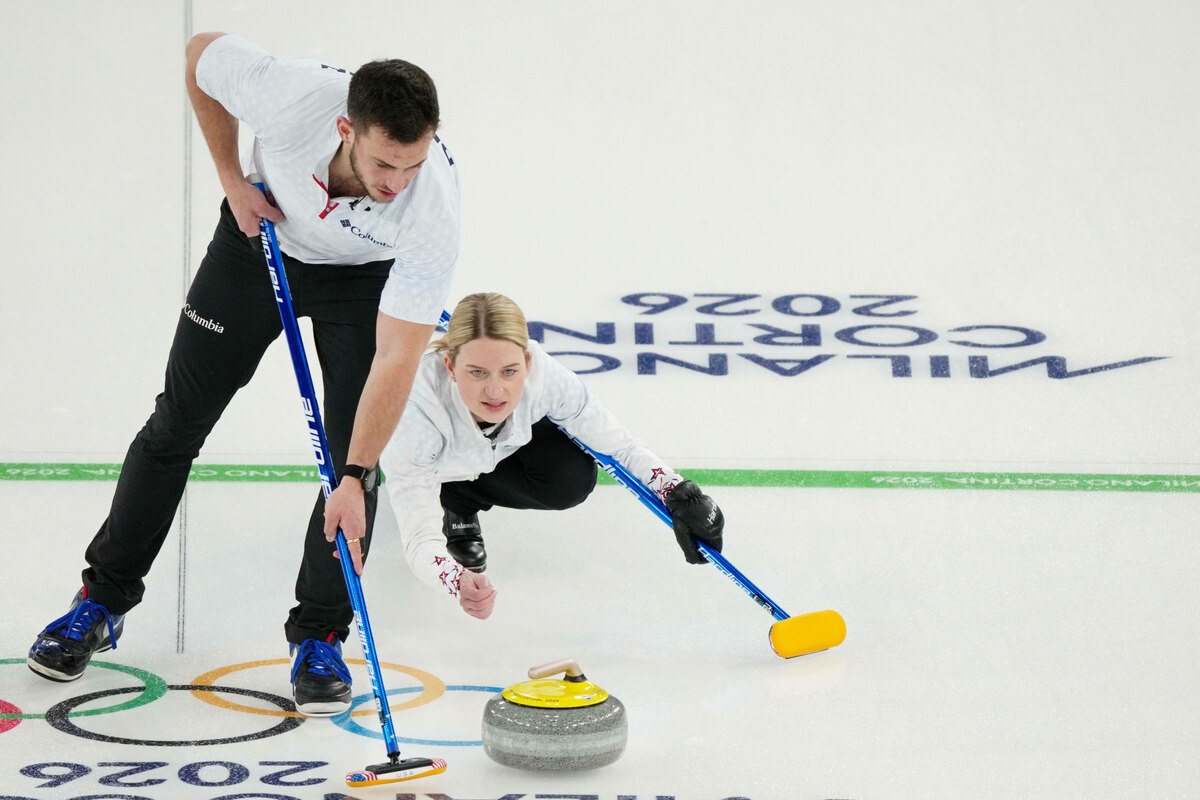
Sports consumers are all too familiar with amazing goals, amazing transfers and amazing scandals. Obviously in these cases you could do without the hammer; it is indispensable in curling. Because the hammer denotes the right to play the last stone in an end. Because every team would like to have this advantage, a draw must be made before the first round. The loser of each round then receives the hammer. Turning the score upside down with the last stone evokes a feeling in every curler that can be described without exaggeration as a hammering feeling.
Icing
Words that contain the English word “ice” are causing shock not only in the USA, but unfortunately also at the Winter Olympics in Italy. The news that the US ICE immigration officials responsible for horror, violence and two deaths will be deployed in northern Italy around the US delegation, caused outrage. As a precaution, three US winter sports associations have renamed their joint Olympic meeting place from “Ice House” to “Winter House”. It should be made clear at this point, however, that icing was already banned at previous Olympic Games. In ice hockey, this word refers to an unauthorized break. If a player shoots the puck from his own half over the opponent’s goal line without another player touching it, the referee must blow the whistle and call a face-off in front of the goal of the person responsible for the long-range shot. Obsessive safety thinking has never been allowed in ice hockey.
Reloader
Sport is often punishment – especially in biathlon. If you don’t shoot well, you have to go into the penalty loop and gain significantly more meters. The really bad shooters even have to go into the penalty loop several times. In the relay, however, the sport of shooting and running shows its benevolent face. There is the reloader. Actually three. If you don’t hit all five hatches, you get a sixth, seventh and eighth attempt. Actually, it works without penalty.
Rittberger
There are still supposed to be people who laugh when someone throws the expression “triple Rittberger” into a discussion about the sense and nonsense of figure skating. The backward jump, which in this country is named after Werner Rittberger, who performed it for the first time in 1910 with a simple twist, is still part of the repertoire of many figure skaters. 2016 has the Japanese Yuzuru Hanyu was the first person to show a quadruple Rittberger in a competition. He himself will not know that he carried out a Rittberger back then. In modern referee language, the jump is simply called a loop.
Switch Double Cork 1440
This is a little tricky. In any case, it is not a double-corked bottle of fine red wine from the year 1440. You can see the mystery in Livingo in the snow park, where the ski and snowboard artists conjure up their jumps in the air. So from the beginning: Switch – this means that the ramp is approached backwards. Two somersaults are then performed in the air while the body rotates four times around its longitudinal axis – 4 times 360 degrees. Hence the 1440. You then land again with your back to the valley. If you want to count, you shouldn’t drink too much red wine during the broadcast.
Telemark
One Landing while ski jumping It’s only really nice when the ski jumper pushes one ski forward while letting the other ski follow a little. The telemark comes from telemarking, a skiing turning technique developed in the 19th century in the Norwegian province of Telemark.