

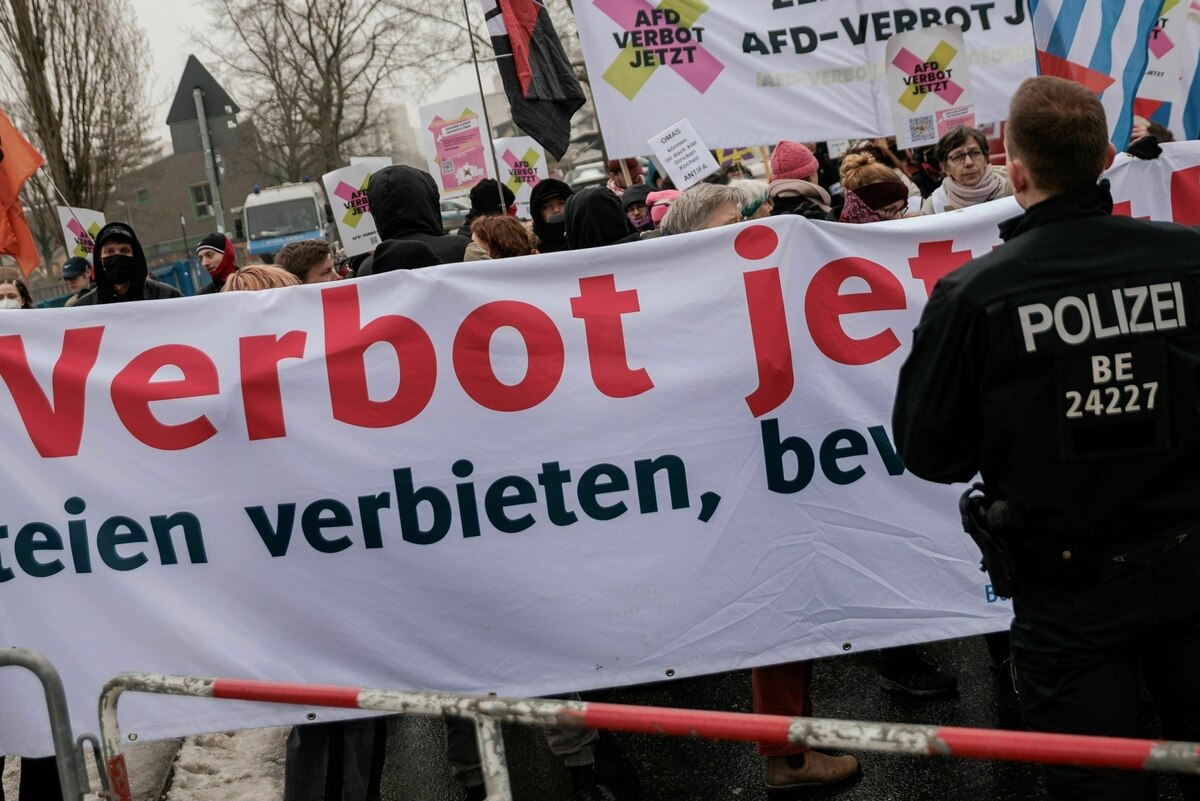
S For over ten years there has been discussion in Germany about whether the right-wing extremist AfD should be banned. In NRW there are Civil society groups have now come together to finally get state politicians to give in. It was clear to critics of the party early on after its founding in 2013 that significant parts of the AfD consisted of right-wing extremists.
It was only years later, in 2019, that the Office for the Protection of the Constitution reacted by classifying the so-called “wing” around Björn Höcke as a suspected right-wing extremist case. Since the beginning of 2025, the entire party has been considered firmly right-wing extremisteven if the Office for the Protection of the Constitution only uses this term internally until the end of the AfD lawsuit.
As long as the debate has been going on, it has been accompanied by voices that either incorrectly believe that a ban on the AfD is not possible or is even wrong. The arguments for the latter are different: Some say that the AfD has to be included because of the relevant number of votes. But removing the basis for the party’s victim narrative doesn’t work. As we see, following him inevitably results in a shift to the right.
Some left-wing opponents of a ban argue that banning an opposition party is not only authoritarian, but also an admission of the failure of liberal democracy. They are certainly right. It is obvious that the CDU, CSU and SPD are largely responsible for the rise of the right-wing extremists. And the objection that a ban on the AfD would not make the right-wing extremists disappear in Germany is also correct.
Time for “last resorts” such as banning parties
We are in a time in which, on the one hand, liberal democracy is increasingly disappointing because it is becoming more illiberal and, on the other hand, it is exposed to massive attacks from the AfD & Co. A party ban should be the last resort. But we are in the time of last resort. All that can now be done is to prevent something worse from happening.
Let’s listen to those who experienced National Socialism. Just a few days ago, Holocaust survivor Leon Weintraub warned against the AfD: “The crimes of the Nazis did not begin in Auschwitz. They began with exclusion, humiliation and contempt for Jews and other minorities.” The AfD is doing the same thing today.
Defending yourself against the enemies of democracy is the crucial lesson from the Holocaust, says Weintraub. Yes, there are differences between the National Socialists and the AfD. But the parallels are too numerous. This is what historians and Holocaust survivors like Leon Weintraub, Albrecht Weinberg and Sally Perel say. When federal politicians say “Never again,” how can they ignore those who have experienced it themselves and say it will start again?
Therefore, listen to them when they say: “Initiate a ban on the AfD. History will thank you.”