

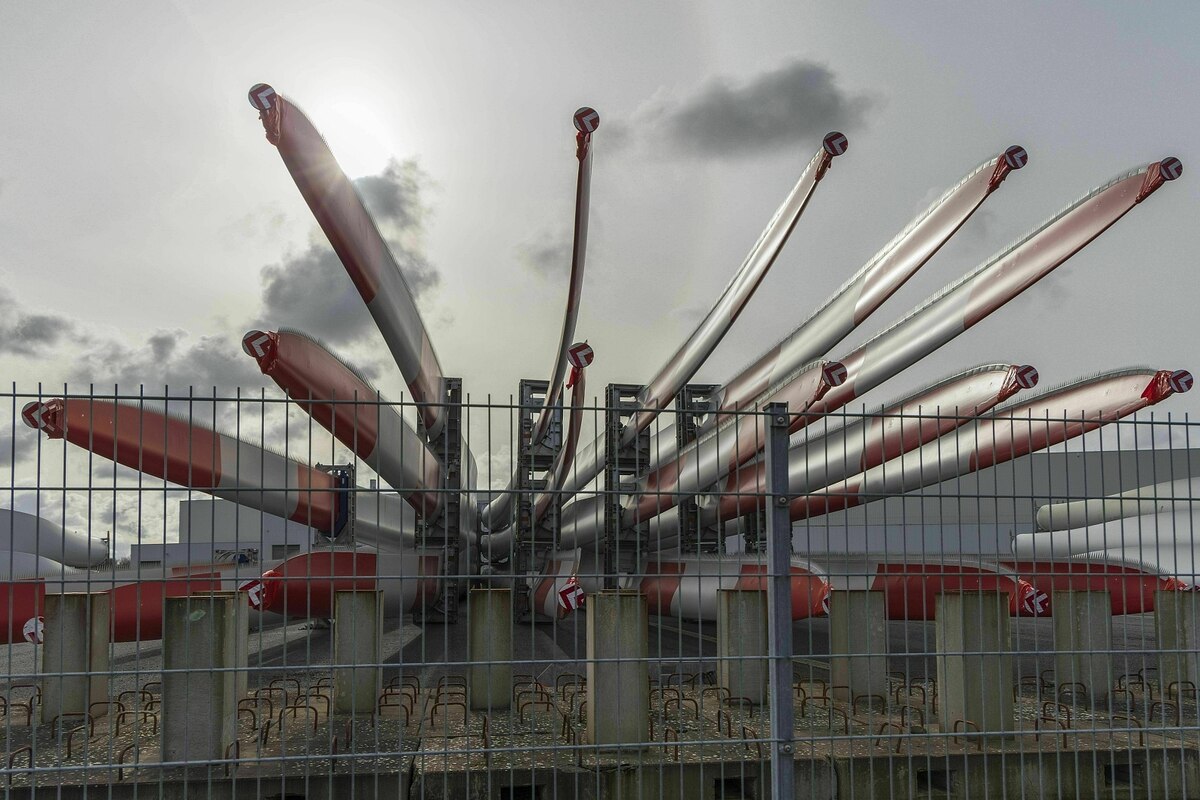
The German one Offshore-Windbranche expects to build many new facilities in the coming decade. However, an improvement in the funding conditions is necessary, said industry representatives on Tuesday when presenting the latest industry figures.
Last year, 41 wind turbines with 518 megawatts were connected to the grid in the German maritime regions. In addition, 19 systems with 278 megawatts were built, but they still lack a grid connection. The total number in German seas is currently 1,680 systems with 9.74 gigawatts under optimal conditions of technically achievable performance.
Last is development somewhat stalled: There were tenders for two areas in the German North Sea no bids last August. Now the areas are to be put out to tender again in 2026, but without a change in the funding, which is defined by the Offshore Wind Energy Act, there will hardly be an investor this time either.
“Politicians should first adjust the framework conditions and then put them out to tender again,” said Dennis Rendschmidt, Managing Director of the mechanical engineering association VDMA Power Systems, when presenting the industry figures. What is necessary is “a revenue model that offers investment security”. Contracts for differences are a good option. This means that the operators of the systems are reimbursed for the difference to a reference value when market prices for electricity are low, but they also have to pay the additional revenue when prices are high.
Chancellor advocates offshore until nuclear fusion
Representatives of the wind industry show up optimistic after the North Sea summit the day before in Hamburg. Especially since Chancellor Friedrich Merz, after being asked by journalists about previous negative comments about wind power, said: “I have always differentiated between wind on land and wind at sea.”
Industry representative Rendschmidt summed up that the summit gave “a clear signal for offshore wind energy” – also because European resilience in the face of geopolitically uncertain times was a standard topic in the speeches. As a result, the heads of state of the North Sea countries signed the “Hamburg Declaration”, according to which the countries want to act together to protect their energy infrastructure “in order to ward off a whole range of threats such as physical sabotage, cyber attacks or other hybrid attacks”.
At the summit, Germany and Denmark also agreed on the first cross-border offshore wind farm, “Bornholm Energy Island”. Plants with a total of 3 gigawatts are to be built near the Danish Baltic Sea island. The electricity should be able to flow to both Denmark and Germany. The project is funded by the European Union with 645 million euros.
The goals are also ambitious in German maritime areas: 30 gigawatts should be installed in 2030, 50 gigawatts in 2035 and even 70 gigawatts in 2045. The expansion will not fail because of the supply chains, said Rendschmidt: “European manufacturers can realize all projects.”
The challenges to the infrastructure are constantly growing due to the dimensions of the technology
Markus Nölke, managing director of the wind energy agency WAB, said that investments must also be made in the ports to build and maintain wind power at sea. Today, the ports are a matter solely for the states; in the future, given the importance of the marine energy industry, the federal government will also have to become more involved. The port industry needs 3 billion euros in support in the coming years.
Ultimately, the challenges to the infrastructure have always increased due to the dimensions of the technology: according to figures from the consulting firm Deutsche WindGuard, the average new offshore system in 2025 had a rotor diameter of 211 meters and a nominal output of 12.6 megawatts. It stands 91 kilometers from the coast in a water depth of 35 meters.
Meanwhile, an interjection from the Federal Chancellor at the North Sea summit could hardly affect the positive mood in the industry: offshore wind power is a transitional technology until nuclear fusion comes, Merz said on Monday. Possibly because the existence of market-ready fusion reactors is still entirely up in the air, no one in the industry seems to consider this sentence to be really relevant.