



As you may have heard, Anthropic had its IPO this past Thursday. At a valuation of $1.5 trillion, it was actually just the second most valuable IPO in history, just behind SpaceX at $1.77 trillion. I bought some shares on the first day at what I thought was a reasonable price, only to see my shares drop the following day as the company’s valuation fell to $1.175 trillion, making it only the 14th most valuable company in the world. Such are the risks of buying individual stocks!
But that price drop doesn’t change the fact that Anthropic’s IPO was a staggeringly large wealth creation event. Anthropic began hiring lots of employees just a few years ago; now, almost all of those people have either hundreds of millions of dollars, or tens of millions of dollars. Andrew Benson had a good breakdown of exactly who would get what, if the company hit its initial valuation target of $2 trillion:
Who actually gets rich if Anthropic lists at $2 trillion?…
– $199B for the 7 controlling co-founders, about 10%
– $28B for Ben Mann, if his stake matches theirs
– $100B for the Anthropic Public Benefit Fund, 5%
– $331B in employee options and RSUs, about 17% , That pool covers about 5,300 employees, an average of $62M each…[H]ere is roughly how many people made what at $2T:
– $110M to $400M each: ~300 to 500 people hired by 2023
– $200M to $300M each: ~440 to 640 hired in 2024
– $70M to $95M each: ~1,360 hired in 2025
– $10M to $20M each: ~3,000 hired in 2026So about 940 people hired by the end of 2024 average nine figures. Everyone hired since averages eight figures.
The company’s (fully diluted) valuation is now only about 80% of that $2T number, so you have to scale those numbers down a little bit. But it’s still a staggering amount of money for just a few years of work! We’re used to seeing the first few employees at a generational company make hundreds of millions of dollars, but seeing several hundred people make that much is just unprecedented.
Let’s put these numbers in perspective. If Anthropic were worth $2T, it would have more centimillionaires than the entire city of Los Angeles. Even with only 350-400 centimillionaires, that’s about as many as Houston, Dallas, and Austin combined:
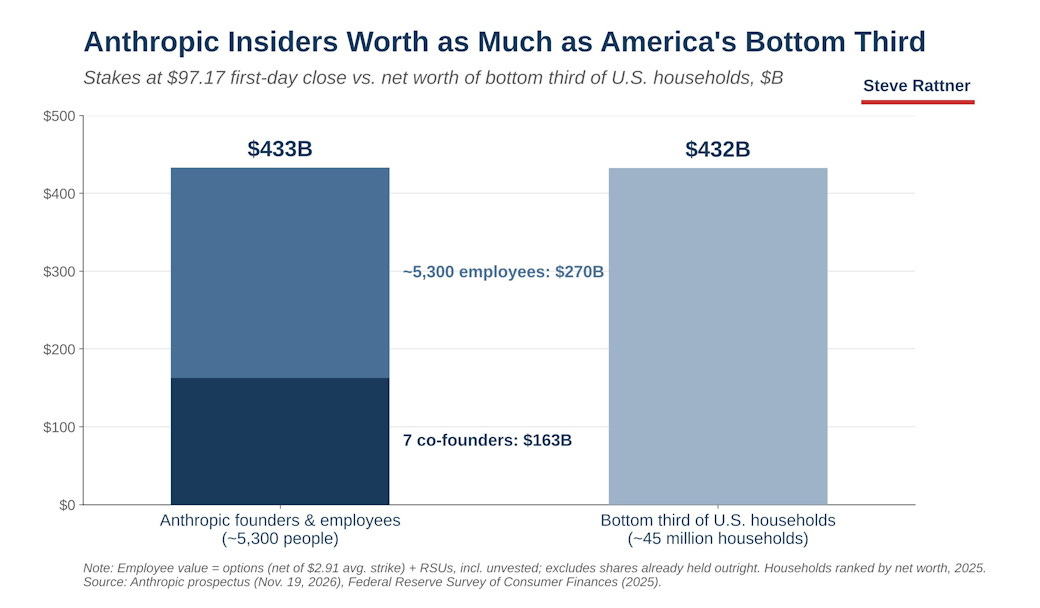
By some reckonings, Anthropic now has between 0.5% and 1.3% of all the centimillionaires in the U.S. Collectively, the company’s founders and employees have as much wealth as the entire bottom third of Americans, combined:
Of course, just looking at these numbers tremendously understates the amount of wealth that has been created in the AI industry over the last couple of years. There’s also OpenAI, which is targeting an IPO valuation of $1.25 trillion. And there are quite a number of AI startups that have gotten very valuable, very quickly. Just a few include Isomorphic Labs at ~$50 billion, Cognition at $48 billion, Prometheus at $41 billion, Safe Superintelligence at $32 billion, VAST Data at $30 billion, Reflection AI at ~$27.5 billion, Cohere at $25.5 billion, ElevenLabs at $22 billion, and so on.
And of course, all of this is just today. I wouldn’t have bought Anthropic stock unless I thought the company had a very good chance of becoming much more valuable than it is today. Despite the early price drop, I’m still very bullish. I think AI’s extremely cross-domain capabilities mean that Anthropic has a good shot at being a very large, diversified conglomerate:
Furthermore, I think the company is amassing a huge pool of top human talent, essentially giving them a hedge against a future in which AI continues to be a complement to top human talent rather than a substitute. Almost every smart person I know here in Silicon Valley either works there or has strongly considered working there. That makes Anthropic resemble Google back in 2004, which became a legendary brain trust. If anyone can figure out a way to make boatloads of money with AI, it’s probably Anthropic. And yes, someone will figure out a way to make boatloads of money with AI. Even if that means the company only becomes as valuable as Google or Microsoft is today, that means I’ll more than double my own investment.
If that happens, all of those wealth numbers from the top of this post will also more than double. And if the U.S. economy grows robustly and AI itself grows rapidly as a percentage of that economy, this could easily turn out to be the greatest wealth creation event in American history, by far — greater than the internet, far greater than crypto, greater even than the railroads.
I can definitely feel this wealth all around me. A lot of the people I went to potlucks with three years ago now have an order of magnitude more money than anyone I ever met before I turned 30. Some of those people are under 30 themselves. A few of them are billionaires. Now, when I go to house parties, they’re often in lavish designer-furnished mansions overlooking spectacular ocean views from high up on San Francisco hilltops.
As a social phenomenon, this is totally unprecedented. Sarah Chieng writes:
You can build a startup in 9 months, get acquired (but rly acquihired) by OpenAI, Anthropic, or Cognition, and walk away a multi-millionaire…You can join the right company at 22 and become effectively post-economic…And I don’t think we’ve even begun to grapple with the degree to which this is warping an entire generation’s relationship with money, ambition, work, and success…When your peers are making generational wealth before 25, what does a normal career even look like anymore[?]
I’m happy for my friends, of course. And I am not personally bothered by seeing displays of great wealth. But I find myself wondering what this is going to do to my society. If the AI class are the only people who get rich going forward, what kind of tensions will that produce among the country’s elites? What would it mean for America if wealth inequality goes up far further even than it already has?
What if only the AI people get rich?
Read more