

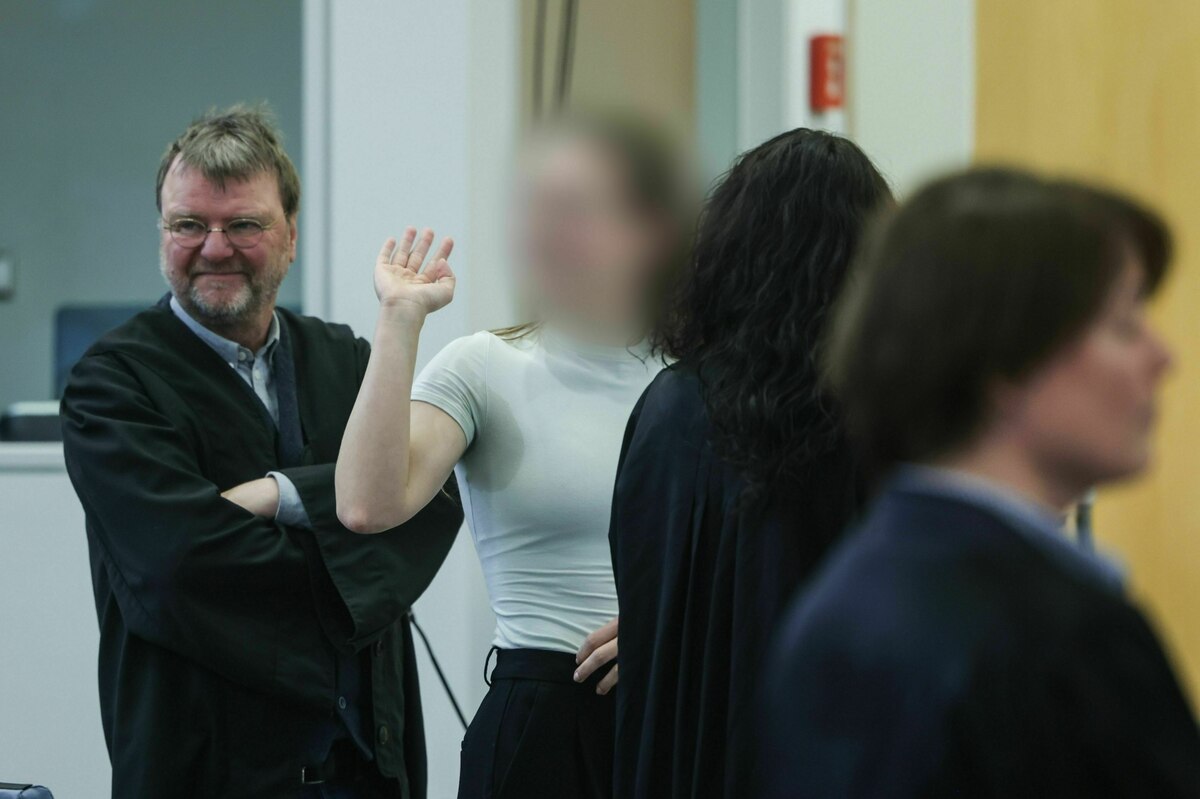
With violent attacks by the defense on the Federal Prosecutor’s Office, the Higher Regional Court (OLG) in Düsseldorf Trial against six young leftists continued, who are accused of forming a criminal organization but also attempted murder.
Federal Prosecutor General (GBA) Jens Rommel is staging “show trials” against “anti-fascists who are accused of having attempted to restrict the scope of action of militant neo-Nazis through militant actions,” explained Alexander Hoffmann, lawyer for the 23-year-old accused Nele A. The accused acts should at most be “limited to dangerous bodily harm” and could not justify charges before the State Security Senate of the Higher Regional Court, argued the Kiel lawyer.
Nele A. and her co-defendants Paula P., Emilie D., Clara W., Luca S. and Moritz S. are said to have attacked right-wing extremists in February 2023 around the so-called “Day of Honor” in Budapest. Neo-Nazis from all over Europe have been coming to the large-scale march in Hungary’s capital for years to glorify Hitler’s Wehrmacht, the Waffen-SS and their fascist Hungarian allies.
The young leftists from Thuringia, Saxony and Hamburg, all between 23 and 25 years old, are said to have struck with batons and sometimes with hammers. The attacked neo-Nazis suffered lacerations and broken bones, and one suffered a fracture to the base of his skull. Emilie D. is also accused of being part of a group that is said to have attacked stores of the Thor Steinar brand, which is popular among right-wing extremists, in Erfurt, Magdeburg, Halle and Schwerin in April 2022. A saleswoman who complained about punches to the head and upper body appears as a co-plaintiff before the Düsseldorf Higher Regional Court.
Just one of several major cases
The trial is just one of three major cases that the Federal Prosecutor’s Office has brought against anti-fascists. Hanna S. from Nuremberg was in Budapest in the fall because of the attacks sentenced to five years in prison in Munich been. A trial against seven other anti-fascists is underway in Dresden. And in the Hungary of the autocrat Viktor Orbán Maja T. from Thuringia could even face up to 24 years in prison – as a deterrent, as the Budapest public prosecutor explained.
Apparently the Federal Prosecutor’s Office is also relying on this, argued lawyer Hoffmann in Düsseldorf. The trial against the five young women and the young man is taking place “not in a vacuum,” but “at a time when, for the first time since 1945, an extreme right-wing party is again developing concrete ambitions to seize power,” the Kiel lawyer quoted from the defendant’s statement from “some of those persecuted by the GBA as anti-fascists.” which was documented by the taz.
Hoffmann explained that the decision, called “evocation,” to charge the defendants before the State Security Senate of the Düsseldorf Higher Regional Court was characterized by “arbitrariness.” Ultimately, cases like those against the NSU 2.0 group, with which right-wing extremists threatened “especially women in the legal field”, politicians and critical journalists, were not brought before higher courts.
Defense lawyer Hoffmann argued that this also applies to trials against the martial arts group “Hooligans Elbflorenz” or the action against the “Freie Kameradschaft Dresden”, which was involved in attacks in the left-wing Leipzig district of Connewitz. In addition, in his opinion, the state’s monopoly on the use of force is based “on a social contract according to which the state guarantees compliance with and protection of fundamental rights.” But this was “partially canceled by the state” due to the authorities’ long-standing inaction against the murderous “National Socialist Underground” (NSU) around the neo-Nazis Beate Zschäpe, Uwe Mundlos and Uwe Böhnhardt – as well as the refusal to ban the AfD.
The defense lawyers of all the defendants also formally defended themselves against the stylization of their clients as highly dangerous terrorists. It is “discriminatory and degrading” for lawyers to have to take off their belts and take off their shoes during complex searches. Even electric toothbrushes needed for overnight stays in Düsseldorf were intensively examined – as if the lawyers wanted to smuggle weapons or other dangerous objects into the high-security wing of the Higher Regional Court.