

W ars” was the title of the conference in Munich that I attended at the end of January. Artists, activists and researchers from Central and Eastern Europe came together in the HochX Theater to talk about culture in a bleak present and an even bleaker future. After all, there has been a war in Ukraine for four years – it is the largest in Europe since the Second World War, and it is threatening to spread. At the same time, authoritarian, pro-Russian regimes are on the rise that despise a free culture and it literally declared war.
In Slovakia, the conspiracy theorist Martina Šimkovičová has held the post of Minister of Culture since autumn 2023. She once claimed that LGBTQ people were to blame for the extinction of the “white race.” According to their famous tautological saying, Slovak culture should be “Slovak” – “and no other”. Therefore, a few months after taking office, Šimkovičová closed the Bratislava Art Gallery, which exhibited contemporary art that she found unpopular.
The agenda of the Minister of Culture led to the formation of a broad civil society resistancebut the destruction could not be stopped. Within a very short time, Šimkovičová had converted the public broadcaster into a state broadcaster, replaced competent directors of state cultural institutions with loyal ideologues and brought the allocation of funding under her control. The AfD is probably up to something similar in this country. The ultra-right are well connected.
Artists at the front
Meanwhile, in Slovakia’s neighboring country, Ukraine, many artists are on the front lines to defend their lives in democracy and self-determination. And those who aren’t there themselves can help their struggling friends or family members. Artist Sofiia Kozlova has been making camouflage nets since the first days of the major invasion. It is important to choose textiles that match the color of the environment so that the camouflage is not exposed.
In her art, such as last year’s work “Horizon Lines,” Kozlova reflects this activity. She combines a photo of the withered, pale yellow sunflower fields from the Kherson region with a photo of jute yarn, which she chose as the material for the corresponding camouflage net. In her photo collage, landscape and material horizons blur. The soldier Vladyslav Kalan, who sent Kozlova from the mining-dominated Donetsk region to record a strangely beautiful tailings pile, died last summer. He was only 24 years old.
Theater with spy technology
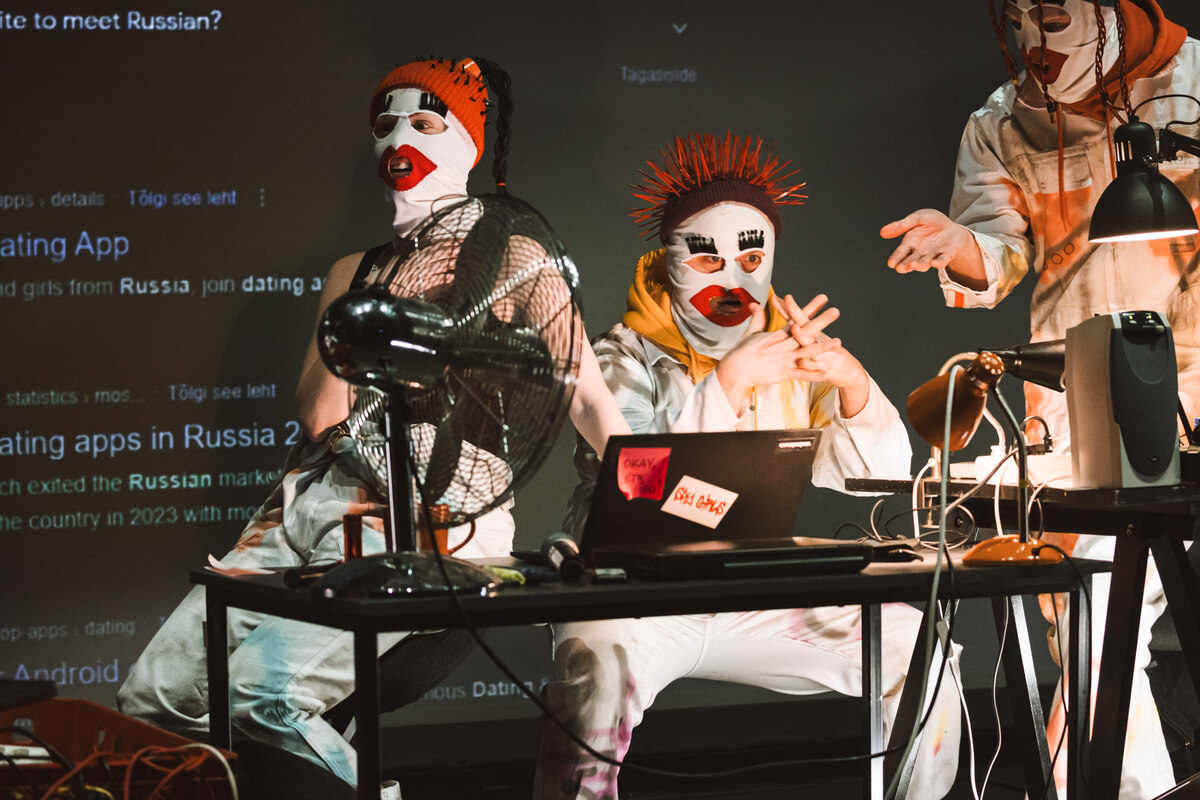
The project by the Polish theater director Magda Szpecht caused heated discussions. Her piece “Spy Girls” It was created on behalf of the theater in the city of Narva on the border with Russia and cooperated with the Estonian secret service. Together with three anonymous actors, the director created fake dating profiles, specifically searched for Russian soldiers, tried to build a trusting relationship with them in order to elicit relevant information from them. “It was easy to trick the men because they all wanted to show off,” Szpecht said during her talk at the conference. On the theater stage, the actors present their exploits in a performance, including intimate text messages and dick pics, but also make a live video call, which turns out differently every time.
After Szpecht’s presentation, a visibly shocked German audience member told me over coffee that she couldn’t automatically see every Russian soldier as an enemy. She found it unfair that Szpecht was exploiting her with her espionage skills.
Well, this is of course in an ethical gray area. But I am sure that the listener’s reaction would have been completely different if she or her loved ones had to live under the constant terror from the air. Or would she just come from one of the countries east of Germany that fear an imminent Russian invasion. Because it is never Putin who uses the weapons and commits war crimes. It’s always just an ordinary Russian soldier.