

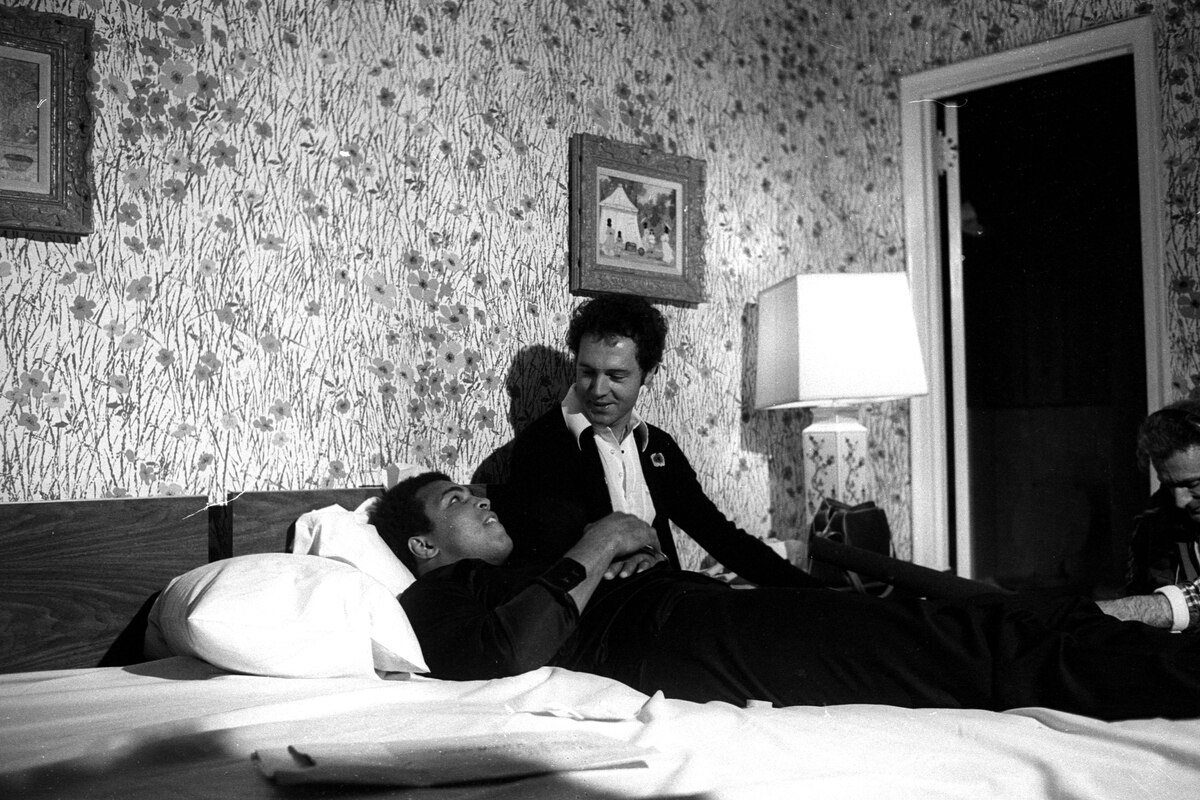
A The photo and moving image were in the obituaries for the football idol Franz Beckenbauer A scene has often been reproduced in which he appeared in New York in 1977 Muhammad Ali met. The boxing champion lay on a hotel bed and asked Beckenbauer about his training methods. “With the ball?” he asked back, puzzled and in halting English. No, without. The boxer wanted to know how he moved his body.
While the two were considered the greatest in their respective fields in terms of their successes, they seemed to be habitually linked by their nonchalance. With Beckenbauer it was the ease in handling the ball. The head always remained up, as if it was about planning the execution of the next feint. His way of playing was acknowledged with elegance, but there was also talk of arrogance and arrogance. Beckenbauer was fast, beautiful and popular. These are the characteristics of casualness as an aesthetic category.
Casualness is the attitude of those who have nothing to lose and most still ahead of them. She was impressively embodied by the young Muhammad Ali, who combined boxing talent with beauty and intelligence. His speed, his prancing, and his dangling arms, which made him appear like a boxer without guard, made him an icon not only of black rebellion, but of youth rebellion as a whole.
The writer Joyce Carol Oates was not unaware of what lay behind Muhammad Ali’s often displayed lack of seriousness. “The sweet art of hurting is a celebration of the male body,” she writes. “Although male viewers identify with boxing, once in the ring no boxer ever behaves like a normal man, and no combination of punches is natural. Everything is style.”
Suspected of narcissism
Casualness carries the risk of failure; the demonstrative looseness of the respective actor seems to invite disaster. But when casualness is openly discussed, there is usually a tone of admiration.
However, the casual person cannot serve as a role model because he lacks the virtue to do so. He seems to be animated by a kind of radical egoism, which is why nonchalance was considered a striking feature in the heyday of neoliberalism, in which risk and guilelessness were seen as the key to opening up new markets. The casual person has always been a personality type suspected of narcissism. Despite its aesthetic appeal, casualness is primarily perceived as a deviation.
As a gesture and variant of self-expression, it is part of the behavioral repertoire of coolness, which has been a desirable state, especially in youth cultures, since the beginning of the 20th century. You try to stay cool, calm, nonchalant, confident, controlled.
Understood in this way, coolness is the anticipated independence of those who are on the threshold of society. You don’t belong yet, be it through exclusion or self-exclusion. Casualness and coolness are always defensive gestures. However, coolness is by no means aimed at a stagnant state, something that one hopes to settle into permanently. Coolness is not based on materialistic values, but is dominated by the moment.
Coolness is permeated by retarding elements. You have to be able to wait, and it’s all about feeling for the right moment. On the other hand, if you haven’t been hot, you can’t become cool. Seen in this way, coolness and nonchalance are part of the ABC of reduced feelings and, not least, characterize a general way of dealing with emotional vulnerability.
Preppers in the pre-war period
There is some evidence to suggest that these are forms of behavior that are being phased out. Flirting with weakness is no longer required; obscene gestures of strength dominate the scene. From a psychological point of view, the so-called prepper, who anticipates emergencies in impassable terrain and is therefore prepared to lead the existence of a bunker, is no longer a social fringe figure.
Preppers imagine themselves to be in pre-war times, and it no longer seems to be just a gloomy forecast from military experts that the long period of peace in the Western world has come to an end. Power outages, snow disasters – it is increasingly important to be prepared, no matter how different the ways of stacking the cans may be.
For prepper pioneers, the fight for survival has long since begun; their existence is a life to death. Even if the prepper – a by no means exclusively male figure – is not cool, he feels connected to coolness through his proximity to death.
Meanwhile, coolness seems to be replaced by the side effects of a political economy of disruption, with South African-born American entrepreneur Elon Musk presenting himself as its noisy messenger of the gods.
Nowhere safe from wantonness
When he marched into Twitter headquarters with a sink in October 2022, he wasn’t interested in improving the company’s hygiene conditions. Rather, he wanted to be perceived as someone who gets involved. A little later, the employees of the platform, which was soon renamed X, discovered that they were nowhere safe from the mischief of the new owner.
The sink in no way illustrated that everything flows. Rather, it signaled Musk’s willingness to rip everything out, an attitude in which he put fear into liberal US society as head of the DOGE organization set up by US President Donald Trump to supposedly increase government efficiency and productivity.
Musk staged politics as a riot and a party, in which he quickly lost interest. Everything about this character is anti-cool, waiting is a horror for her, she seems to lack any will for self-control. Bloated and overweight, Musk explicitly makes his publicly admitted drug use visible. He celebrates the appeal of self-indulgence. If there is such a thing as self-control, then it consists of microdosing, which Musk says he uses to ingest the respective substances. This kind of drug use is the privilege of the rich.
Arguments don’t matter
The associated entrepreneurial model has recently become well known as disruption. In the “Glossary of the Present 2.0” (Edition Suhrkamp), the sociologist Ulrich Bröckling described how Donald Trump implemented his understanding of disruption as an anarchic and anti-institutional instrument of power in the political field during his first term in office. “Where arguments play no role, ‘alternative facts’ make the appeal to facts obsolete, regulated procedures are suspended and the administrative apparatus is weakened, all that remains is to fixate on the strong man.”
Even before Trump’s second term in office began, it became clear that the channels of social communication were now once again flooded with the means of disruptive destabilization. Business practices and neo-imperialist fantasies of conquest were lost in the obsessive language in which Trump talked about buying Greenland, bringing the Panama Canal back under US control and making Canada a US federal state.
“Disruptions are forced,” says Bröckling, “to gain competitive advantages, or used strategically to enforce authoritarian ambitions – but they are also perceived and treated as security problems.” So now there is disruption on a global scale of geopolitical security architecture.
What was immediately seen in the political sphere as a furore of dissolution of boundaries with which Trumpism is demolishing the old world order follows a behavior that the sociologist Stefanie Graefe (also in the “Glossary of the Present 2.0”) has identified as a characteristic of agile management.
A negative reference point is the waterfall model, “in which at the end of a detailed planned work process a finished product is created that can no longer be changed: the customer is equally inundated by the product.” Tech entrepreneurship is flooding the market with ideas and disruptive maneuvers, so that they appear, at least temporarily, as if they are able to make capitalist power structures invisible.
The wild children of Silicon Valley
In everything that the wild children of Silicon Valley do, they strive to maintain the air of the unconventional and revolutionary. It’s not about creativity and innovation, but about something that can later be interpreted as creative. “The political agenda is not about what can or should be different in the future, but rather what will turn out differently than expected anyway.”
Graefe describes how the imperative of agility combines the bad from two worlds: “the hierarchical structure of the command system of industrial society with the unreasonable demands of the post-Fordist digital economy.” If politics is still possible at all, it will have to embark on a “disruption management course” (Ulrich Bröckling).
There currently seems to be no antidote to the acting out of disruptive assertion and domination fantasies. Cold teachings, like them Helmut Lethen once diagnosed for the early 20th century no longer apply. Where rule-breaking and lack of control reign, it must therefore seem strange to refer to weakness as an aesthetic category and solution. The new power players have not learned from mistakes, but pretend not to make any.
It’s similar too Miley Cyrus seen in her song “Golden G String”. The “old boys,” she sings, hold all the cards and aren’t particularly squeamish when it comes to playing them. The pop rebel, who became famous under the name Hannah Montana, explicitly referred to Donald Trump in the piece. The “mad man in the big chair” has an iron heart and shouts to everyone: “If you can’t make ends meet, then the fault is probably yours.”
Populism is all about loss
A slogan that has long seemed like an official decree, be it as a result of the devastating fire in Los Angeles at the beginning of 2025 or after the arbitrary shooting of the poet Renee Nicole Good by an immigration and border protection officer (ICE) in Minneapolis. Unlucky. Everything else is cynically lied about.
There are good reasons to fear the pursuit of power driven by the phantasmagoria of individuals as a destructive threat. In populism, writes the sociologist Andreas Reckwitz in his Study on “loss” As a fundamental problem of modernity, everything revolves around losses. “The ever-new fears of loss come in handy for populism; in fact, they are systematically nurtured by it. Populism is political entrepreneurship for losses.”
For Reckwitz, loss is a hidden driving force in modern societies. In an aging society, practices of so-called “doing loss” are necessary, “a loss competence in dealing with fragility and finiteness, which ranges from practices of withdrawal to caring for the fragile other to saying goodbye.”
In this sense, the behavioral repertoire of casualness marks a tipping point. She doesn’t claim invulnerability, but rather flirts with vulnerability. Playing with weakness does not tend to lead to giving up and giving up on success. Rather, it prepares feints for a counterattack, solutions based on the experience of weakness.
The expression “I have a weakness for nougat pralines or a well-ripened Merlot” is usually attributed to the willingness to seduce and indulge. In the arenas of self-assertion, however, there is a vulnerability at play that does not primarily need to be remedied as a flaw, but rather deserves attention as a resource of freedom and the “other way forward”. A dignity of weakness that has yet to be developed could sensitize for a future whose most important goal is reflected in the Adorno maxim of being different without fear.