

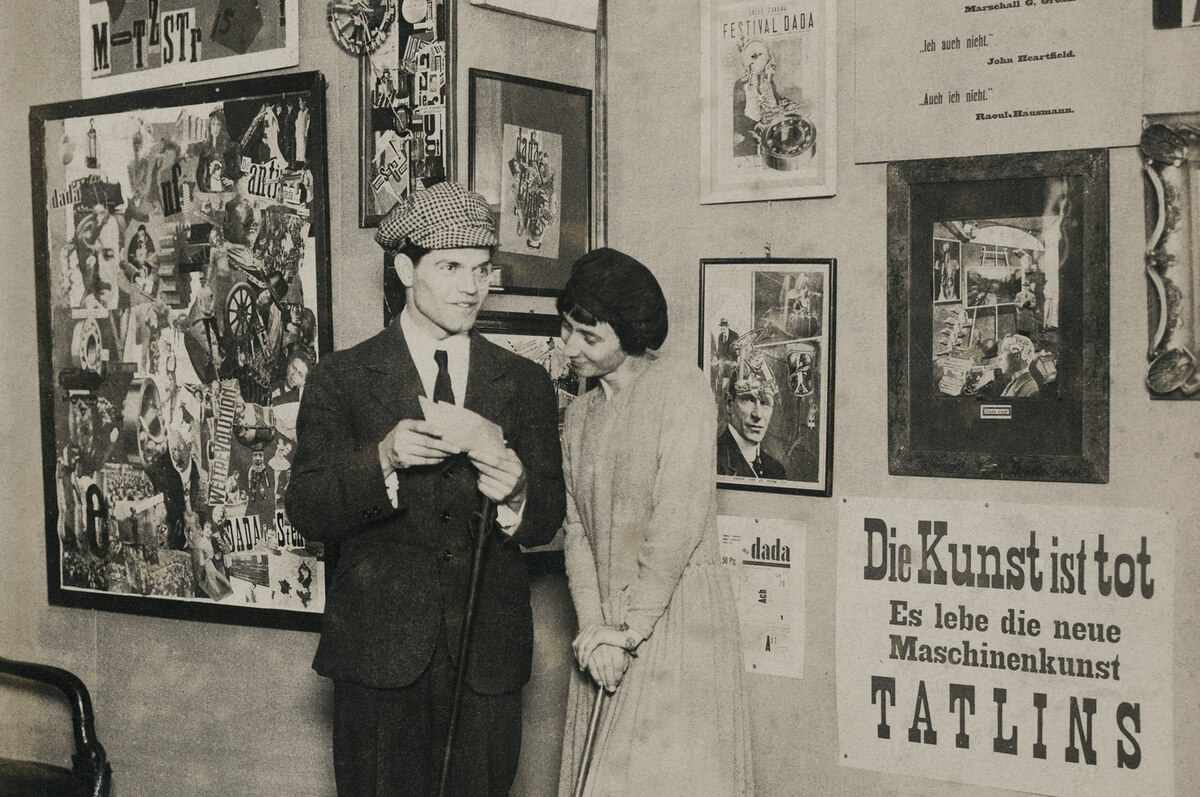
Painter, photo montager, inventor, photographer, fashion theorist, writer, dancer, performer – there is no artistic field in which Raoul Hausmann, one of the central figures in German art history after the First World War, has not tried his hand. As a radically innovative style pluralist with exuberant self-confidence despite a lifelong lack of financial success and with ostensibly liberal views, as long as they only applied to himself and not to his partners, Hausmann would have fit wonderfully into today’s times.
In the retrospective “Raoul Hausmann – visionary, provocateur and big ego”, the Berlinische Galerie, led by curator Ralf Burmeister, is now paying tribute to the modernity and changeability of this thoroughly ambivalent artist of life, the tribute that Hausmann primarily attributed to himself throughout his life: “PS,” he informed his fellow artist Wolf Vostell, forty years his junior and associated with the Fluxus movement, in an exchange of letters in 1967, around five years before his death: “I invented 1) Photomontage / 2) Decollage / 3) Sound (letter) poem / 4) Optophone”.
In this way, the productive egocentric skillfully wrote himself into art history: Hausmann, as a so-called Dadasoph, was a co-founder of the Berliners Dada movementalways considered himself and his creations to be avant-garde. Completely disillusioned by the horrors and aftermath of the First World War, he shouted in Dada collages such as “Finally unlock your head!” to dismantle everything that has been established. To do this, he developed the principle of photomontage: sound poems that intertwine seeing and hearing to deconstruct familiar language and he even invented a synesthetic perception device called the optophone. This should transform images into sounds and vice versa.
The exhibition
Raoul Hausmann: “Vision. Provocation. Dada.” Berlinische Galerie, Berlin, until March 16th
The fact that the Optophone never came onto the market and that other Dada colleagues also claimed a share in the discovery of photomontage did not affect Hausmann’s self-image as an inventive artist. And so it is not surprising that one of the most influential photographers of the 20th century, August Sander, photographed Hausmann three times: “Inventor and Dadaist” from 1929 shows the actually anti-bourgeois Hausmann impeccably dressed in a suit, tie and monocle. In a second photo, Hausmann poses in a decidedly cosmopolitan way: shirtless, wearing self-designed “Oxford pants,” he holds two women in his arms – his second wife Hedwig Mankiewitz on the left, his partner Vera Broïdo on the right.
200 works exhibited
The tour through the two hundred exhibition exhibits, arranged chronologically in seven chapters, is an exercise in tolerance for ambiguity: Hausmann was able to naturally see and act as an anarchist artist at a young age, primarily because his wives and partners, all of whom were also artists, constantly brought home the money.
His first wife, Elfriede Schaeffer, with whom he had their daughter Vera Hausmann when he was just twenty-one, earned bread for the family as a violin teacher. Hannah Höchwith whom Hausmann lived for seven years during his marriage, but for whom he refused to leave his wife, was a draftsman at Ullstein. Hausmann’s second wife, Hedwig Mankiewitz, came from a wealthy Jewish family. Hausmann went into exile with her and Vera Broïdo, also Jewish, in 1933.
The retrospective addresses the contradictions in Hausmann’s life credo of “being honest without hesitation” by showing the role of women in Hausmann’s life and art: they were his sponsors, inspirers, archivists and estate administrators.
Raoul Hausmann, “ABCD”, 1923/24, Musée national d’art moderne, Center Georges Pompidou, Paris, graphic collection, purchased in 1974
Photo:
VG Bild-Kunst, Bonn 2025, Repro: bpk/CNAC – MNAM
Höch’s self-portrait “Woman and Saturn” from 1922, which can be seen in the exhibition area “‘Mr. I’ (as the Dada historiographer Hans Richter called Hausmann) and the others” and in which Höch makes the subject of her two abortions during her relationship with Hausmann, is just as stirring as a letter documented there from Hausmann to his daughter Vera, in which her “raven father” asks her, “hoping for understanding”, to do so. to cede her inheritance to his last partner Marthe Prévot.
Hausmann had lived with Prévot in Limoges, France, since 1944. After his death on February 1, 1971, she also ensured that his late work survived. “My relationship with Hausmann” and its strange charm is summarized by Dada colleague Kurt Schwitters (whose Ursonata the Deutsches Theater Berlin currently reinterpreted) in a letter to Hannah Höch from 1922 as follows. “It will always be like this: that when I need him – I am there for him!”