

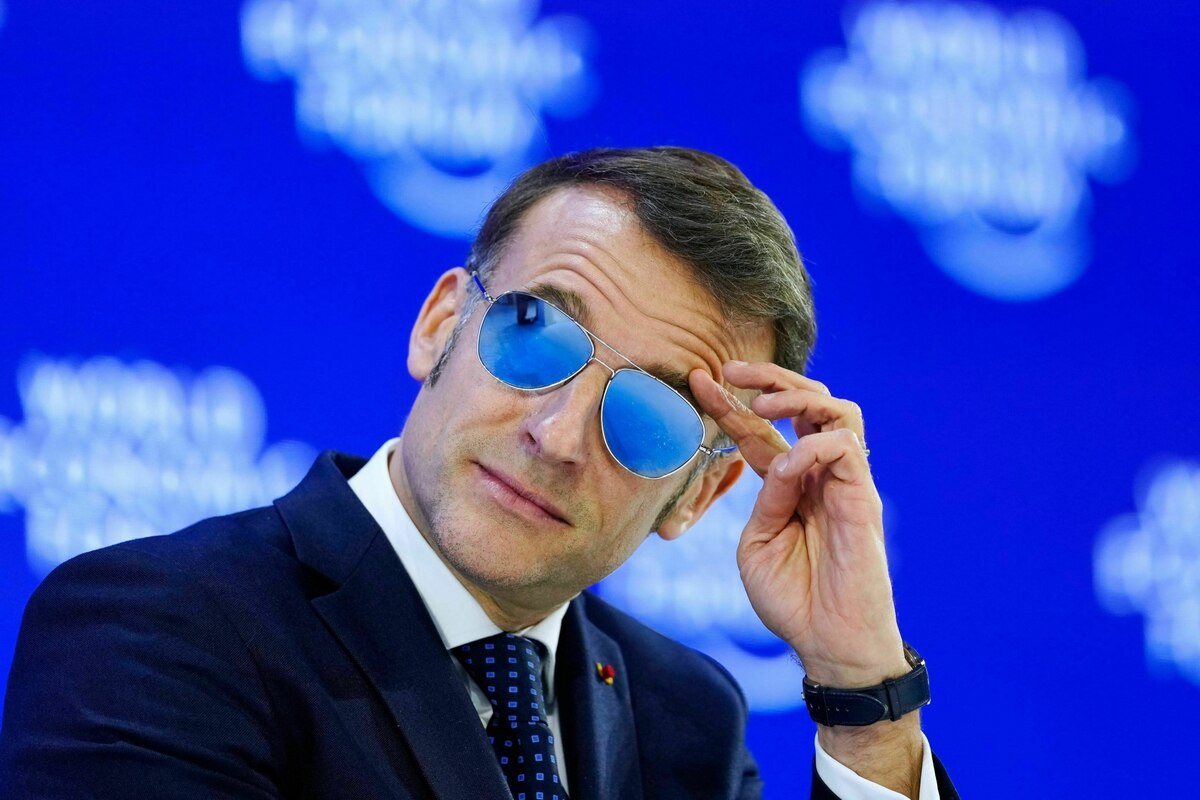
The World Economic Forum in Davos on Tuesday was the opportunity for French President Emmanuel Macron to respond with unprecedented sharpness to new aggressive statements from US President Donald Trump. He has not digested the criticism from Europe of his idea of a “peace council” and has threatened, in particular, with punitive tariffs of 200 percent for French wine and champagne imports. That couldn’t go unchallenged.
Macron protested in Davos that he preferred “the rule of law to brutality.” “We do not want a world order that is decided by those who believe they have the louder voice and the stronger stick.” Without naming anyone, he warned against annexation plans: “We have no time to waste with crazy ideas, we must not open Pandora’s box.”
Trump had previously published a text message from Macron on his Truth Social network. Since this short message was not normally intended for the public, the question arises as to whether Trump wanted to ensure more transparency in the diplomatic tug-of-war or rather highlight Macron’s contradictions and embarrass him. The presidential office in Paris confirmed the authenticity of the message, but did not comment further.
In Europe, Macron currently has the role of a spokesman for the resistance against Trump’s threat to annex Greenland. Together with other European states, Macron has not only sent a first delegation of elite soldiers to Danish territory, but has also announced reinforcements with troops from all branches of the armed forces. He also firmly rejected Trump’s invitation to his “Peace Council”, be it for Gaza or even as a competitor to the UN.
Ingratiating feigned friendliness
His text message to Trump sounded much more conciliatory. “My friend,” he addresses the American confidentially and assures us that in many conflicts such as Syria or Iran he is completely “on the line” of the USA. Macron wrote with mock naivety that he just doesn’t understand what Trump is doing in or with Greenland. You should be able to talk to each other among “friends” – without being threatened with sanctions if there are differences.
Macron suggested a Paris summit in G7 format for Thursday after the planned meeting in Davos. And to make it sound friendly, there was an invitation to dinner at the Elysée Palace before Trump’s return flight. But neither will happen now.
It is typical of Macron’s struggle for diplomatic clout that he also wanted to invite “the Russians” “on the sidelines” of the planned meeting in Paris. He plays this card again and again so that France is still taken seriously in the poker of the great powers or at least noticed on the world stage. Even if Macron offends his EU and NATO partners, he has repeatedly sought talks with Vladimir Putin. But so far he has achieved nothing with his telephone diplomacy.
Trump mocks the French president’s efforts to act as Europe’s leader and demand Europe’s independence in defense. The US President had imitated Macron and thus made him look ridiculous. So he publicly showed what contempt he has for France’s president. Macron won’t resist him for long, said Trump, because he won’t be in office much longer anyway, which is why no one wants to discuss things with him.
Macron’s domestic political situation is weakening him
None of this seems to discourage Macron, who finds himself forced into a diplomatic double game in front of and behind the scenes with sometimes contradictory tones and positions. In addition, he is very weakened domestically, which does not promote the credibility of his foreign policy, as Trump maliciously emphasizes.
Macron’s chummy texting tone contrasts with his advances in the EU. In response to Trump, he wants a counter-threat of a closed Europe with the “bazooka” of the anti-coercion instrument (ACI), which would have to be decided by the member states with a qualitative majority. It is still unclear which Macron can achieve more or achieve anything at all: the flattering friend or the offensive opponent.