

This Thursday is a big day for American Catholics. The first beatification to take place on U.S. soil in almost 10 years is happening in St. Louis, Missouri, in the afternoon. For those not familiar with the Vatican’s lexicon, a beatification is the penultimate step on the path to sainthood. To qualify, a person must have performed at least one miracle. (For canonization, the final step, two miracles must be verified.)
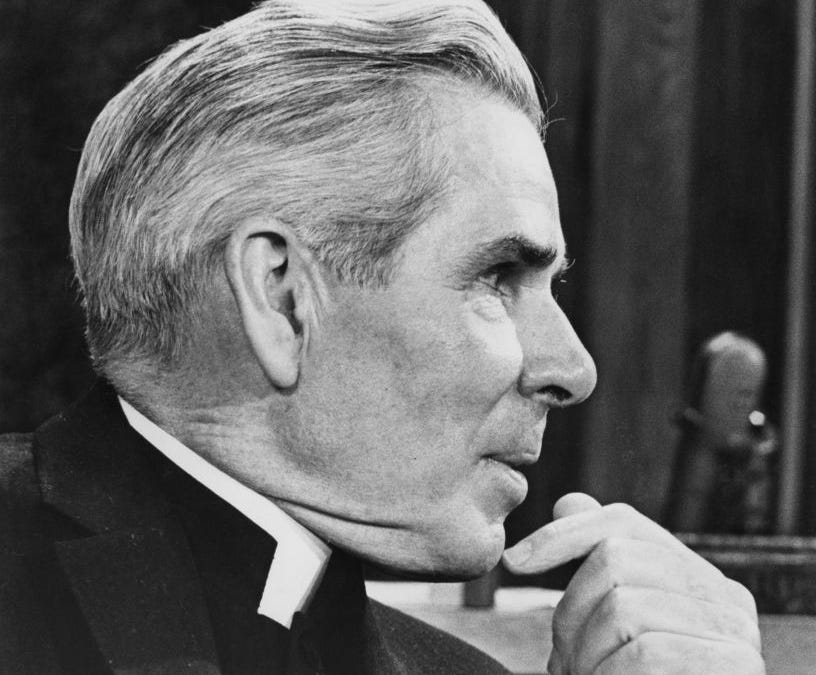
The man to be blessed this week is Venerable Fulton J. Sheen, who grew up a couple hours north, outside of Peoria, Illinois, where he was ordained a priest in 1919. By the ’50s, he was a household name. Whereas other preachers looked with suspicion on the new forms of evangelizing offered by the 20th century—namely, radio and television—Sheen embraced them.
He also, years later, inspired the man who is now one of our own era’s best-known multimedia bishops. It’s a pleasure to welcome Bishop Robert Barron, founder of the Catholic media empire Word on Fire, back to our pages, to reflect on why Fulton J. Sheen could be on his way to becoming America’s next saint. —The Editors

From the very beginning of my work in evangelization through the media, Fulton J. Sheen—whom the Church is declaring “Blessed” this week—has been my model and inspiration. At Word on Fire, he is one of our principal patrons and heavenly friends. Yet I first discovered his pioneering work on radio and television in a rather roundabout way—and thereupon hangs a tale.
Sheen was born on May 8, 1895, in El Paso, Illinois, about 30 miles east of Peoria, and less than 200 miles north of St. Louis, where his beatification takes place on Thursday. After entering the seminary and being ordained to the priesthood, he was dispatched for further studies in Washington, D.C., and, later, Belgium. But despite his intellect, he was not destined for a long career in academia. In 1930, he began to host a nationally broadcast radio program called The Catholic Hour. That cultural outreach expanded in 1950, when Sheen was approached for a prime-time program on network television. Life Is Worth Living, which aired throughout the 1950s, was born.
At the height of Sheen’s powers, he had an audience of 30 million viewers every Tuesday night and was competing against the likes of Milton Berle, Frank Sinatra, and Jackie Gleason. I remember once, when I was young, Sheen came up in conversation, and my father—an ardent Catholic and taciturn man—said from his chair, “I like what he said. I like the way he said it.” That laconic observation summed up how many Catholics of that generation felt about this great evangelist and intellectual. They looked at him with a great sense of pride and admiration.
Read more