
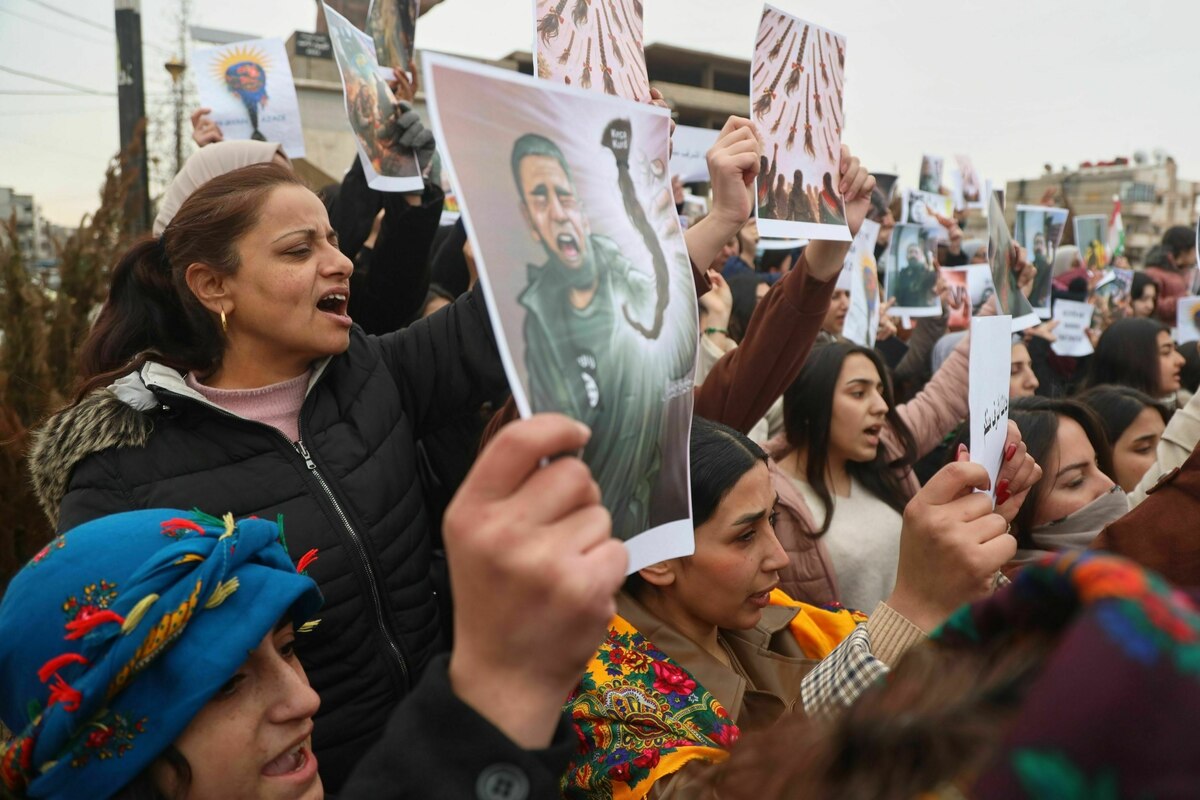
People in the cities of Al-Hasakah and Al-Qamishli have not slept for several nights. Not because of the usual noise of big cities, but because of a sense of unrest. An unrest that reigns over all houses. Which is reflected in the eyes that stare at the smartphone screens – waiting for new news.
News about an impending political agreement that could change the fate of the region: A four-day ceasefire began on Tuesday evening, which at least relatively pacified the fighting between the Kurdish self-administration in northeastern Syria and the central government in Damascus. In these four days, the two parties should agree on how to proceed. Soon they will expire.
We wake up at night. Not because we can’t sleep, but because we fear waking up in a new reality. Which sets us back years. Which undoes the hard path we have traveled over the last ten years.
What if?
As a Syrian Kurdish journalist living and working in northeastern Syria, what is happening around me is not just news footage. My job and my identity are intertwined. I’m trying to understand whether we are moving towards real stability – or not Repetition of old crises in a new form. Not just to give a good analysis. But also because I am personally affected.
The failure of negotiations on the implementation of the Agreement of March 10, 2025 between the Syrian interim government in Damascus and the Kurdish-dominated Syrian Democratic Forces (SDF) many residents of the region saw it as a setback. But that’s not all: this failure was perceived as the beginning of a new phase of uncertainty. This was quickly reflected in the actual security situation.
We Kurds do not want our areas to become a new war zone
In recent days, we have witnessed Syrian government forces wresting more and more territory from SDF fighters in the areas of Raqqa and Deir ez-Zor. The Kurdish leadership tried to present the fact that the SDF lost areas as a conscious decision: they wanted to end bloodshed and avoid a large-scale confrontation, according to the statement.
As a journalist, however, I see this justification as part of a political narrative that tries to come to terms with losses. And as a person who lives in this region, this development worries me.
Our author loves Damascus, despite everything
In order to make my feelings as a Kurdish Syrian woman understandable, I have to take the readers with me to Damascus – before 2011. I was studying there at the time. I love this city. But their rulers at the time imposed their model on us: celebrating Nowruz was not completely forbidden under the now overthrown Assad dictatorship. But the celebrations were always accompanied by caution and fear. Our Kurdish language and our cultural programs were erased from the public space. There was no recognition under their presence. Our identity was only partially allowed.
When I moved from Damascus to Al-Hasakah after 2011, I realized what it means for my identity to be part of my everyday life. I saw Kurdish being written and taught in my native language. How it was used alongside Arabic not only in the markets but also in the institutions. I felt valued and recognized.
Today, I am growing increasingly concerned that any forced or ill-advised change could erase this uniqueness. That a monochrome era will be established again. That differences are no longer allowed.
How can we hold on to Syria if we fear it will marginalize us again?
“Our fear is based on experience”
What makes these days even more difficult, even more frightening for us are the photos and videos that reach us from other areas of Syria. They document how government-affiliated armed groups deal with their opponents, depicting brutal violence and extrajudicial killings. These scenes are not news from afar, but are understood as immediate warnings. Our fear is based on experience.
We Kurds do not call for confrontation and do not want our areas to become a new war zone. Our demand is a peaceful agreement that protects civilians and prevents new violence in this exhausted country.
Northeast Syria cannot be separated from the rest of the country. We as Syrian Kurds are not calling for secession or withdrawal from the state of Syria. Our demand has always been linked to rights: constitutional recognition of our identity, protection of language and culture, an end to the politics of marginalization.
The model of a rigid, centralized state that existed before 2011 cannot meet these demands. We ask ourselves: How can we hold on to Syria if we fear that it will marginalize us again?
Fear of a Kurdish-Arab conflict
One of my biggest concerns today is that Syria will slide into a Kurdish-Arab conflict. This region has long been known for its coexistence of Kurds, tribes and Syrians. But if the Kurdish question turns from a human rights issue into an identity conflict, the social fabric is in great danger.
What we as Kurds are striving for are not special privileges. Ultimately, we are all Syrians and have all suffered from oppression and deprivation, regardless of our affiliation. Perhaps the challenge today is to move from a logic of dominance to a logic of partnership. From simply overcoming fear to building trust.
The experiences of the past will not fade easily. The language spoken by an entire generation cannot be erased by a political decision. But while we wait for a decision, we are betting that dialogue will prevail over the sound of guns.
Translation from Arabic (with the help of AI): Lisa Schneider
The author is an alumni of the Workshops „Her Turn II“ the taz Panther Foundation.