

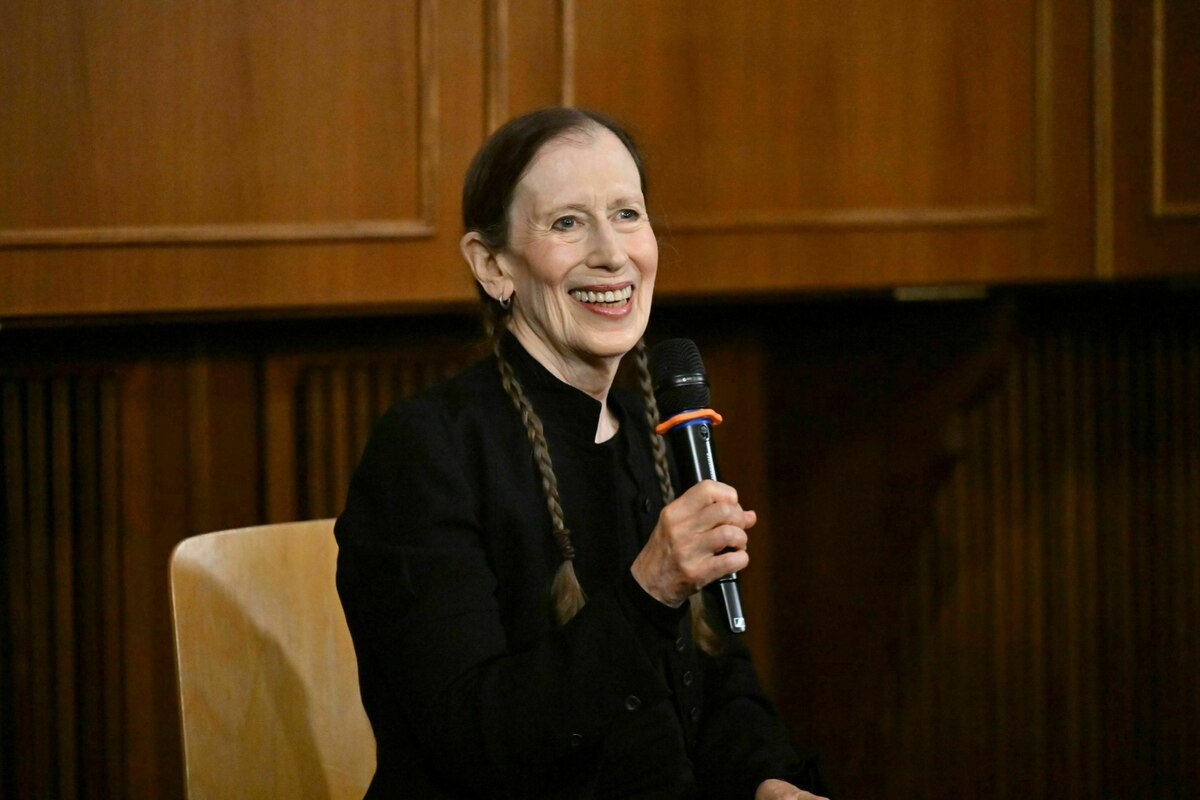
Slow breathing, swallowing, breathing, screaming, falling silent: That’s what Meredith Monk sounds like on her album “Impermanence” from 2008. It particularly characteristically shows Monk’s art of “extended vocal technique”, with sound gestures such as humming, croaking, panting, laughing as well as throat sounds (vocal fry) and falsetto, with rapid changes of yodeling and trills. She describes her syllables without a specific meaning as “phonemes”: sound images that she sees as “poetry of the senses”.
On the occasion of Monk’s 60th stage anniversary last year, the Berlin Academy of the Arts announced on Wednesday that Monk would be awarded the Berlin Grand Art Prize this year. The prize is awarded annually in six different sections and is endowed with 15,000 euros. It was founded in 1948 by the Berlin magistrate in memory of the March Revolution of 1848 in order to emphasize the special importance of the arts for a free society.
It is another honor for the now 83-year-old performance and vocal artist Monk, who was awarded the “National Medal of Arts“, the highest artistic honor in the USA. In 2024, the Munich Haus der Kunst showed her video works and installations in a large overview of her works under the title “Calling”, and in October 2025 she took up the Pina Bausch Professorship at the Folkwang University of the Arts in Essen.
Alternative methods of spatial perception
Born in New York in 1942, Meredith Jane Monk began her first performances and vocal experiments in the Fluxus and Happening movement of the New York downtown scene in the mid-1960s; her voice covered three octaves. In 1964, at the age of 22, she moved to the derelict neighborhood below 14th Street. The rents are low and she meets like-minded artists like Laurie Anderson, Trisha Brown and Joan Jonas. She performs her performances in empty factory buildings or in private apartments.
As a child she suffered from a visual impairment and developed with the help of it Dalcroze-Eurhythmie alternative methods of spatial perception through rhythmic movement and ear training. She addresses this in feminist works such as “16 mm Earrings(1966) by playing with female role models from fairy tales and Wilhelm Reich’s theory about the male orgasm recites. In the performance “Juice” she works metaphorically with menstrual blood.
“I work in the cracks”
In 1968 she founded her organization “The House” to promote interdisciplinary performances and in 1978 she founded her “Vocal Ensemble”, which still exists today. She writes operatic works and begins her ongoing series “Shrines” in 1981, based on Buddhist spiritual shrines in which she addresses environmental issues. Last published in 2023 “Songs of Ascension Shrine“, a performance at the Oliver Ranch in California with two staircases as a double helix. In a podcast from National Endowment of the Arts, which Trump now wants to liquidateshe said of her work: “I work in the cracks, where the voice begins to dance, where the body begins to sing, where theater becomes cinema.”
On March 21, 2026, her work will be honored as part of the opening weekend of the MaerzMusik festival. With a concert with Meredith Monk as well as the documentary “Monk in Pieces” (2025) and her own film “Book of Days” (1988).