

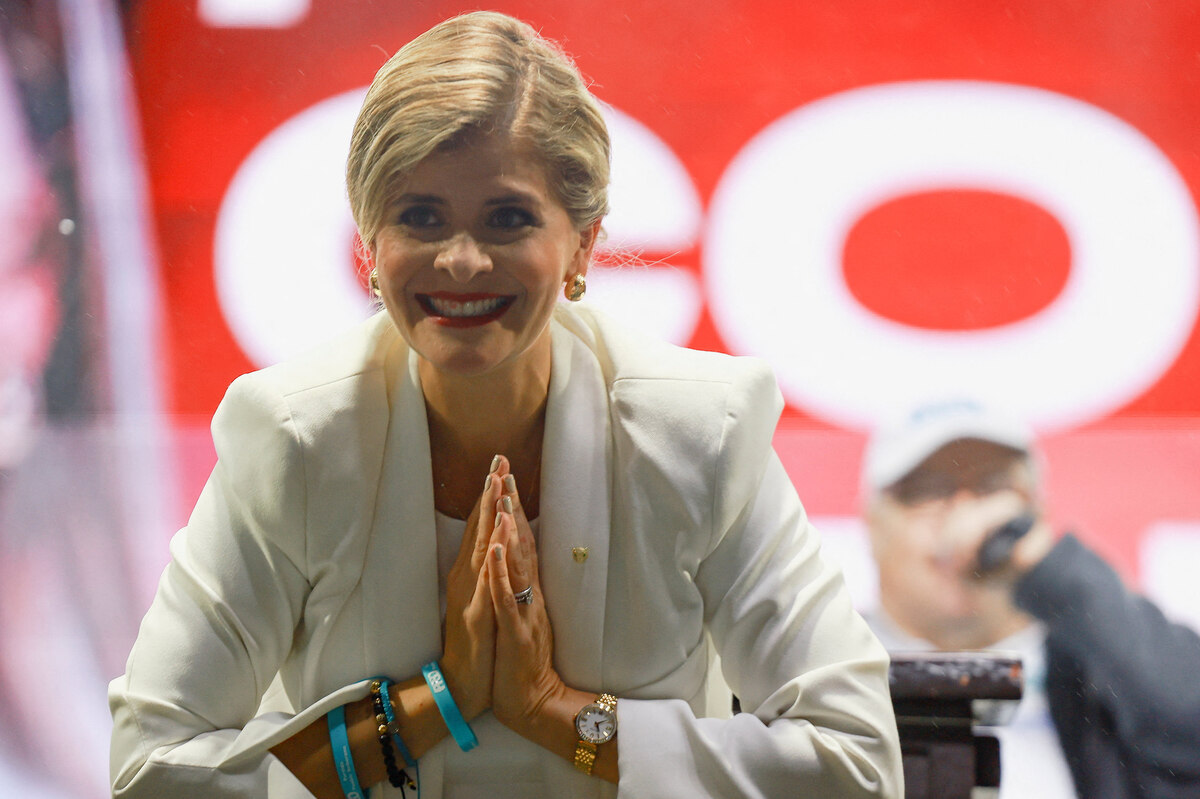
The result is still preliminary, but after almost 88 percent of the votes were counted, Laura Fernández is ahead with almost 49 percent of the votes, according to the Supreme Electoral Tribunal (TSE). The conservative candidate, a party friend of the incumbent President Rodrigo Chaves, will most likely win the presidential elections in Costa Rica in the first round. To win the first round, at least 40 percent is required, which the candidate from the Sovereign People’s Party (PPSO) easily exceeds.
Her strongest rival, the liberal-conservative economist Álvaro Ramos, received around 33 percent of the vote and has already conceded defeat. The Coalition Agenda Ciudadana follows behind with 4.48 percent and the left-wing alliance Frente Amplio with 3.53 percent. Voter turnout was significantly higher at 69 percent in the election of outgoing President Rodrigo Chaves four years ago.
He is considered the president-elect’s mentor. She promised her predecessor that she would “fight tirelessly” to ensure that Costa Rica continues “on the path of economic growth, freedom and, above all, progress.” The 39-year-old political scientist Fernández, who has so far been in the shadow of President Chaves, stands above all for continuity. She was a member of the cabinet as Minister for Economic Affairs and Development Planning between 2022 and 2025 and has experience in development cooperation, including with the German Society for International Cooperation (GIZ).
However, Fernández has stayed in the background; she is not a strong personality like her polarizing mentor Rodrigo Chaves, according to analysts such as political scientist Tanía Rodríguez from the University of Costa Rica in San José. Another indication of this is the fact that Fernández avoided election debates in the run-up to the election and her government program is vague and general.
Congratulations from El Salvador
Laura Fernández was among the first to congratulate her on Sunday night Nayib Bukele, authoritarian president of El Salvadorwho, alongside Rodrigo Chaves, laid the foundation stone for a high-security prison based on the Salvadoran model a few weeks ago. Bukele, who presents himself as a successful fighter against gang crime in Central America, but relies on mass incarceration without constitutional guarantees, is seen as a role model in Costa Rica, precisely because the once stable country is suffering from increasing drug crime, a high murder rate and violence.
This fuels fears that Rodrigo Chaves served. He has portrayed himself as a strong doer, but he has also been accused of corruption and restricting press freedom. Laura Fernández may now protect him from investigations with a position in her cabinet. It will soon become clear whether she will act like her mentor against the state institutions, which he accused of rigid structures and incompetence.
For Didier Leitón, a trade unionist in the country’s plantation sector, the ruling party, which will have around 30 seats out of 57 in parliament, has an anti-union stance. “We have nothing to expect from this government,” he says, pointing to the weakening of the judiciary under Chaves.