

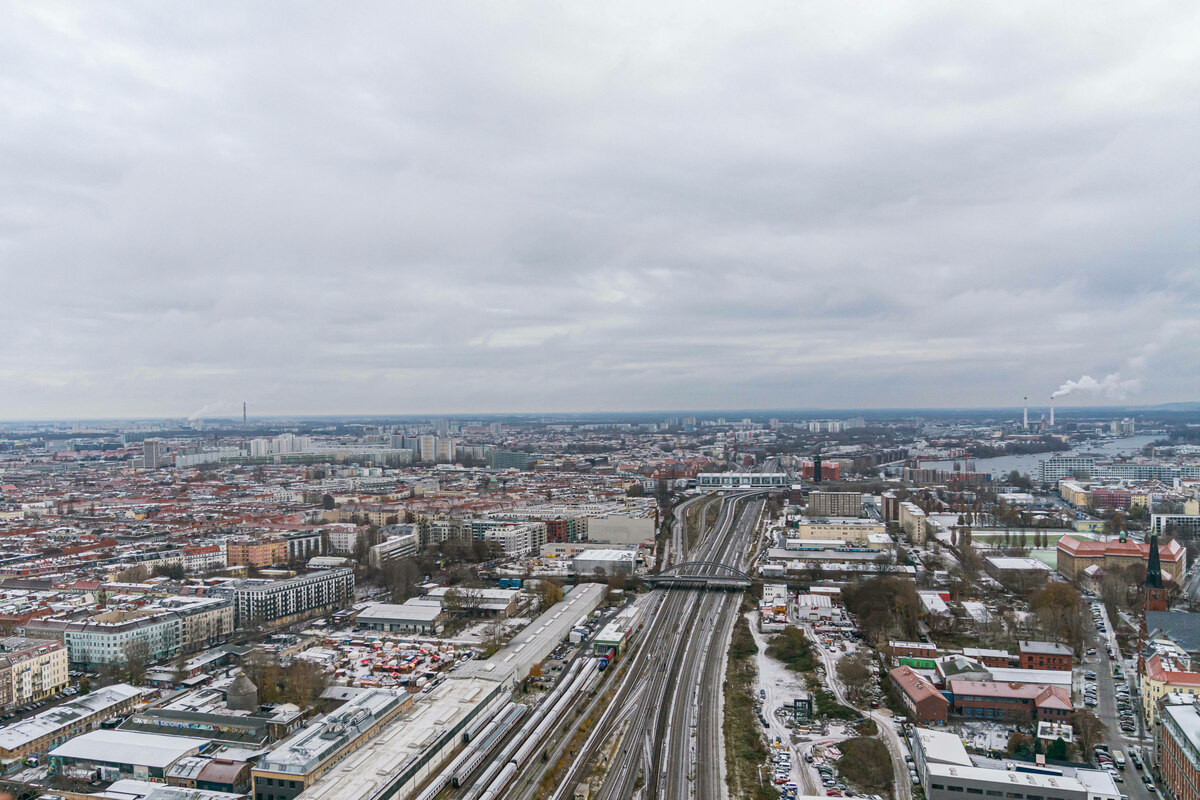
M Take the S-Bahn and look at the panorama of Berlin: a short break for €4. There are days when I need this, the view of this city that I love and hate. The gaze keeps everything at a distance. The problems of my small life disappear behind the big facades.
Like in Robert Altman’s films, where everything takes place at the same time without ever touching: main things, dialogue, secondary things.
The S-Bahn stops at Ostkreuz. The huge buildings are empty. Homeless people live in front of it. They hang around without a plot, like a cool arrangement of characters.
A city like a body without organs. The fuller it is, the emptier it becomes. So much space for slick offices with white light, so little for, I dunno, public paths right on the water.
Maybe this emptiness irritates me because I’m looking for closeness and at the same time shy away from it. I get out and let the escalator guide me down. My body knows this movement: get an overview, there is the world, there I am, don’t attract attention. Distance as a learned attitude. practiced, when someone asks me for money and all I can say is: sorry, unfortunately not. I feel it all over my body. The private no as a cog in a machine of denial of responsibility. This cold is a well-kept tradition in this country: order is more important than closeness. Your compliance will be particularly rewarded.
Here I am that guy in the corner
The other day I was in this new bar. It was early evening. Attractive queer women in exquisite vintage pieces examine me. Cute predators with controlled instincts. It makes me nervous at first, then it relaxes me.
It’s not this look that keeps me at a distance from the city. It is a look that allows closeness. It frees me from the pressure of having to portray something. Here I am that guy in the corner. Doesn’t understand being. Doesn’t even drink beer at the bar. Misses tenderness without conditions. Loves pathos for his false promises, but is a master at cuddling. This closeness costs nothing.
Recently I have the poet Stella Nyanzi met in Bern. I invited her to the Norient Festival. We sit at a large table eating. There is a shimmering energy in the room – we have a long poetry night ahead of us. I sit next to Stella. She apologizes for eating so slowly when we have to leave soon. She laughs. And tells. From arriving by train from Berlin, where she lives. And of eighteen months in a maximum security prison in Uganda. Because of a poem against the president. We talk about it very casually.
It’s like my view of the panorama. The casualness also somehow keeps us at a distance. Language creates closeness without touching.
The bar, the empty buildings and Nyanzi. Three situations following the same pattern. In the bar, proximity costs nothing. It doesn’t take place in front of the empty buildings. With Stella, words had consequences. The poet CA Conrad once said: Whenever you don’t say something that you actually want to say, a part of you dies. Maybe that’s why I like talking to ChatGPT so much: Nothing dies if something isn’t said. And the dead words live on – as common sense.