

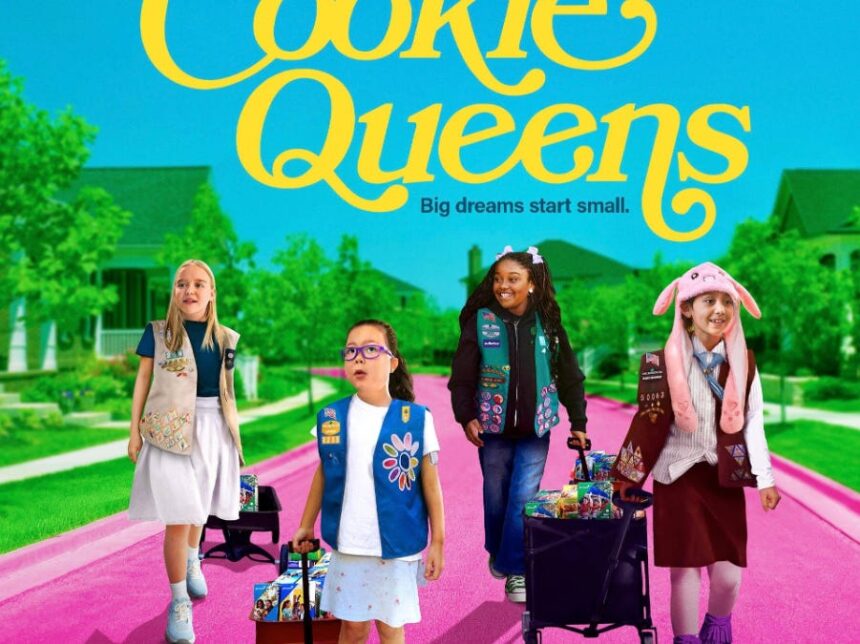
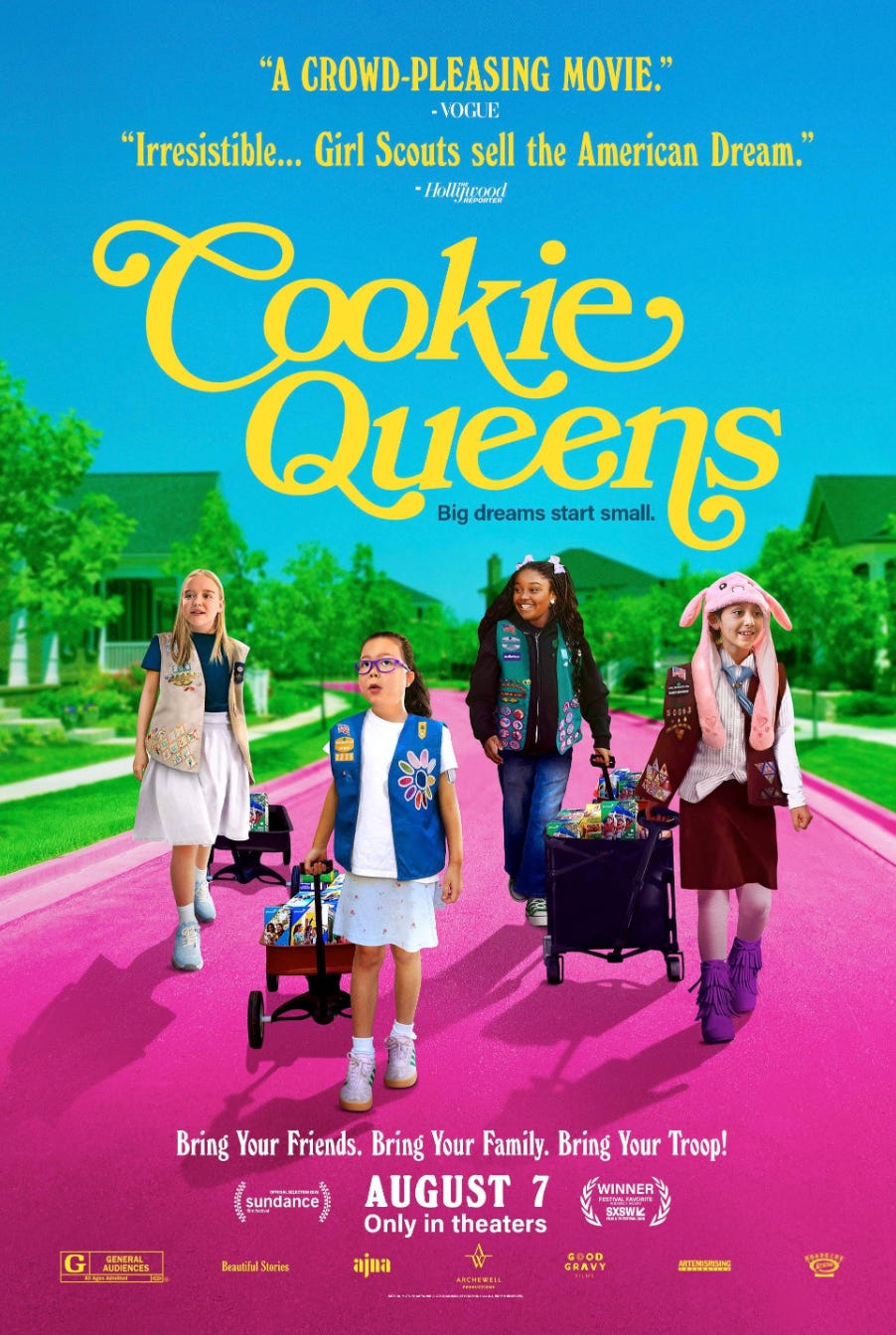
In this vHopeful Conversation, I speak with Emmy Award-winning filmmaker Alysa Nahmias about Cookie Queens, her joyful, incisive documentary following four Girl Scouts through the high-stakes world of cookie-selling season. What begins as a lively look at an $800 million enterprise becomes a rich coming-of-age portrait of ambition, friendship, family, class, confidence, performance, and the early lessons girls absorb about value, success, femininity, and power. Alysa shares how a challenge from her own children inspired her to make a documentary that could engage younger audiences, how she found the film’s remarkable young protagonists, why she chose an immersive observational style rather than talking heads, and how each girl’s personal definition of success became the film’s real dramatic engine. We also discuss the complicated economics behind Girl Scout cookies, the pressure girls can feel to perform and achieve, and the importance of letting them be both wise beyond their years and fully, joyfully themselves.
Transcript lightly edited. Podcast available on Apple, Spotify or wherever you listen on this Substack or Ted’s Hope for Film
Vanessa Hope I’m very excited to be joined by Emmy Award-winning filmmaker Alysa Nahmias. Her films, including Art & Krimes by Krimes, The New Bauhaus, and Unfinished Spaces, explore how people create meaning, identity, and possibility within the worlds they inhabit.
Her new film, in theaters for four weeks, which we are so excited to discuss, is called Cookie Queens, and it follows four Girl Scouts through the heightened ritual of cookie-selling season, capturing its humor, hustle, family dynamics, and unexpected emotional stakes. Alysa, it’s such a pleasure to have you here. Thank you for joining.
Alysa Nahmias Thanks for having me, Vanessa. I’m so happy to be with you, and such an admirer of these conversations with other filmmakers, so it’s an honor.
Vanessa That’s so kind. Well, and you were right, as we were discussing beforehand: there are a lot of filmmakers who listen in and care about how people make the amazing films they do. And especially with your new film, Cookie Queens, you were saying it’s such an incredibly joyful experience in theaters. People are sharing their laughter and tears, maybe. I don’t know—it’s a very emotional story.
Alysa Yeah.
Vanessa But let’s start at the beginning. How did you choose to tell this story and find your Girl Scouts?
Alysa Well, as you said, my last films were focused on art and politics and kind of different worlds, which is part of what the magic of documentary is: that we get to do that. My kids actually, at the time, were nine and eleven. They watched my last film, Art & Krimes by Krimes, and also Wildcat, which I produced, and they were like, “Mom, they’re really good. We liked them, but next time, could you make films that we actually want to share with our friends?”
I laughed a little bit in the moment, but then I was like, that’s actually an interesting challenge as a nonfiction filmmaker. Like, how can I make work that satisfies me creatively and also can reach all-ages audiences and build a new generation of nonfiction viewers for cinema? Not that I would do that single-handedly, but I appreciated the challenge, you know?
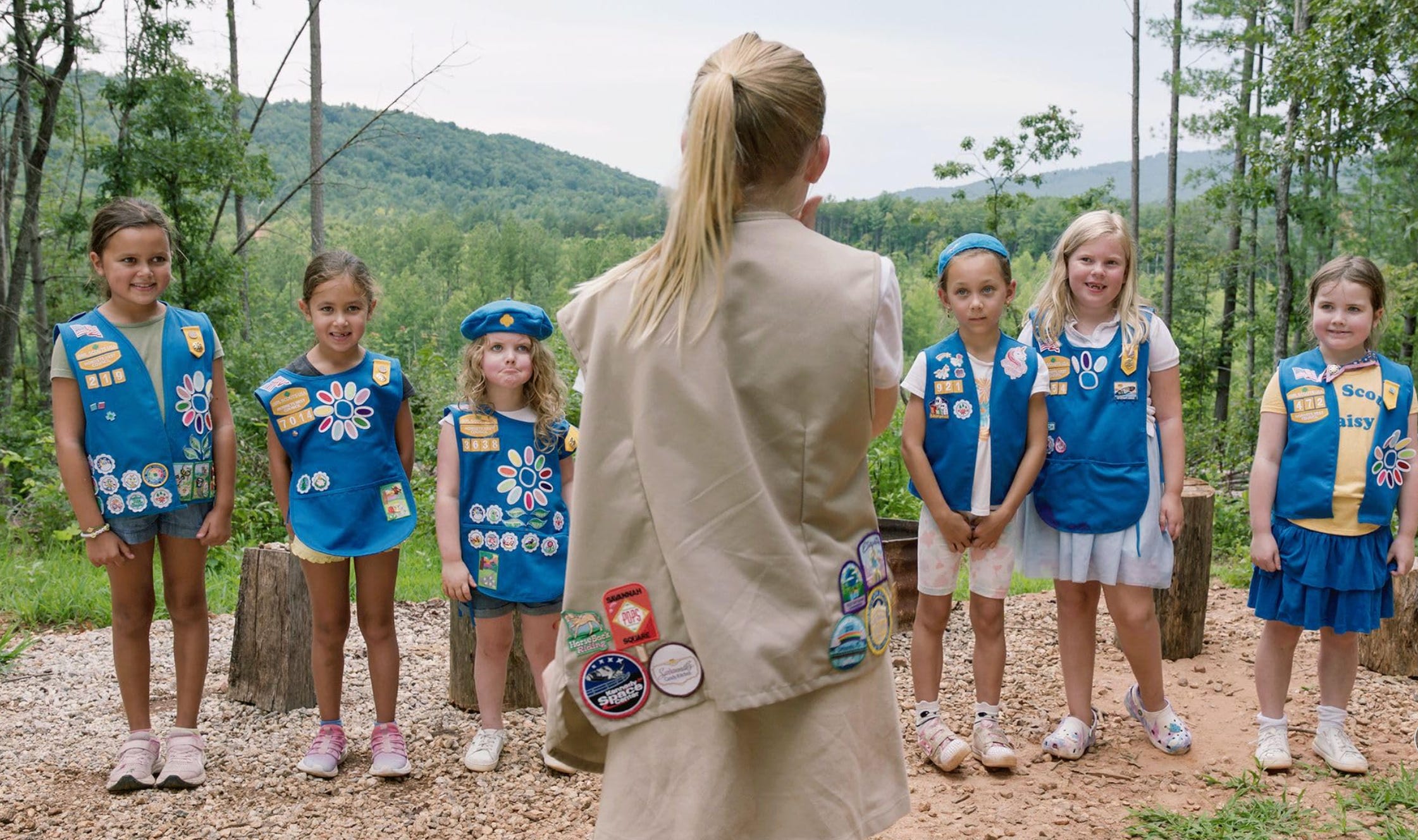
Vanessa It’s such an important point, really. I grew up watching movies, and those movies—I mean, Spielberg comes to mind right away—but having a child in a movie helps a child connect with the story in a movie and want to see it.
Alysa Yeah. They say you have to see it to be it, you know? And I think—for documentary, I didn’t see my first one until college. I was fortunate to live in New York, where I could go to Anthology and Film Forum in college and see docs sometimes, but I think a lot of people don’t see them in a theater at all, and particularly not as kids.
So anyway, then when my producer was telling me about being sold a lot of Girl Scout cookies and this interesting visual world, the way he even told the story was actually really interesting to me because he talked about this young woman who was really cute and kind of unassuming, and she complimented his hair and all of that. And then, actually, she was really smart, she was super savvy, and he ended up emptying his wallet to buy all these cookies when her mom came around the corner.
And so I thought, you know, that’s so fascinating. I really relate to that. The way that the world sees girls and women and the way we know ourselves to be are not always in sync. And that was the interest: looking at the cookie sale as this microcosm of girls and women and the economy, and how we learn to operate in that, and how we learn how we’re seen, and all of that. So I thought this would be fun and entertaining and beautiful and funny, and also, for me, a really personal story that I thought both kids and adults could relate to.
Vanessa And you have quite a range of ages of Girl Scouts, from five to twelve…
Alysa Yeah, exactly. Well, and some of the older sisters are even older in the movie. Yeah, like sixteen.
Vanessa Yes, yeah. And I still wonder how you found them, because they’re all pretty adorable and different, and across the country. You must have traveled a lot. Maybe you auditioned a lot of girls.
Alysa Yeah. They’re all brilliant, and they have incredible imaginations. And one of the things I was looking for was that they would be a diverse ensemble. I knew I wanted to look at class, actually, and look at the ways that the playing field is not even, even in Girl Scout cookie sales—how it depends where you live, how many resources your family and community have.
So I knew I wanted a cross section—not an authoritative or exhaustive sample of American girlhood at all, but something that would give us a sense of that. And so I worked with an awesome casting producer, Whitney Adams, and my producing team—my producer Jen Sims. We all ended up looking at tons of casting videos.
We put out a very grassroots casting call, let’s say, basically in parent Facebook groups. Some Girl Scout councils helped us out, but the film is entirely independent. Girl Scouts was not involved in the production, although they knew about it. And we met with hundreds. Whitney probably met hundreds of girls on Zoom and families, and then I met with dozens. And then I did visit. So I went to visit, like, nine families in person, to spend a few days and get to know them and their troops and communities. And then from there, we ended up filming with seven to get the four in the film.
Vanessa Yeah, your four are very distinctive, and they all have, as you’ve said, different class backgrounds, different concerns, different levels of cookies that they can sell. Talk about how you chose these particular four in the end.
Alysa Yeah. I think, for me, the whole concept for the film was about the cookies, but totally not about the cookies. And so I knew from the start that it was going to kind of play with the subgenre of competition documentaries, because we don’t see, at the end, one girl win the competition on a stage where they all get together. That kind of thing wasn’t going to happen, as it does in, like, Girls State or Spellbound or some other amazing competition docs.
This had to be based on each girl’s own definition of what she wanted, and we had to care about each of those things equally, and understand that we could care about a girl pulling a wagon as much as we could care about a girl who wanted to be the reigning champ and keep her record.
And so I looked for inner journeys. Like, as I was talking with the girls and the parents, what are the challenges they’re going to face that have nothing to do with cookies, based on, like, you know, sisterhood? Like, does Nikki, for example, want to be like her older sisters so desperately?
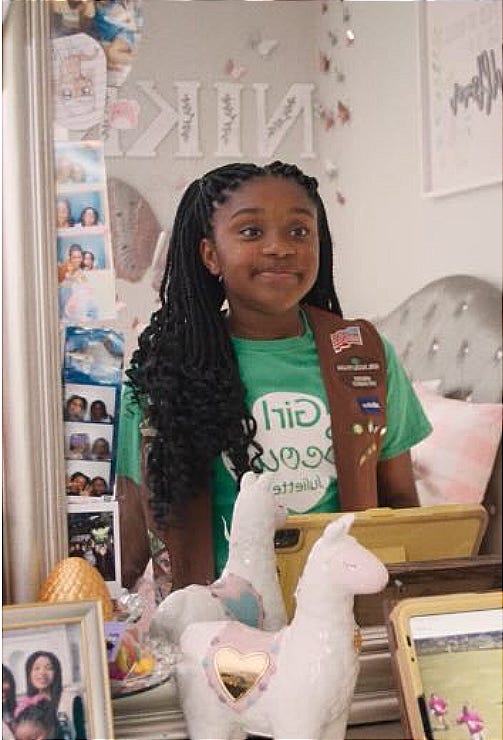
And I felt like those things are really universally relatable, and they speak to how we operate as humans within these kinds of economic structures and identities that are imposed on us and pressures that are imposed on us versus what we kind of generate ourselves. So that was a tension that I just feel as a person, and I was looking for also very different kinds of imagination.
Vanessa Yeah. Mm-hmm.
Alysa Like some more calculating and some more, differently creative—
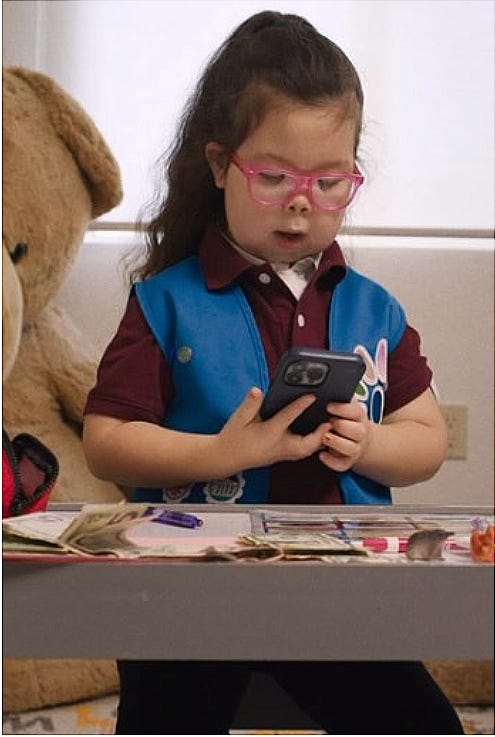
Vanessa Yes, like Ara, the five-year-old with type 1 diabetes who is so optimistic about what she can achieve and kind of bringing her parents along on the journey.
Whereas I think it’s Olive in North Carolina whose parents are, like, on it, in it with her, making the videos. Like, I’ve never seen so many boxes of cookies in any one person’s house.
I had no concept, to be honest, before watching your film, of how any of this worked. I’ve never met a Girl Scout selling Girl Scout cookies. And now I understand I can buy them online and all of that. But it’s a huge business and phenomenon, and each girl really approaches it in their own unique way.
Alysa Totally. And I think, you know, $800 million a year. Girl Scout cookies outsell Oreos and Chips Ahoy! combined in just six weeks annually.
Vanessa I like that. That’s a nice thing, I think, maybe.
Alysa Well, yeah. I think, as you see in the film, obviously the organization does a lot of good and has a lot of capacity, and so many kids benefit. And also, some of the girls have some interesting things to say about the split on that money. And I thought that was also fascinating to me: how early kids understand the economy. And Ara wants to master it almost like a game, you know? And it’s not a game.
It’s very serious. The stakes are so high for so many people. And yet also, because it is constructed, we all decide what has value and how things operate. That does mean that we can ask questions and make changes. And I think, you know, Olive and Celia and Nikki and some of the other Scouts in the film are really looking to say, “Well, what’s fair?” They’re asking smart questions about, “Well, we’re doing all the work. So where should the money go?” And I think those things are questions that are important for all of us to ask.
Vanessa Yeah. Does Ara actually feed a cookie to her stuffed animal?
Alysa Yes. She rehearsed—yes, I wanted to play with that. I loved how, in this concept, the girls are kind of performing already, right? So documentary—it’s very real, but we get to witness the reality of them performing and rehearsing.
And so I wanted to get at how each girl does that. Like, do they do it with their dolls, their toys? Do they do it with family members? Do they do videos? I was interested in it because performing femininity is something that we all learn how to do, whether we decide to do it or not.
Vanessa Yeah, right. And listen, I have to put on a little makeup for these videos, but I never did as a child. But I think it’s a new thing that younger and younger girls are learning they have to put on makeup. I mean, we see this in the film. This is—maybe it’s social media.
Alysa Yeah, I was super interested in that. Like, what are those ways that girls are learning: What does it mean to be a girl? What does it mean to be a woman? What does it mean to be a salesperson or a businessperson? And what does that look like for a girl?
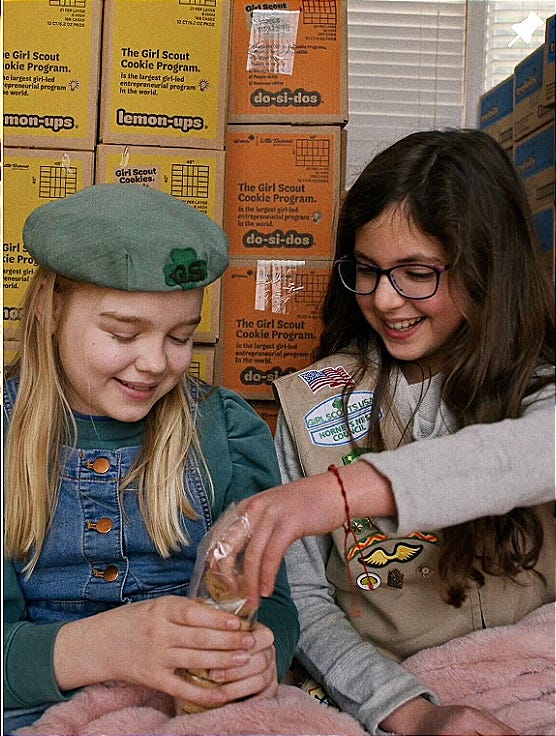
And they’re really not just rehearsing. They’re doing big business, like we were just saying. So that was shocking to me too, because I wasn’t a Girl Scout. My mom was, and it’s actually one in three American women have been a Girl Scout at some point in their lives. It’s a huge number of people.
And so I thought it was interesting to look at, visually, how girls are learning that and performing that and sharing wisdom or difficulties and pressures that they face around anything from makeup to success and identity.
Vanessa Yeah, and the Native American girl who’s in Texas, Shannon Elizabeth—it was a little nail-biting. We were concerned, like, what if she can’t sell the cookies and they’re stuck with some debt from having taken on the cookies? You were following in real time. As a filmmaker, you were not knowing what the outcome would be.
Alysa We didn’t know what the outcome would be for any of the girls. And that was one of the things I knew with Shannon Elizabeth’s story, is that her mom’s a teacher, her stepdad works in accounting, like in a big company—but they’re a sort of blue-collar, middle-class family, and they are really wanting their kid to go to camp, and she really wants it. And it means so much to them.
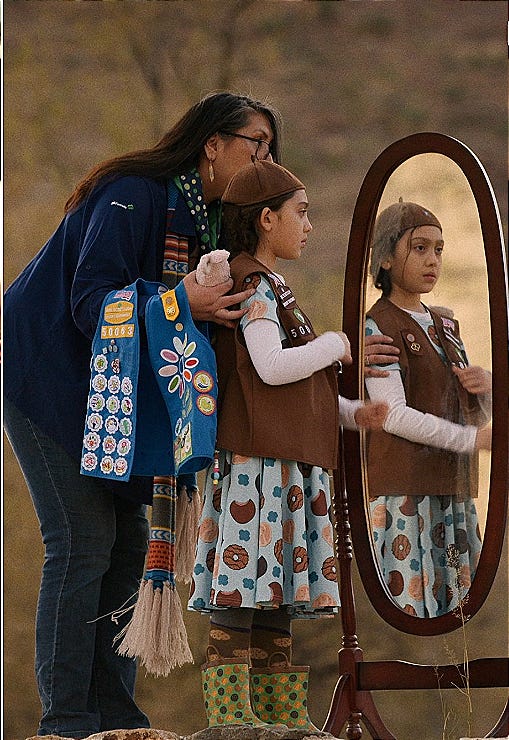
And I think there’s a way that that story is emblematic of so much that American families struggle with, where it’s like, somehow we can feel it so viscerally with the cookies. Like, why can’t they do this? Why is it that they’re going to owe the money if they can’t pay it? Like, can’t she just go to camp? Can’t we find a way for her to go to camp?
And I think that’s so important to feel, because it’s true not just for cookies, but for health care, education, you know, all of these things that American families want to be able to provide for our children. And it’s difficult, and we have to find creative ways sometimes. And oftentimes families do go into debt, not just for cookies.
And so I think that is something that’s so real to me. And somehow, with the cookies, we can get really furious about it. And I hope that people can feel that furiousness about other things too.
Vanessa Yeah. And so you chose, in your beautiful producing of this film—and you’re a great documentary producer with many producing credits—but you made this decision not to have talking heads, no one outside of the story itself. The girls, you’re with them in real time, and you’re getting inside their heads. You know, you interview them about their concerns.
What are we to understand about this bigger picture of Girl Scouts as an organization? I learned a lot about what it does for each of these girls. Have they kind of consolidated data or something about lessons, or is it mostly about leadership for girls? What comes out of being a Girl Scout for most girls?
Alysa Well, I can’t speak for Girl Scouts, the organization. I don’t know what comes up for most girls, but I think what I witnessed, just as a filmmaker spending time as a director with girls and families, is that at the troop level, when you have parents engaged with kids’ lives and volunteers who are really devoted to these troops, and girls who have a safe space to grow up together and to trust each other and to take risks together, and they can mix with girls who are different ages or different schools or different parts of town, like, that’s really important.
It seems like that is creating a kind of resilience and a kind of community that’s really important for young people. And Girl Scouts is a place where that can happen, that I’ve seen. I’ve also seen it myself when I was growing up on my soccer team, you know, and I think kids and families can find that in different ways.
I really wanted the film to be about girlhood. As a director, I was interested in that visual, visceral, emotional experience that was universally relatable, whether you’re a Girl Scout or not. And so, to be able to have it all observational, all present tense, I didn’t even do interviews. It’s not like they aren’t in the film—we just didn’t do them.
And my cinematographer, Antonio Cisneros, is such a talent, and he would get down low. We had, like, a stool—we had all kinds of things where he could be in their world, so that the parents were framed out a lot. I almost never wanted to be only with parents. It was always about the girls’ point of view and the girls’ understanding.
Vanessa Mm-hmm. Yeah. And you really get the girls to open up to you. It feels like they connected, like you built a bond, and it gets very intimate. Like, Olive sharing that her parents are maybe too into the cookie season. And it’s such a big deal how many cookies she sells—she gets on local television news—
Alysa Yeah, she’s the record holder in her area, and so I was interested in that. Like, what does it mean to have that looming over you? That, you know, even as a filmmaker, my last film was really great. What do I do now? Do I try to make a better one? Do I try to—you know, you won this award, what’s next?
And she’s only twelve years old, but she’s grappling with that, right? And I think people can relate to that in any way. And she confronts the authority figures in her life, both the head of her Girl Scout Council, the CEO, and also her parents, to say, “Look, this is a challenge I’m facing. I’m doing all this work, and I can’t tell if the pressure’s coming from me or coming from you or both.”
And that’s something that, yeah, it took a lot of time and trust. That was toward the end of the season. We’d been filming for weeks and weeks, and my crew of five people, we filmed all of it. So I didn’t set a crew in different places. I wanted to be there as the director in every room, and have my cinematographer and my producer—we really wanted to build that trust. We spent a lot of time off camera.
And I think that’s when the kids started to really just feel like we’re family, just as we feel for them. Like, I just called all of them to wish them happy back-to-school. You know, I have all these nieces now.
Vanessa That’s so sweet. That is so nice. I love that. That’s beautiful. I love the detail you capture of each of their characters. The way that, for example, Olive, who we were just talking about, you capture her at a school dance, kind of, like, having to teach the boy how to dance. Who’s leading who?
Alysa Yeah. Yeah, totally.
Vanessa Yeah, and Nikki having her older sisters in the Girl Scouts in such a successful way and wanting to be a part of it with them, wanting to dance with them when they’re doing their dance and then, you know, the discrimination. Shannon Elizabeth is so cute with her karate.
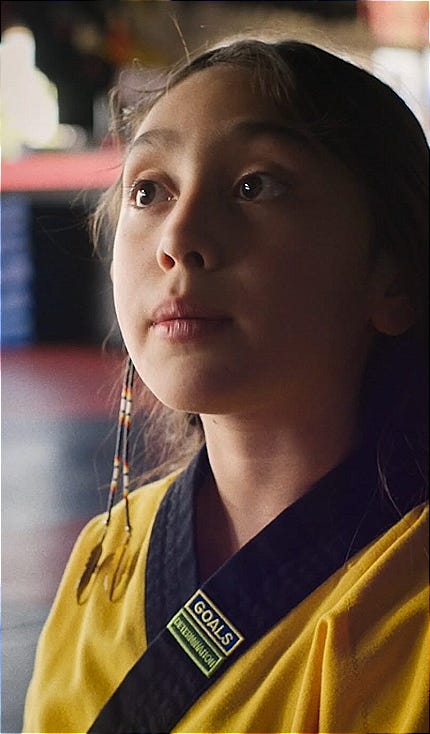
Alysa We do karate with Shannon Elizabeth. So, well, for me, a lot of that was about—I wanted to film with each of the girls in non-Girl Scout, non-cookie activities so that we could understand them a little more three-dimensionally, and also to see girlhood represented more three-dimensionally.
I don’t think we often see stories about girls where they’re either, like, grown up too quick or they’re, like, at-risk, vulnerable. And I was interested in letting girls be both. Letting them be, like, sometimes they’re like, in the moment with the dance or when Olive’s on the news, we see her as kind of a little adult.
Or even when Ara is like, “That’s going to be eighteen bucks,” you know, and she’s five years old, but she’s like, “Not giving you the product until you give her the money.” But I also wanted them to be just kids, where, like, as Olive is talking about business, she’s slurping ramen with her best friend, or she’s putting on lipstick for the first time in the mirror, and find these moments where girls can be both.
We can be incredibly smart and wise beyond our years, and also we’re allowed to be, you know, young and naïve. And part of that naïveté, I think, makes them so strong, because it’s what drives them to ask questions like, “Why? Why isn’t this fair? How come I can’t get more? How come it seems, you know, not like the way it should be?” And I think those are interesting ways to look at girls that we don’t always see in the media.
Vanessa Yeah, and I think that the sense of community that you’ve described that comes from being in the Girl Scouts is so critical, as you’ve said, to their resilience and sense of self and identity and leadership. Does the capitalism piece of it detract, or is it something that they can learn to take agency with too?
Alysa I want people to think about that as they watch the movie. Like, we live in capitalism. We live in a pretty extreme form of it, where the wealth gap is increasingly wider, where industries are being monopolized. You know, we are all part of that, and arguably it is really important to teach our children how to navigate that, how to potentially find any mobility, any opportunity within that that might exist.
And also, how do we do that without taking away childhood, without taking away play, whether it’s for kids or adults? And, like, I think that is something I grapple with as an artist, where it’s like, we work in play and we work in commerce and we work in ideas and imagination and visionary worlds, and we also work in a pretty concrete reality of a marketplace.
And so that part is really personal for me. And I do think the capitalism part—it’s like, I want people to think about that. I want them to ask questions. I’m okay with people feeling uncomfortable watching this film, because it is uncomfortable sometimes for all of us, let alone watching kids have to deal with some of what they’re faced with in this economy.
Vanessa Right. Because it’s a business and it’s about selling. That’s what I was thinking with Nikki and her sisters, the idea that they could age out or that people have a type that they associate with the Girl Scout, which is a much younger girl.
Alysa Yeah, we’ve heard it with actresses in film or directors, you know, frankly. But it is shocking and kind of disturbing how early girls are taught that and realize that. And also, again, arguably, they do need to know it because they’re going to face that. They already are facing ageism at a young age.
And Girl Scouts at least provides a space where they can have others going through it simultaneously and have some adult support.
Vanessa Yeah. Is there a particular Girl Scout cookie that’s your favorite?
Alysa I love it. I’m of the classics. Have you tasted them? Oh my gosh. We’re going to send you a care package very quickly.
Vanessa I never had a Girl Scout cookie. No, no, no, you don’t have to.
Alysa So, of the classics, I like a Thin Mint. It’s a chocolate-covered kind of mint cookie, mint-chocolate cookie, and you can put them in the freezer. They’re really good. They’re also vegan, and my daughter’s vegan, so we like those.
And then, when we were filming, I got to sample everything too many times, and I did come around to this cookie called the Lemonade, which is like a shortbread cookie with lots of lemon icing. Yeah. But, you know, the cookies are processed foods. That’s part of what the film trades in the opening montage, as you saw. There’s just a very little bit of archival, but what I wanted to show was how the Girl Scout cookie sale evolved from actually a pretty revolutionary thing.
Women who couldn’t get bank accounts, who couldn’t own property, who couldn’t get many jobs, were raising money to be able to empower young women to have experiences and do things together. So that’s awesome. And I think it has evolved into this really industrial-scale, $800 million business with two industrial bakers and all these councils. It’s this industrial-scale enterprise, and I think the cookies are okay, you know? They’re not, like, my favorite things in the world, but they’re fun and you do get to support the girls.
Vanessa That’s kind of interesting. I like cooking, but the idea that it’s not about every girl has to learn to cook and bake. They’re selling. They’re doing the business.
Alysa Yes. Correct. They’re selling, and I always thought, from the beginning, I was interested in this idea that girls would make so much money selling something sweet. It still has to be something sweet, something, you know, baked. I think there is a kind of—again, this idea of performing femininity. Like, even when we’re super successful, are we super successful because we’re pretty or because we make something that’s sweet and kind of harmless? Like, “You girls stick to that. Stay in the kitchen.” Yeah, well, if we’re going to stay in the kitchen, we’re going to make $800 million a year doing it.
Vanessa Right, exactly. And that’s why it’s beautiful that you get such a sense of their full personalities and their other interests and their challenges in the world, and you make us fall in love with these girls. So I’m glad you’re still in touch with them, and I hope that they’re all doing well.
Alysa Thanks. Yeah. Well, and I love when Olive says, you know, someone says, “You’re a good salesperson.” “I’d like to be a Supreme Court justice.” You know, and I think that sums it up pretty well, where it’s like, “I’m good at this, but I’m good at so much, and don’t underestimate me.”
Vanessa Yes. I love that too. It’s wonderful. And so it’s been in theaters. It’s been there for a few weeks, which is a big deal for a documentary, and we hope everyone gets a chance to watch the film, whether on TVOD starting September 8 or the Academy site or the website is where they should check for information.
Alysa Exactly. So our website is cookiequeensfilm.com, and we’re on Instagram at @CookieQueensFilm, and that’ll have all of the latest. But yes, we love when people watch in a theater—lots of laughter, sometimes tears, I’ll warn you. All ages can come. And then we also think it’s going to be so much fun for people to watch at home with their loved ones. So I’m excited for it to be streaming very soon.
Vanessa Yeah. And of course Roadside Attractions are wonderful, so it’s great they’re distributing you and you’re in theaters with them.
Alysa Yeah, they watched it at Sundance and acquired the film, and we’re so grateful to be working with Roadside Attractions.
Vanessa Yeah, fantastic. Thank you so much, Alysa. This was really wonderful.
Alysa Thanks, Vanessa, for having me.
Alysa Nahmias, Director/Producer/Writer
Alysa Nahmias is an Emmy Award–winning filmmaker and founder of the Los Angeles–based production company AJNA. Most recently, she directed and produced the Emmy-winning ART & KRIMES BY KRIMES, which was distributed by MTV Documentary Films and Paramount+, about artist Jesse Krimes, who smuggles his large-scale artwork out of federal prison as an act of survival. Her directing credits also include THE NEW BAUHAUS (2019), about the life and legacy of renowned artist László Moholy-Nagy, and her directorial debut UNFINISHED SPACES, co-directed with Benjamin Murray, about Cuba’s revolutionary architecture, which won a 2012 Independent Spirit Award, numerous festival prizes, and was distributed by Netflix, PBS, and HBO Latin America. It is in the permanent collection at the Museum of Modern Art, New York.
Alysa’s recent work as a producer includes the Emmy Award–winning WILDCAT for Amazon Studios, directed by Melissa Lesh & Trevor Beck Frost (Telluride 2022); the Oscar-shortlisted and Sundance Jury Award–winning UNREST (Sundance 2017), directed by Jennifer Brea; and the scripted feature NO LIGHT AND NO LAND ANYWHERE (2016), directed by Amber Sealey with executive producer Miranda July. Her producing and executive producing credits also include AFTERNOON OF A FAUN, directed by Nancy Buirski with creative advisor Martin Scorsese (NYFF 2013); I DIDN’T SEE YOU THERE, directed by Reid Davenport (Sundance 2022); HOMEGROWN, directed by Michael Premo (Venice 2024); and Alison O’Daniel’s genre-defying THE TUBA THIEVES (Sundance 2023).
Alysa is a 2019 Sundance Momentum Fellow and longtime creative advisor at Sundance Catalyst and Film Independent Labs. She is a Co-Founder and Board Treasurer of FWD-DOC as an active ally for disabled filmmakers, and she is a member of the Television Academy and the Academy of Motion Picture Arts & Sciences. Alysa lives in Los Angeles with her partner, graphic designer Rob Carmichael, their two children, and one new kitten.
WATCH COOKIE QUEENS NOW ONLINE
Apple TV, Amazon, YouTube, Google Play
IN SELECT THEATERS: GET TICKETS
HOST YOUR OWN SCREENING: BOOK HERE