

CTM festival time is a season of its own in which the whole world looks at Berlin. Only this time she sees: little. Berlin is foggy, cold and icy. A nostalgic mood arises, that’s how it was back when the festival took place in the Maria am Ostbahnhof in its boorish years around the turn of the millennium and, despite the onset of anti-electronic backlash (does anyone remember the the bands?) and a small budget, reliably offered sizzling highlights.
Back then, the cold was part of the program as standard. It is now rather rare due to climate change. Either way, the harsh winter weather of 2026 is perfect for the Baskerville dog. Even the Berlin City Cleaning Department (BSR) is afraid of the monster and prefers not to block the paths to the Treptow festival base Haus der Visionäre. And so the masses don’t flock to the entrance, they stumble, slide and stumble.
Anyone who knows the Boredoms knows that noise is never an end in itself, but rather an expression of zen-meditative discharge
Inside there is a familiar picture: the audience is young, old, international and diverse. Baseball caps, scarves and hoodies with slogans can be seen, often in the signal color black. The CTM Festival is a learning workshop where people watch and is co-built. It’s better to keep moving anyway, because the room temperature in the visionaries’ house is slightly higher than outside the door.
A real head cleaner
Volume provides comfort. Especially when Eye & COLO from Osaka immerse the hall in a shooting game soundscape: intestinal winds from gods and whining sine tones, plus blast beats of 200 bpm upwards and occasional bleating. A head cleanser on the gloomy world situation. Anyone who knows Yamantaka Eye from his noise rock band Boredoms knows that noise is never an end in itself, but rather an expression of a zen meditative discharge. Out-of-body music that floats the shit back with verve. Eye and his colleague COLO stand largely motionless in front of the laptops like Buddha statues with headsets. There is dancing in the audience.
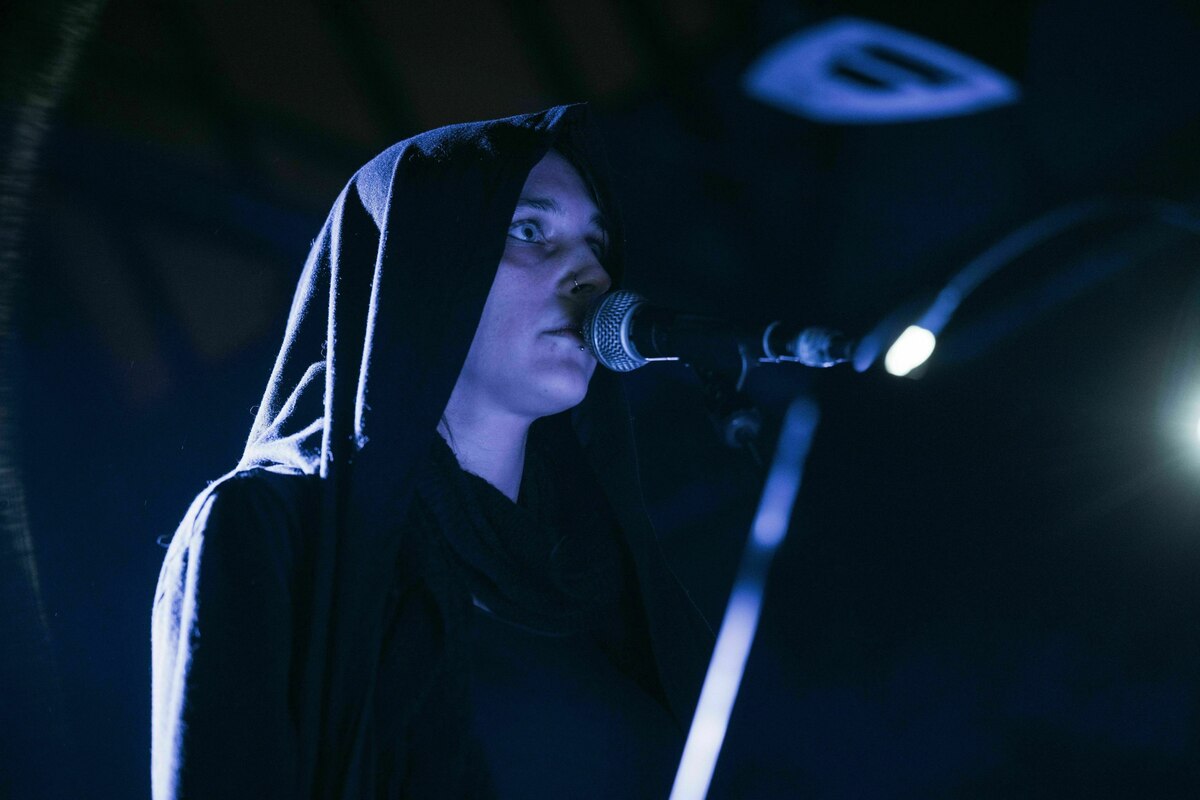
Directly from the Middle Ages, or perhaps just from Montreal, the death metal singing group Growlers Choir has found its way to Radialsystem, another CTM base. This time the room temperature is comfortable, but the singers, dressed like Cistercians in simple habits, still cool the hall down. As they walk down the steps of the public gallery, wheezing as if to execution, the Hound of the Baskervilles appears again in their mind’s eye.

Eye & COLO from Osaka immerse the Berlin House of Visionaries in a shooting game soundscape
Photo:
Oyèmi Hessou/flickr
Then the vocal cords produce croaking and clearing of the throat. Choir leader (and composer) Pierre-Luc Senécal conducts – at eye level with the singers – and records the dark musical backdrop on his laptop. Blast beats crackle again, guitars scream like hell, there are always abrupt breaks in between, the vocal arrangements fit and fit into the evil musical bed.
How to compose graphically
Despite the refrigerator temperature, the workshop with the Polish composer Marcin Pietruszewski in the House of Visionaries is heartwarming. The streets are still not gritted, but the artist, who teaches in Weimar and Newcastle, clearly explains how to compose graphically. Pietruszewski uses the open source program Supercollider to record sounds on the screen and creates music with a coordinate axis: Hatchings on the X-axis represent timbre (frequencies) and pitch (tempo) on the Y-axis.
The old human desire to visualize sound has become reality here. The Polish artist explains that he was concerned with the question of how well an algorithm could describe sound and refers to the Greek electronics pioneer Iannis Xenakis and his idea of stochastic music. On the screen it looks like you are watching an EKG when it shows a heart muscle.
Deep Leonie and the cold she causes not only slows down parts of local transport, the CTM program is also in jeopardy when Canadian Kara-Lis Coverdale’s flight is canceled. The Berlin vocal acrobat Lyra Pramuk spontaneously steps in. First it’s the turn of the British woman feeo. In the fully occupied Radial system, visitors nestle close together in a semicircle around the singer-songwriter and her guitarist Caius Williams. Feeo’s texts talk about cold, about unmarked graves and all sorts of dark things, but her voice warms the room.
Tones and sound sequences
Her lecture is reminiscent of Tirzah, as is Beth Gibbons, quite harmonious for a festival that is actually dedicated to the dissonant in 2026. “Dissonate <> resonate” is the CTM motto. Pramuk joins in anthemic, performing her songs with waving sleeves latest album “Hymnal”. In this hymn book, Pramuk has not written down much of the text; she concentrates on tones and sound sequences.
This is accompanied on the big screen with a film by Lucy Beech, in which glossy, shiny lips open and close in close-up, eyelashes become tangled, water waves against canal walls and flocks of birds flutter. “This is the time and this is the record of the time,” Pramuk repeatedly quotes Laurie Anderson’s “From the Air,” from her debut “Big Science” from 1982. The times, yes the times.
In the end, Coverdale still makes it. But the ranks have already thinned out. The artist sees music as care, and composes for breathwork and psychedelic-assisted therapies. You could imagine what she creates as the soundtrack of a fairy tale film that has slipped into the surreal. She covers all conceivable arcs of tension, dissonant, consonant, actually healing. Dogs have no chance.