

G I was just sitting among descendants of women who had been persecuted by the National Socialists. It was January 27, 2026, the day on which the victims of National Socialism are remembered in Germany.
A little later I was standing on a crowded train heading to Berlin and scrolling through my cell phone. I saw the Instagram reel of a German influencer: looking concerned, demo screams in the background, an Anne Frank quote faded in. Among other things, the sentence: “It feels like history is repeating itself.” Broad agreement in the comments.
The USA shortly before 1933, Donald Trump the next Adolf Hitler, that’s the tenor. She is not alone with this theatrically staged feeling that does not do justice to reality. Prominent voices in the USA also resort to Nazi comparisons. The actor Edward Norton spoke at a film festival “mass shootings of American citizens by the Gestapo”. And the US historian Mary Nolan, an expert on German fascism, called ICE im Daily Mirror as a “mixture of SA and Gestapo”.
You can compare a lot of things. What matters is whether the comparisons are valid – and why they are so relevant right now. When events are overwhelming, language sometimes fails. We look for terms to make the cruel tangible, to classify it. But what is happening here goes beyond that.
National Socialism became a reference for every form of state violence, arbitrariness and loss of control. It serves as the greatest possible alarm call; In a world of attention economy, ever bigger shockers are needed.
The situation in the USA is dramatic enough. Renée Good and Alex Pretti were killed by brutal ICE agents. People are arbitrarily arrested, families separated and imprisoned. But the comparison to the Gestapo remains wrong. National Socialism was not just tough crackdown by the state. It meant total dehumanization, industrial destruction, supported by an eliminatory ideology, legitimized by broad social approval.
The USA looks back on a different history, a different political tradition than the Germany of 1933: almost 250 years of democratic development, which Trump is currently damaging by expanding his power, hollowing out institutions and governing unpredictably.
Nazi comparisons shift the standards. They turn a political situation into an end-time narrative. Anyone who assumes that they are persecuted like Jews were back then is declaring themselves a victim of a repeating historical development whose outcome is predetermined. That sounds radical, but it is politically paralyzing because it ignores your own scope for action.
Historian Wolfgang Kraushaar recently described ICE as “paramilitary unit in the civil service”. Such units have always existed in authoritarian and dictatorial regimes. However, it is difficult to draw a compelling historical parallel to ICE. Maybe that’s why ICE seems so threatening: because it is not a copy of an authoritarian instrument, but rather the violence takes place in the democratic system, ordered by the elected head of state.
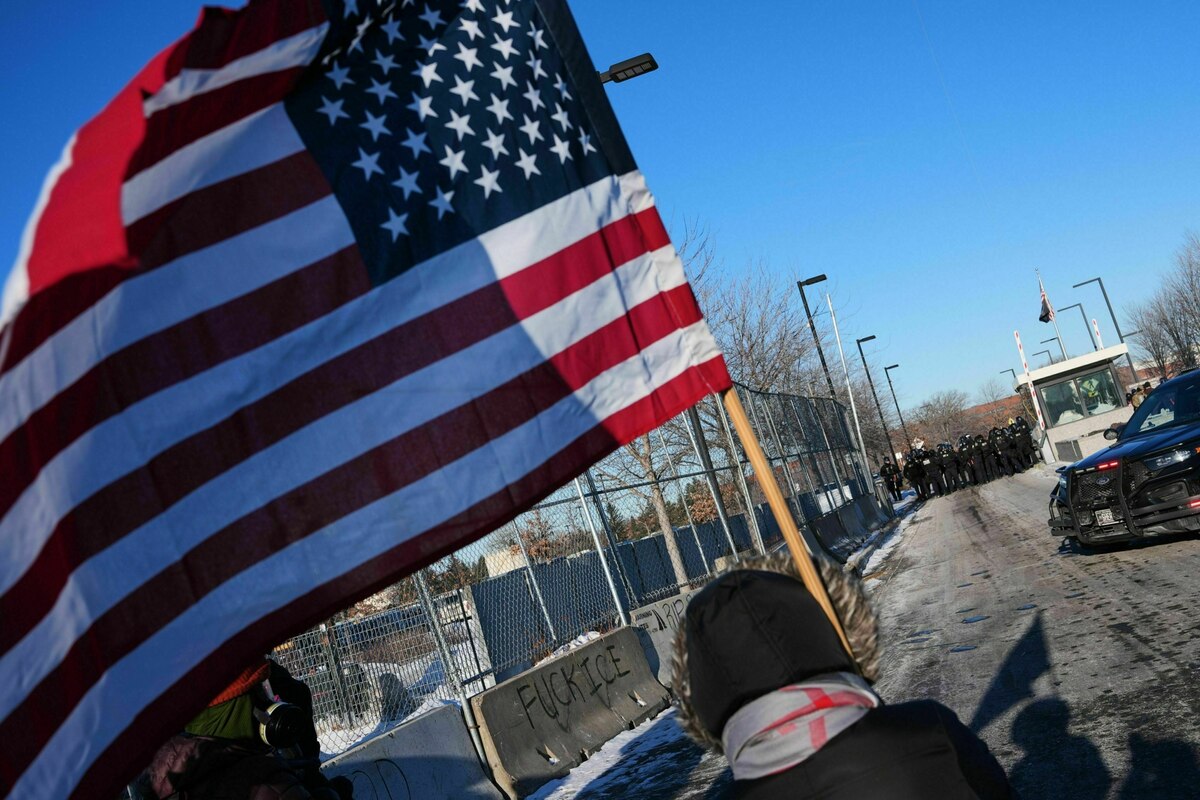
For weeks, people in Minneapolis have been taking to the streets in freezing temperatures against the harsh crackdown by ICE. Your perseverance is remarkable, important. And this resistance seems to be having its first effect: some ICE forces are being withdrawn.
What will follow next? Who knows? Nazi comparisons offer no answer. What’s more exciting anyway is: What is possible – politically, practically, today?