

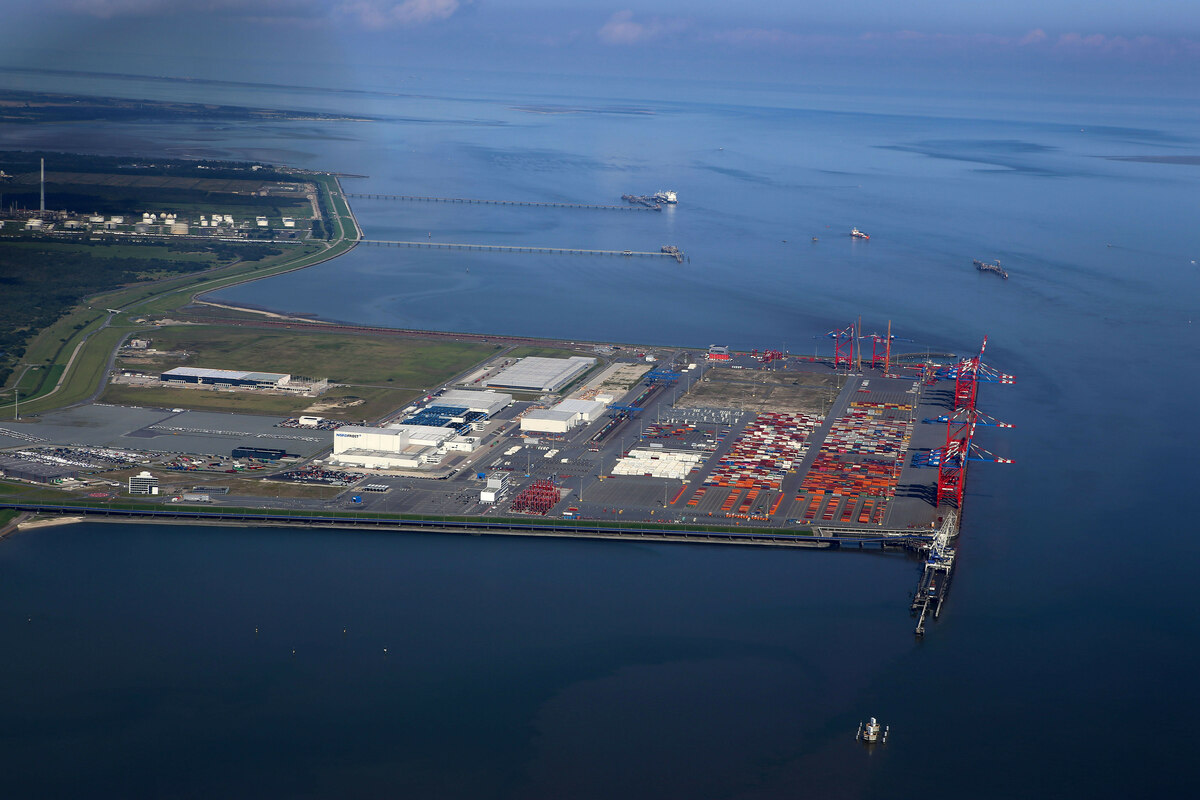
Three environmental associations want to prevent a green energy hub from being created in Wilhelmshaven in an EU nature reserve. The Lower Saxony BUND and Nabu, together with the German Environmental Aid (DUH), have concluded a protection alliance for the area in question, the Voslapper Groden Nord. If the city council de-designates the area on Thursday next week, the associations want to take legal action against it.
The Voslapper Groden is protected under the EU Birds Directive and is part of the EU’s Natura 2000 protected area network – the premium standard of nature conservation. At 267 hectares, the area is one and a half times as large as Hamburg’s Outer Alster and is located between a refinery and a chemical factory not far from the Jade Weser Port.
It was placed under protection because “a mosaic of different biotope types has developed here,” as the text of the regulation states. There are wet dune valleys, reed beds and small bodies of water, but also dry grassland and grassland. The number of animal species that can be found here is correspondingly large: ground beetles, wild bees, bats. When it comes to birds alone, there are 128 species that breed and rest here.
By changing the land use plan, the city council should create the conditions for that a pier for six gas tankers can be built off the coast and a “port-oriented energy park” on land.. The city administration argues that this is important for the transformation of the energy industry in Germany.
City hopes for better living conditions
The city itself will also benefit from the development with new jobs and trade tax revenue, it says on its website, “so that living and living conditions can be sustainably improved.”
This is the bearer of hope belgische Firma Tree Energy Solutions (TES)which wants to transship, store, regasify and liquefy energy sources such as methane, liquid natural gas (LNG), electric natural gas (ENG) and hydrogen. Hydrogen is to be produced, but also electricity from methane or LNG, with the resulting CO2 should be caught.
Sascha Müller-Kraenner, Federal Managing Director of the DUH, does not think it is a given that a transshipment point for essentially green energy will ultimately be created here. “In the short term, it’s about expanding the LNG infrastructure,” says Müller-Kraenner. There are currently two floating LNG terminals in Wilhelmshaven. A regasification plant on land is now to be added.
There is currently only business with that LNG, which is predominantly imported from the USA and is harmful to the climate to do, says Müller-Kraenner. Despite all the assurances that the systems should be converted to green energy, the DUH managing director is worried that an infrastructure for fossil fuels could de facto be built here, which would stand in the way of an energy transition.
And, says Müller-Kraenner, these plans were “completely at the expense of biodiversity”. Müller-Kraenner criticizes that alternative implementation options have not been examined. He believes that the planners could have limited themselves to actually green products, sought synergies with existing industry and thus used already designated industrial areas.
There are no suitable compensation or replacement areas for this unique breeding and resting area either in Wilhelmshaven or in the region.
Susanne Gerstner, BUND
Ultimately that is it Project planned too bigso only an area as spacious as the Voslapper Groden comes into question. If the city wants to destroy an EU bird sanctuary and thereby set a precedent, “it should discuss the dimensions of the project,” says Müller-Kraenner.
Markus Bulla, parliamentary group leader of the voters’ association Win@WBV, pointed out on Monday that various specialist committees were dealing with the issue before the council’s decision. At the moment, the experts assure that “there are sufficient coherence areas” – i.e. replacement areas that are intended to ensure that the Natura 2000 network of protected areas is not torn apart. The 267 hectares of Voslapper Groden are to be offset by five other areas with a total of 400 hectares.
But a large contiguous area is also crucial from the perspective of conservationists. The proposed replacement areas are pre-loaded and “do not have sufficient functional unity or a lack of disruption,” criticizes Lower Saxony BUND state chairwoman Susanne Gerstner. Studies show that the fragmentation of protected areas leads to the loss of biodiversity, according to a statement from the nature conservation associations.
“There are no suitable compensation or replacement areas in Wilhelmshaven or in the region for this unique breeding and resting area with its threatened bird species such as bitterns and bluethroats,” says Gerstner. Such an area cannot simply be relocated.