

The Cost of Starting a Startup Is Approaching Zero
Remember what it took to launch a startup just five years ago?
You needed a small, lean team and a big pile of cash. And of course, you had to be in San Francisco, where startups are magically born in a garage or a basement.
At least that’s what happened with most big tech companies that dominate industries today.
But right now, that reality has completely changed.
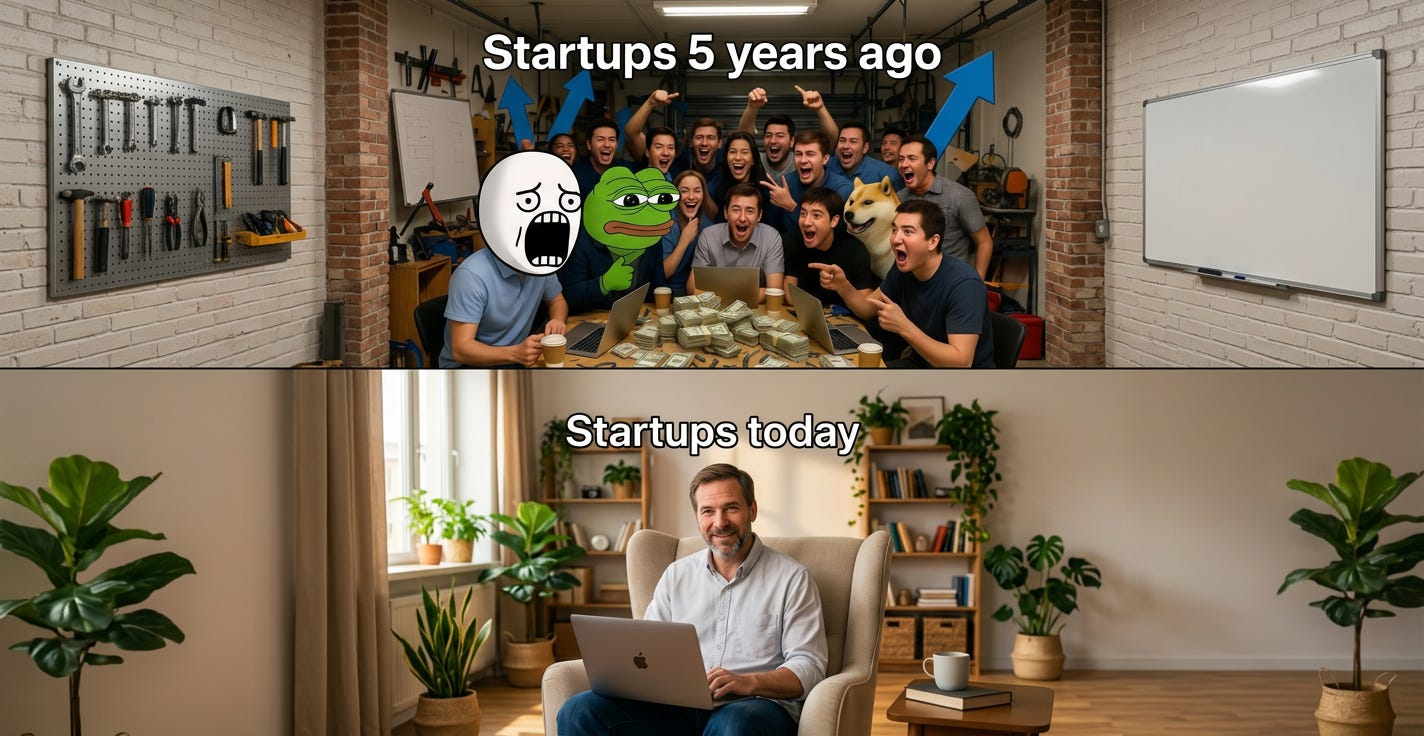
Thanks to modern AI products and incredibly cheap cloud tools, a single person with a laptop can build, launch and hit their first revenue in weeks for a fraction of the old cost. The actual price tag of starting a company has fallen off a cliff.
Capital is no longer the ultimate gatekeeper. This massive drop in the cost of building is changing everything, including how companies are born, who gets to build them and why the traditional VC playbook is suddenly looking very outdated.
together with Vanta:
Building got cheap. Selling to a European bank or a government buyer still runs through the same gate it always did, and one team of one has to clear it.
The ISO 27001 Checklist for Teams Ready to go Global
ISO 27001 is the globally recognized standard for information security — and the credential often required by European customers, governments, and regulated industries.
This checklist maps every step, from building your ISMS to passing your certification audit:

Whether driven by a customer request or a proactive security push, you’ll have a clear picture of exactly what to tackle and when with this checklist from Vanta:
Table of Contents
1. Numbers Don’t Lie
2. Intelligence Unleashed
3. One Founder, Every Function
4. The Part the Bull Case Leaves Out
5. What Venture Capital Hasn’t Figured Out Yet
6. The One Cost That Isn’t Falling
1. Numbers Don’t Lie
The change becomes clearer when you look at how quickly the underlying inputs have moved.
Though the share of startups built by a single founder has not edged up gradually, it has risen from 23.7% in 2019 to 36.3% by the first half of 2025. That kind of movement rarely happens without a deeper structural driver. It reflects a change in what it takes to build something that can attract users and turn a profit.
The most direct driver sits at the infrastructure layer. The cost of running intelligence, which now underpins everything from product features to internal workflows, has fallen at a pace that is difficult to compare with prior technology cycles.
Running AI is now roughly 100 times cheaper than it was less than two years ago. Models that once required meaningful operating budgets now run at a fraction of that cost. Systems like DeepSeek R1 deliver performance comparable to GPT-4 at close to 15% of the operating expense.
A constraint that used to be fixed has turned into something that scales with usage.
That change carries through the rest of the stack. Development environments, design systems and distribution tooling have followed a similar trajectory. Capability has expanded while the cost to access it has declined.
The effect shows up in how quickly companies reach product-market fit. Upekkha’s recent cohorts are reaching product-market fit faster and with significantly lower capital requirements, reflecting a broader move toward capital-efficient company building.
This is not explained by better founders or fundamentally different ideas. The same validation process now runs on a much cheaper base.
Put these pieces together and the direction becomes clear. Computing is cheaper, tools are more capable and distribution infrastructure is easier to access.
Each layer reinforces the others. The cost of starting a business is no longer anchored by the inputs that once defined early-stage company building.
This isn’t just a software story. Starting a commerce business has followed the same path. What once required a physical store, upfront stock and logistics deals can now be set up through platforms that handle payments, shipping and financing all in one place.
In many cases, the annual cost to operate at that level sits well below four figures. The barrier that separated small operators from scaled businesses has weakened across sectors not just in code-driven companies.
2. Intelligence Unleashed
A common instinct is to assume that when a core input becomes cheaper, the value around it compresses. That logic holds in some markets but not here.
What is happening is closer to a well-known economic pattern often referred to as Jevons Paradox: as the cost of a resource falls, total consumption tends to go up, not down. That is exactly what is happening with intelligence.
Lower Costs Are Driving More Demand
You can see this in how infrastructure spending is behaving.
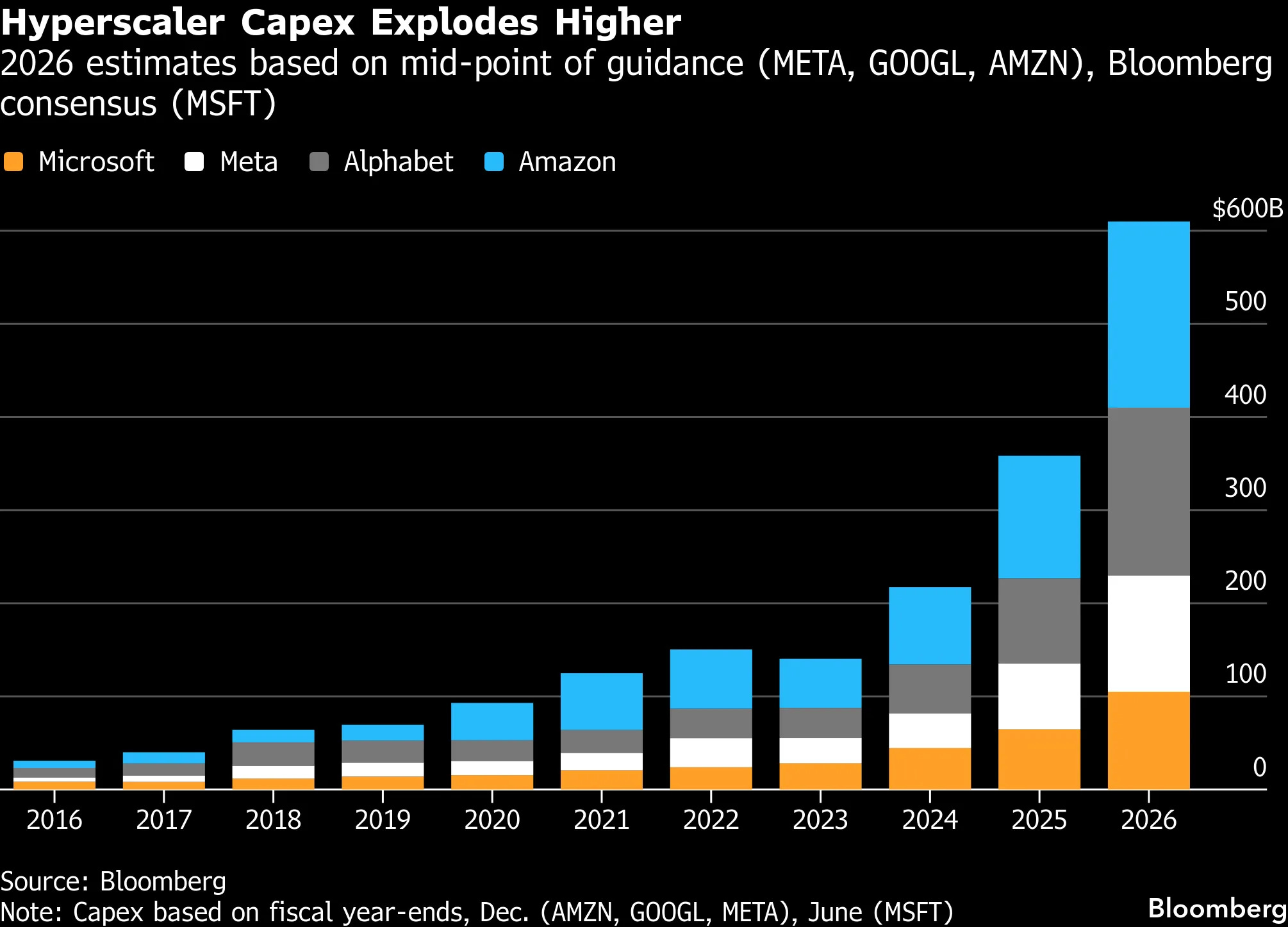
It has expanded the surface area where intelligence can be applied.
This changes how the cost of starting a business plays out in practice. Founders are no longer optimizing for how little intelligence they can afford to use.
They are embedding it across the product surface, in workflows, in support and in internal tooling.
Tasks that were previously manual, delayed, or ignored altogether are now part of the default build. The boundary of what can be turned into a viable company moves outward.
The more important change sits in how ideas get tested.
Startups can launch cheaper
A few years ago, validating a product that depended on advanced automation or data processing often required a few million dollars in capital and a team to support it.
That same validation cycle can now run on tens of thousands of dollars. The difference between $5 million and $50,000 is not incremental. It determines who gets to try in the first place.
A solo founder’s AI startup is no longer an edge case built on extreme efficiency, it is becoming a standard outcome of cheaper inputs.
You can see this in categories that were previously constrained by cost.
Legal workflows that required large teams can now be supported by systems that draft, review and summarize at scale, allowing small teams to serve enterprise clients.
In healthcare, ambient documentation tools can capture and structure clinical interactions in real time, reducing the need for dedicated staff while improving throughput. These problems are not new. Solving them at smaller scales was not economically viable.
As the cost of running AI keeps falling, more of these opportunities open up. Cheaper intelligence does not reduce the space for new companies.
It increases the number of viable starting points, especially for founders who operate without venture capital and rely on speed and iteration instead of large upfront funding.
3. One Founder, Every Function
It becomes clearer when you look at how a solo founder works day to day. The constraint is no longer the number of hours available or even the number of skills a single person can realistically develop.
It used to be about coordination.
Building a product required multiple functions to move together. Engineering, design, marketing, support and operations each demanded time and ownership. That coordination overhead shaped how teams were built.
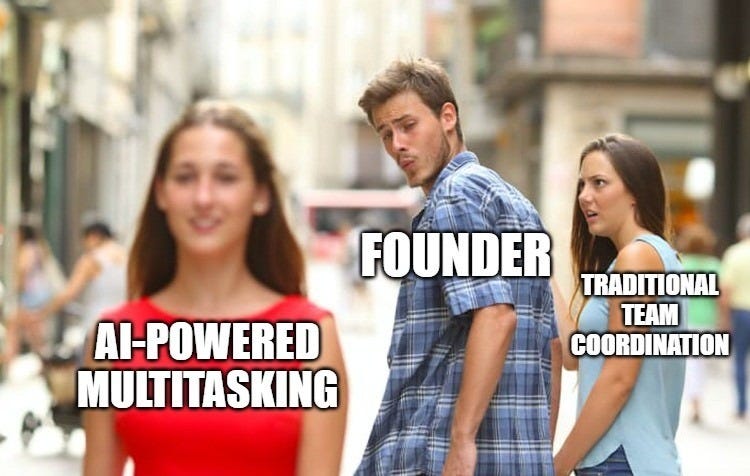
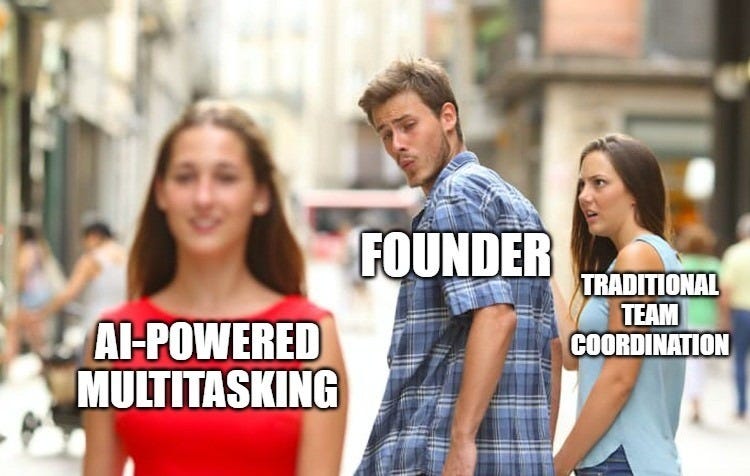
Overhead has decreased. An AI-powered founder doesn’t just complete tasks more quickly. They can manage multiple functions simultaneously, maintaining a continuity that small teams used to struggle with. Ideas turn into deployed code in much shorter cycles.
Customer support is handled through systems that resolve most queries before escalation.
Marketing runs as an ongoing loop of content, distribution and feedback within the same stack. The work still exists, but it no longer requires separate owners at each layer.
Interpretation matters
This shows up in the data but the way you read this matters. Solo led companies accounted for roughly 30% of startups in 2024, yet they received only 14.7% of venture capital.
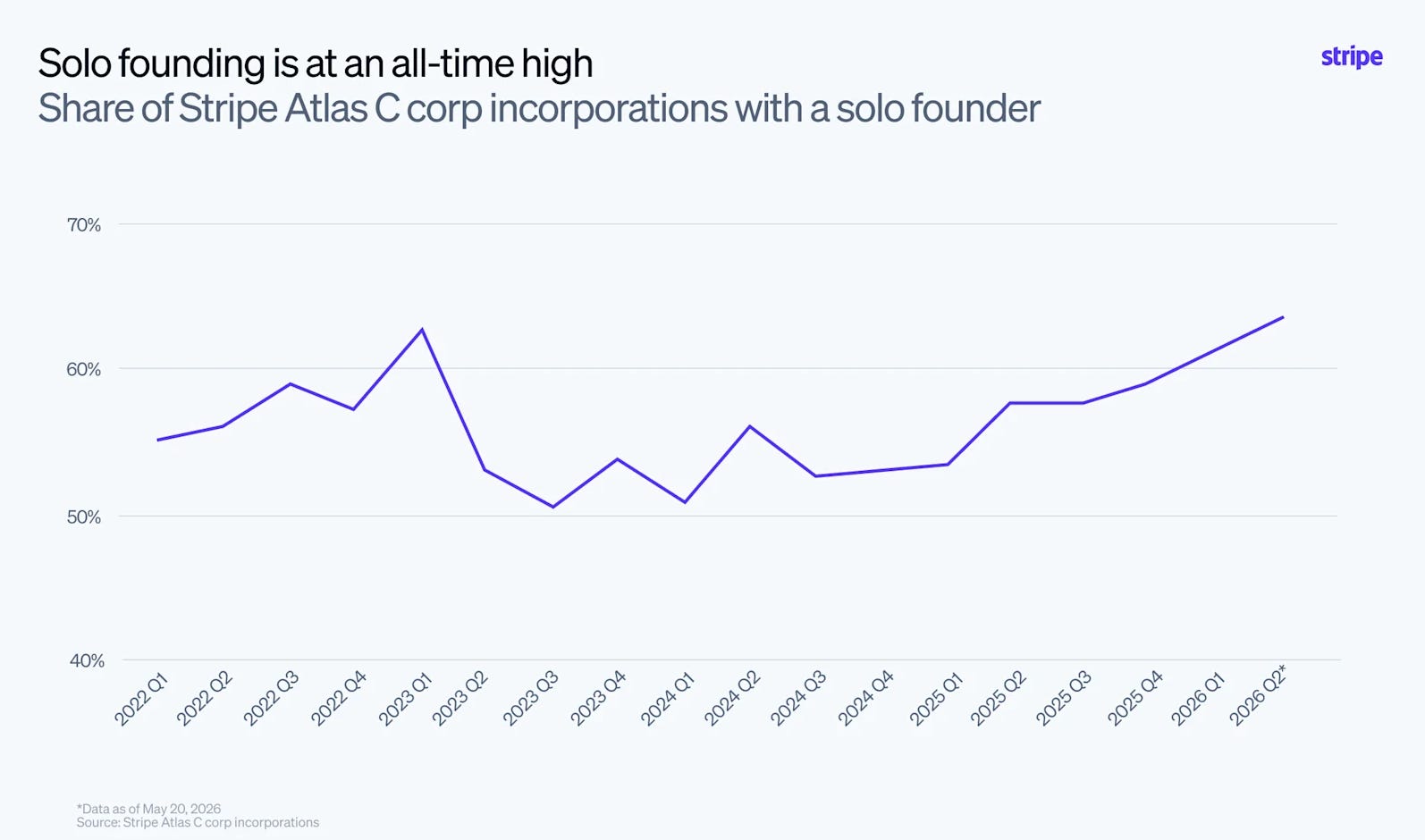
That gap is not only a reflection of investor preference, it also reflects choice.
When the cost to start a startup drops, the need to raise capital early becomes less compelling. Many founders are reaching product-market fit on their own terms instead of aligning with a funding model built for larger teams.
The examples are no longer outliers. Pieter Levels has built and scaled products like Nomad List and Remote OK to seven-figure revenue without employees.
Danny Postma took HeadshotPro past $1 million in annual revenue as a solo founder before selling it for a seven-figure outcome. Maor Shlomo built Base44 alone and sold it to Wix for $80 million within six months. Jan Oberhauser started n8n as a solo project in Berlin, which has since grown into a company valued in the billions. Different categories, different paths, same underlying pattern.
A solo startup is now defined not by limitations but by the number of functions a single founder can manage independently. As tools advance and AI becomes cheaper, the scope of what one person can do continues to grow.
4. The Part the Bull Case Leaves Out
The cost story has another side that does not fit neatly into the optimism around cheaper inputs.
The same systems that make it easier to build also introduce a cost structure that looks very different from traditional software.
For decades, software businesses operated on a simple premise. You paid once to build the product and each additional user cost almost nothing to serve.
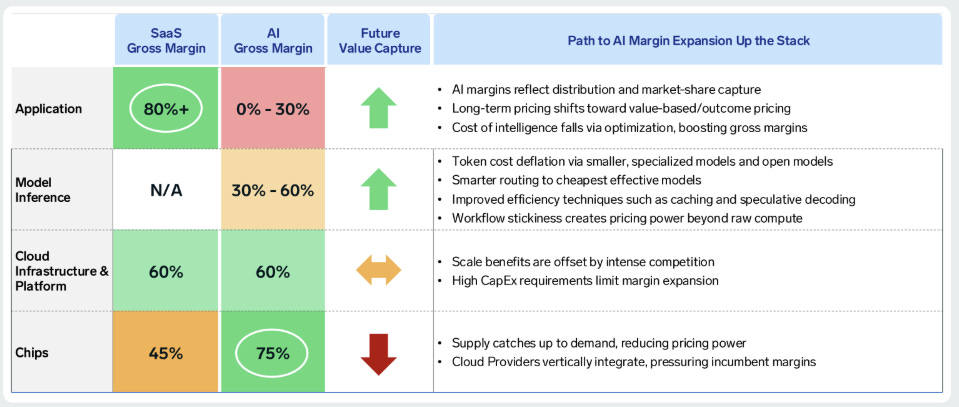
That is what allowed SaaS companies to reach gross margins above 80%. AI changes that at a structural level.
Every time a user interacts with the product, it costs something to run. And the more people use it, the more those costs grow. Serving customers still costs money and expenses scale with demand.
Battery Ventures’ 2025 State of AI report places application layer gross margins in the range of 0% to 30% for many AI products.
That is not a temporary inefficiency, rather a reflection of how these products are delivered.
Today, AI chip makers are capturing the most profit earning 75% gross margins while software companies built on top of AI are barely breaking even at 0 – 30%.
Over time, this is expected to flip as AI becomes cheaper to run and software companies start charging based on the value they deliver rather than usage. Cloud providers are stuck in the middle, with heavy infrastructure costs and fierce competition keeping their margins flat.
The biggest profit opportunity ahead belongs to companies that can lock in users at the application layer not those selling the underlying technology.
The gap between cost and pricing becomes more visible in real deployments. Early estimates suggested that GitHub Copilot was costing Microsoft around $80 per heavy user each month, while the product was priced closer to $10. That pricing was intentional.
The goal was adoption and market share not profitability. But it exposes a structural pressure. If the cost of intelligence does not continue to fall, or if pricing power does not catch up, the economics become difficult to sustain.
There is also a dependency that sits beneath this. Most startups in this category are not training their own models. They rely on a small group of infrastructure providers competing aggressively for market share. OpenAI, Anthropic and Google are not optimizing for margin today, they are optimizing for distribution and ecosystem control.
The prices founders are seeing right now reflect a temporary phase of the market not where things will eventually settle.
This creates a tension that is easy to miss when focusing on how cheap it has become to build.
Launching a startup may be getting more affordable but the cost of serving customers can move in the opposite direction if those underlying rates change.
A product that works at today’s pricing may look very different if inference costs rise three to five times, or if usage scales faster than expected.
There is no clean resolution to this. Both dynamics are real at the same time. It is cheaper than ever to build and test a company.
It is not yet clear what the stable cost structure of running that company will look like once the current pricing environment settles.
5. What Venture Capital Hasn’t Figured Out Yet
The change in cost structure is starting to expose a mismatch at the center of the venture model. VC was built for teams that needed time, coordination and capital to validate large ideas.
Venture capital has a mismatch problem
That logic still holds in some categories, but it does not map cleanly to a world where a single founder can reach product market fit with a six figure budget.
When the cost to start a startup falls this far, the role of capital changes whether investors adjust or not.
The data already points in that direction. While solo founders now account for roughly 36% of new startups, they receive only around 15% of venture funding.
That gap is not only biased, it points to a deeper change in demand. A growing share of these companies are not raising because they do not need to.
If a founder can build, launch and validate with limited capital, the tradeoff between dilution and speed looks very different. For many, venture capital is no longer the default path to the first meaningful milestone.
This creates a product mismatch. VC is still packaged as large checks for teams that plan to scale headcount quickly.
That made sense when building required coordination across multiple functions. It is less relevant when those functions can be handled by a single operator using modern tools.
The input VCs provide, capital in exchange for ownership, is no longer as scarce at the earliest stage as it once was.
Founders no longer need as much funding
The signals used to evaluate ambition have not caught up. Headcount still carries weight in how opportunities are assessed, even though it is becoming a weaker proxy for output.
Revenue per employee is emerging as a more relevant indicator. A company generating $3 million in annual revenue with two people is often treated as an edge case rather than what it actually represents: a highly efficient system.
These are not lifestyle businesses. They are early examples of solo founders in the VC world building capital-efficient machines.
Investors who continue to filter for team size and capital intensity risk missing a category that is expanding in plain sight.
What worked before when money and coordination were the main constraints doesn’t really hold up in today’s market. Whether these companies can scale is not the right question.
It is whether the frameworks used to evaluate them are keeping pace with how they are being built.
6. The One Cost That Isn’t Falling
The cost of building has moved in one direction. Deciding what to build has not followed the same curve. Lower barriers mean more people can enter, test ideas and ship products.
But that doesn’t actually make the real challenge any easier. It just means way more people are jumping in, launching products and fighting for attention.
Suddenly there’s a ton more noise and founders have to work harder to cut through it all.
Once everyone has access to the same powerful tools, being fast at building stops being the main advantage. The real edge now comes down to judgment knowing what’s actually worth building.
Choosing a problem that matters, reading demand accurately and knowing what to ignore become harder as the marginal cost of entrepreneurship approaches zero.

This shows up early. A product can be built and launched quickly, but whether it finds sustained demand depends on factors that do not compress with tooling.
Distribution still needs to be earned and pricing needs to hold under real usage. Retention reflects whether the product solves something people care enough about to pay for. These forces operate on their own timelines, independent of how cheap it has become to build.
There is another layer beneath this that does not get much attention. The systems that enable a one-person startup are concentrated in a small number of platforms.
Cloud providers, model APIs and distribution channels form the base that most of these companies sit on. Founders do not control these systems and they do not set the terms on which they operate. Changes in pricing, access, or policy at that layer flow directly into the economics of the business.
Cloud computing lowered the cost of starting companies while concentrating value upstream. AI infrastructure may be heading in the same direction.
That leaves a founder in a position where building is easier than it has ever been, while the foundation that supports that build sits outside their control.
The question is how much of that dependency the next generation of companies can absorb before it starts shaping what gets built in the first place.