

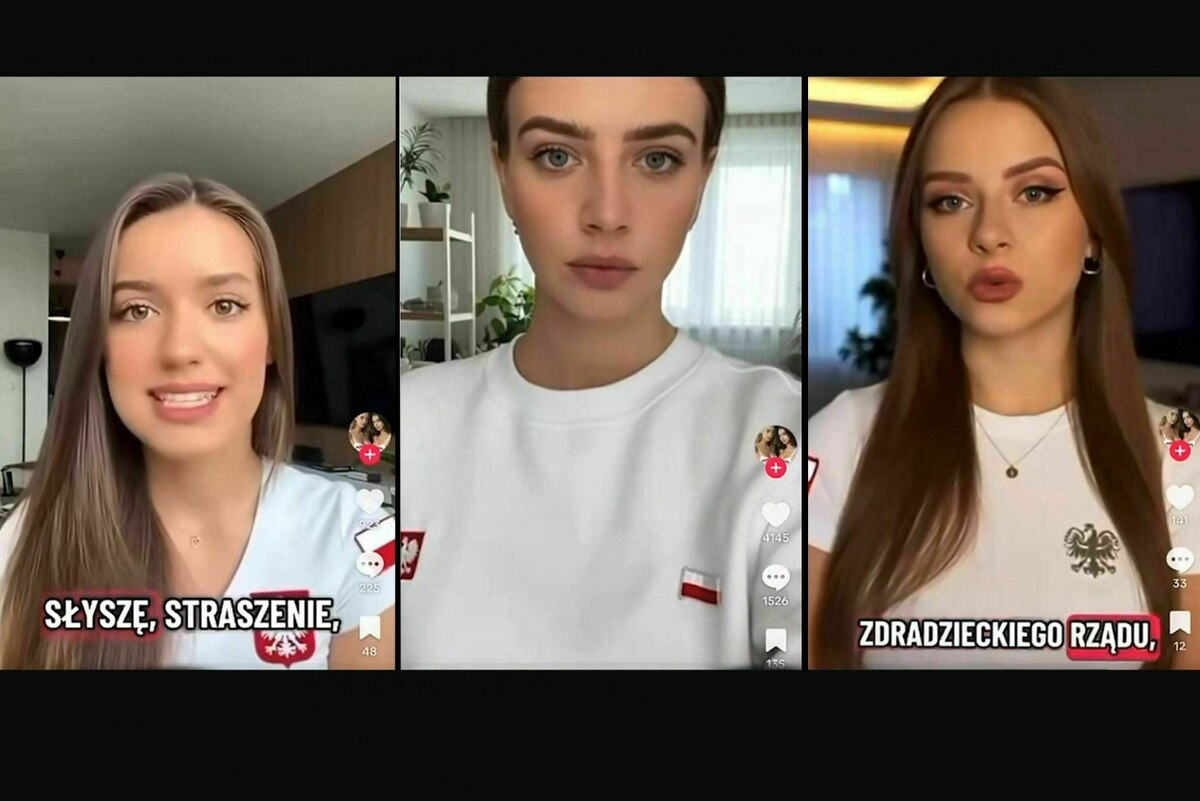
The eagles on the left on the T-shirt, the white and red flag on the right. At the end of the year, young, normally beautiful Polish women spoke on Tiktok about their dissatisfaction with Polish politics. The videos were published on the Prawilne Polki channel. The big topic: a Polish exit from the European Union, the so-called Polexit.
“I don’t remember a Poland before the EU, but I want Polexit, even if it is more expensive, because I want freedom of choice,” says a brown-haired young woman into the camera. “Yes, I want Polexit, enough of Poland being ruled from Brussels, enough of making us afraid that we won’t make it without outside approval,” explains another woman. None of them appear a second time on the channel.
The page has now been deleted; in just a few days it reached several thousand users, but the videos and the young women were AI-generated. Res Futura, a European foundation that deals with information security, was one of the first to draw attention to the videos. According to one X contribution it assumes that the content was created using artificial intelligence. The videos should be aimed specifically at a young audience.
But what role do young women play in creating AI content, and how are actors trying to influence Polish society using fake videos and disinformation?
First they do nothing, then they delete everything
According to the Polish fact-checking site Konkret24 An existing Tiktok account was renamed Prawilne Polki in mid-December. Translated, the name means “true” or “decent Polish women”. There was also a new description: “Here beautiful Polish girls openly express their opinions and what they think.”
Aleksandra Wójtowicz researches disinformation and cybersecurity at the Polish Institute of Foreign Affairs. For them, Prawilne Polki, despite the name, is clearly AI-generated videos. “The videos are very cheaply produced. You can tell that they are not real women based on the voice, which seems artificial and doesn’t quite match the mouth movements.” The dangerous thing is that there are people who no longer recognize such differences, she warns. The videos are threatening because they could influence people, even if they were created quickly and cheaply.
In addition, it is becoming increasingly difficult “to see with the naked eye whether it is AI-generated content,” says Mateusz Łabuz. He works on international cybersecurity at the Institute for Peace Research and Security Policy. You can use AI recognition software, but even it cannot 100 percent distinguish AI-generated content from real videos and photos. In the case of the Polish Tiktok channel, a video was subsequently marked as “AI-generated” by Tiktok, shortly before it was deleted.
Tiktok not only removed Prawilne Polki at the beginning of the year, but also, according to Wójtowicz, removed all videos tagged with the Polexit hashtag in the past six months. “It’s almost funny, first they don’t do anything, and now they delete everything,” she says. It is therefore more difficult for the analyst to find out what was previously posted on Tiktok about the topic and who appeared in the videos.
Address young men
The fact that young women are used to spread right-wing to extreme right-wing ideas on the Internet is not new. During the presidential election campaign in Poland in spring 2025, there were already AI-generated images of supporters of far-right candidates.
Especially a lot of attention received an AI image showing women at a bachelorette party should show. In the middle of the group photo they hold a banner with the name of the then candidate and current President Karol Nawrocki. But a woman’s left hand merges with her dress – an indicator that this is a generated image. Problems with AI-generated software often occur, particularly with hands and fingers.
More women than men took part in both the 2025 and the 2023 parliamentary elections. They voted more progressively, but were also more inconsistent in their voting behavior over several election periods. That is why PiS and Konfederacja in Poland have been trying to appeal more to women for years. Videos like these should help, says Łabuz. “Attractive, self-confident young women talking about sovereignty and Polexit – that normalizes the demand to leave the EU.” As a user, you tend to listen and perceive the videos as harmless content.
But the AI women should also appeal to young men who already sympathize with right-wing content. These are also the core electorate of the Polish Konfederacja. “When young men see women of normal beauty who talk about their fears and dreams for the future in a strong Poland, then that speaks to them,” says Łabuz. The details were deliberately placed on the women’s T-shirts. “Patriotic women are cool” is the motto.
A Russian attack
But who is behind the AI videos? “Of course, some people would say it’s definitely Russia, but we find that attributing these videos is very difficult – especially because there were only a few, they only took place on Tiktok and were quickly deleted,” says Wójtowicz.
Although there cannot be a clear traceability of this specific example, there are clearly cases in which Russia is trying to influence the opinions of Polish society with targeted disinformation campaigns.
One of these cases is this “Operation Doppelganger” which probably started in February 2022. According to an analysis by the EU DisinfoLab team, Russia uses clones of legitimate websites and networks, such as media houses, to spread anti-Ukrainian narratives. The campaign was active not only in Poland, but also in Germany, France and the USA, among others.
According to Wójtowicz, there will also be more hybrid Russian attacks like this in the future Violation of Polish airspace in autumn 2025. Shortly before the September 9 incident, social media accounts with a wide reach known for spreading Russian disinformation published posts about alleged provocations from Ukraine. They assumed that Ukraine was planning to involve Poland in the war.
There is also content that is intended to discredit Ukrainian refugees in Poland. For example, it is spread that residential complexes would only be built for Ukrainian women or Ukrainian soldiers would have easier access to doctors. The Polish health authority addressed the latter in a meta post in fall 2025 and warned of manipulation by Russia.
In addition to migration from Ukraine, anti-European content was also among the most widespread narratives, says Wójtowicz. “I assume that the AI Women’s videos were intended to serve as preparation for a larger campaign ahead of the upcoming general election in 2027.” The fact that it is just one account and the focus on one platform speaks for this.
According to surveys, Poles’ frustration with the European Union is already increasing. A survey from the end of December came to the conclusion that that almost a quarter of those surveyed want to leave the EU. Many of the hotly debated topics, for example migration or agricultural policy, are related to the EU, making some citizens more open to anti-European disinformation.
Dariusz Standerski, State Secretary in the Polish Ministry for Digitalization, requested proceedings against Tiktok due to the distribution of AI content in an open letter to the EU Commission at the end of December. Aleksandra Wójtowicz supports the government’s move. However, she also says that there is still a lot of catching up to do: “The best start would be to pass the law on digital services. We are the last EU country not to have done that yet.”
This law is currently the EU’s strongest tool for regulating platforms. The problem is that the Polish president has so far rejected this. “But the fact that he was only able to veto it now is also the government’s responsibility, because it has not been able to prepare a bill for implementation for more than a year.”
She would also like to see more investment in the exchange of information between different countries. Russian disinformation campaigns often affect several EU countries. If it is possible to find out who is financing individual campaigns, the EU would have to decide on sanctions.