


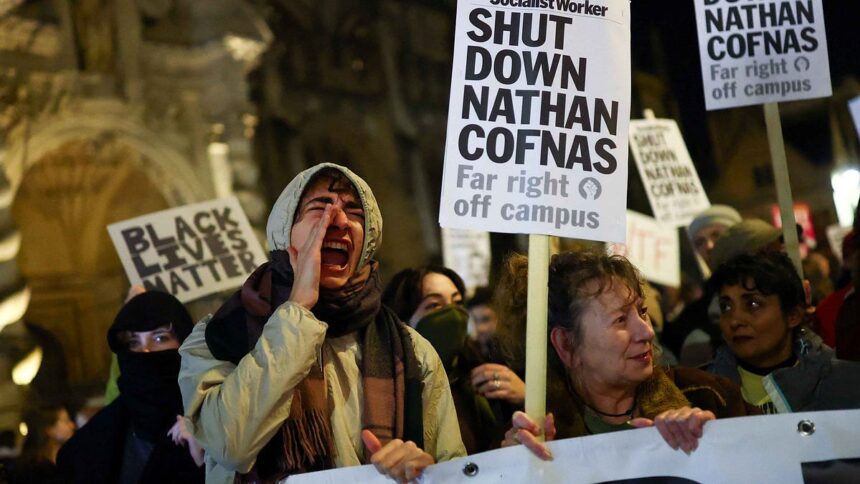
Student protests are nothing new. Nor are violent riots on campus, like those organized by people inside and outside the University of Oxford on Tuesday evening. The intimidation of students and others was intended to prevent people from hearing from the academic Nathan Cofnas. He leaped to fame earlier this year when he was the first academic to blow the whistle on the fraud committed by another academic, Jason Arday of the University of Cambridge. Cofnas’s reporting revealed to the public what was long suspected within Cambridge’s walls: Arday had fabricated important parts of his life and career, and was unqualified for his job, not to mention his celebrity status.
Arday later took his own life as public scrutiny increased, and his suicide has led to a massive inflation of claims about his death and against those who exposed his fraud. These have been made by figures as prominent as the principal of Homerton College, Cambridge, Lord Simon Woolley, who told a demonstration in London’s Trafalgar Square that Arday, who was black, had been the subject of a “lynching” and a “public assassination.” These are strong terms to throw around, even metaphorically—which is what Woolley now claims he intended them to mean.
Not all of the demonstrators who turned out by the hundreds on the streets of Oxford on Tuesday night will have taken these words metaphorically. Enraged activists formed a human cordon, blocking not only attendees of the event but also other students trying to access their dormitories. When one student attempted to pass, he recalls that a protester rebuked him, saying, “Don’t try and break the picket line, mate. It makes you look as though you hate black people.”
Read more