


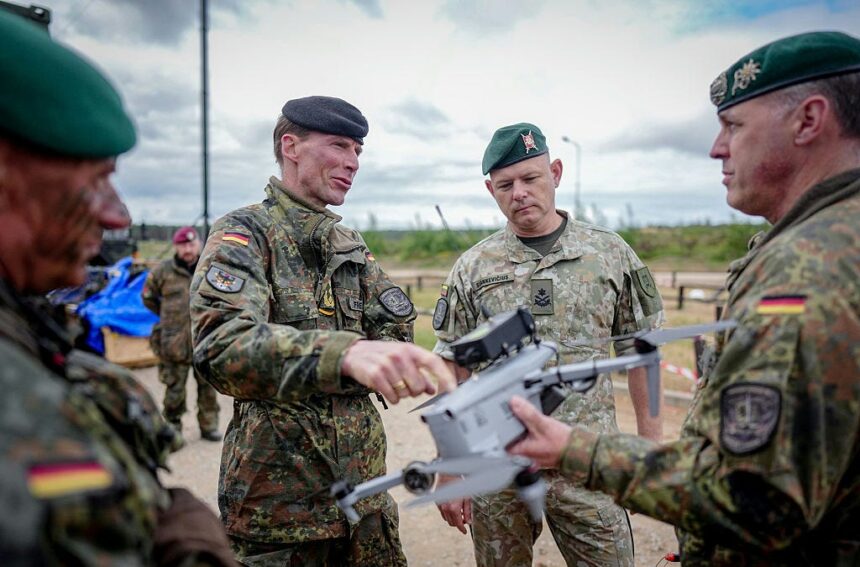
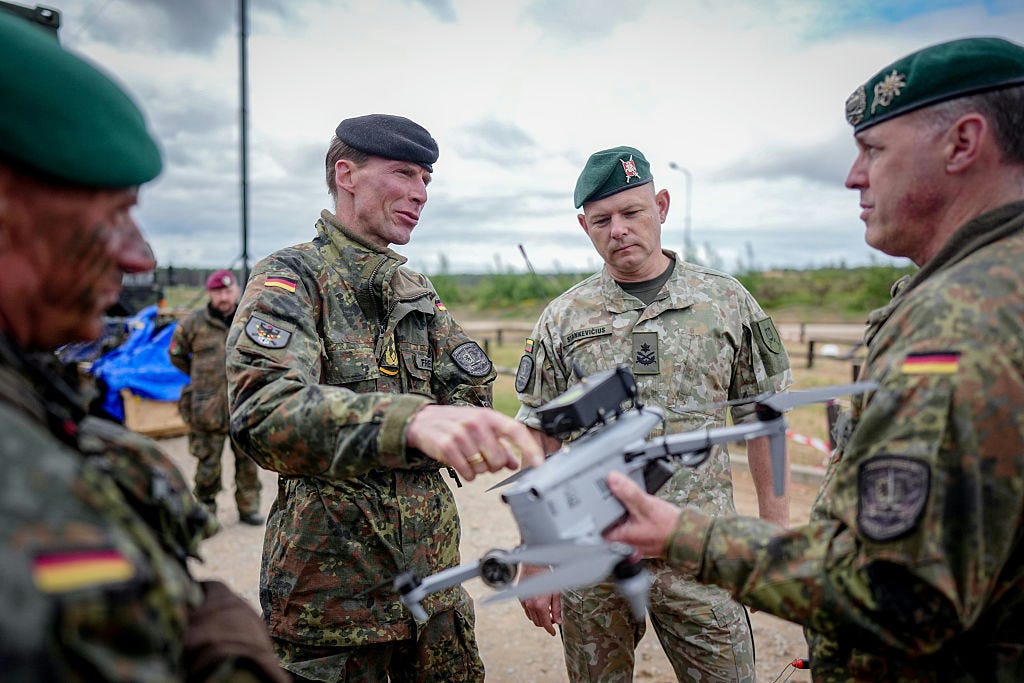
VILNIUS, Lithuania—I’m sitting on a park bench with the commander of the Lithuanian army, Nerijus Stankevičius, talking about the day Russia will attack his country. He calls it “D-Day”—referring not to World War II, but, using its military definition, the day when a combat operation occurs.
In downtown Vilnius, birds are chirping. Tall, good-looking Lithuanians —all Baltic citizens are tall and good-looking—walk to work.
“When D-Day comes, we need to mobilize the reserve forces and fill the structure.” When, not if: That is the clear expectation of the Lithuanian security officials. General Stankevičius, a trim and youthful 49, runs through the requirements of the war in the clinical tone your father might use to discuss how the family needs to get ready for a big vacation trip.
“So, one challenge is that our capital is close to the Belarusian border,” he says. Indeed, to the east, Vilnius is only about 15 miles from a hostile frontier—so close that old-fashioned artillery could fire from the other side and strike us. And to the west? “We have Kaliningrad Oblast, where we have this kind of Russian enclave with huge military forces over there, so . . .threats from both directions.”
In Lithuania’s south these two territories approach one another, squeezing the friendly border with fellow North Atlantic Treaty Organization (NATO) member Poland—leaving only a 40-mile-wide gap, in the midst of which sits the Polish town of Suwałki. It will be a busy place should war begin. Add to these terrestrial concerns the fact that, in a major crisis, Russia would activate air defense bubbles centered in Kaliningrad to the west, Belarus to the east, and St. Petersburg to the north. The result will be that, thus surrounded, Lithuania and its two smaller Baltic neighbors, Latvia and Estonia, will not see the cavalry come to their rescue anytime soon.
Read more