

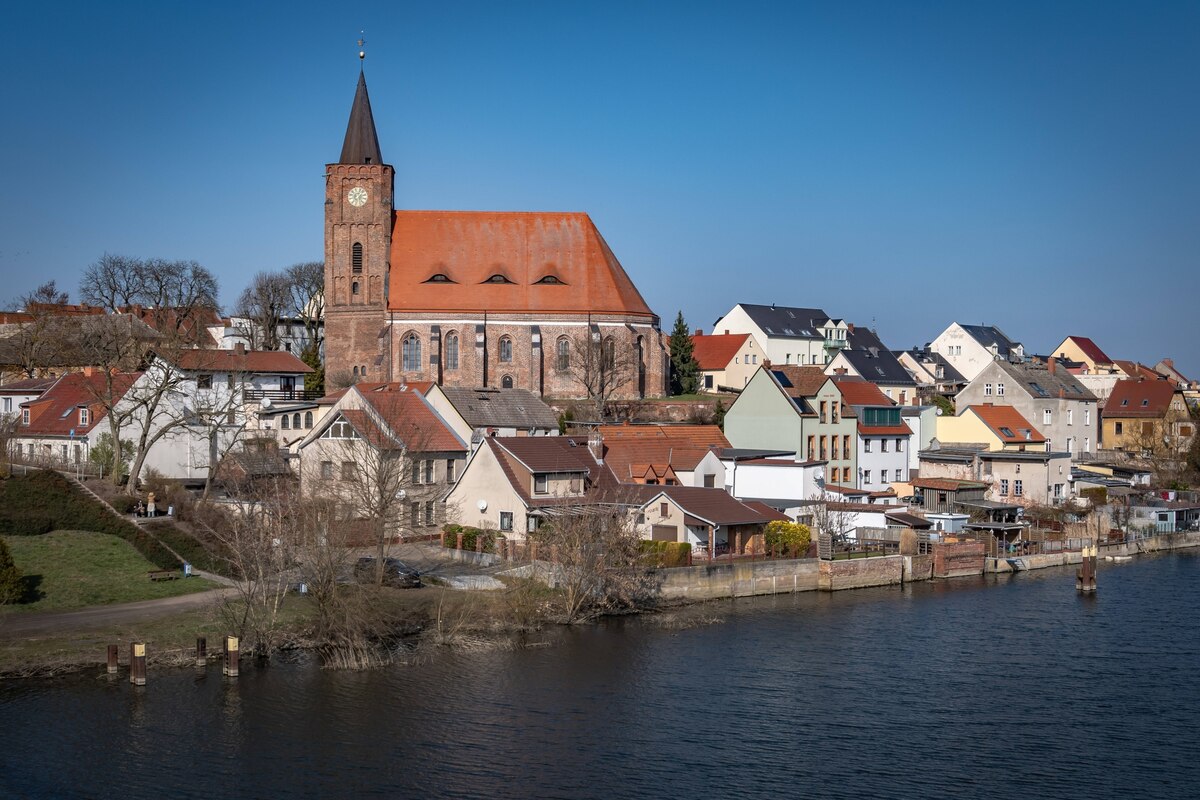
If you like picturesque city views, you should go to the bridge in Fürstenberg. Behind the canal, which flows into the Oder a few hundred meters further, the old town rises on an impressive hill, unusual for Brandenburg. The streets fall steeply down to the bulwark, with the mighty St. Nicholas Church towering above everything. If Canaletto had ever been here, he would have painted a veduta.
Anyone coming from the train station approaches Fürstenberg from the land side. On Fellertstrasse there are one-story and two-story farmhouses lined up, with neat civil servants’ houses from the 1920s in between. The street leads to the market square of Fürstenberg with the town hall, built in 1900 in the neo-Renaissance style.
The town hall has not been able to fulfill its function for too long. “In 1961, Stalinstadt was renamed Eisenhüttenstadt,” recalls Oliver Funke. “And Fürstenberg, which until then had been independent alongside Stalinstadt, was quickly incorporated.”
Oliver Funke is managing director of the Gewi building management company, the name of the municipal housing company in Eisenhüttenstadt. A few years ago, when the renovation of the socialist planned city was essentially completed, he decided to move over. Over the Oder-Spree Canal and the railway line, into Fürstenberg (Oder), the medieval sister of the socialist steel city founded in 1250 from 1950. Gewi renovated 46 apartments in the civil servants’ houses on Fellertstrasse. They will soon be ready for occupancy.
Oliver Funke has immersed himself in a different urban cosmos. “There are families in Fürstenberg who have lived there for generations,” he says, making it clear that a young city has to struggle with completely different problems than a time-honored one. “Families came to the planned city in 1950, consisting of dad, mom and children. But grandma and grandpa still lived in Saxony or Thuringia.”

When Eisenhüttenstadt was new and still Stalinstadt: a family in 1959 with a Trabant P 50 in the middle of socialist housing construction
Photo:
Hannes Betzler/SZ Photo/picture alliance
And there is another difference in this city sisterhood with the considerable age difference of 700 years. It is the housing market, Funke’s very own field. In the core city, which consists of residential complexes I to IV, which has renovated its property in Eisenhüttenstadt, the new rental rents are 6.50 euros per square meter net. “In Fürstenberg, the apartments in the renovated old building are rented for ten euros,” says Oliver Funke.
East or West?
Anyone who arrives at the train station in Eisenhüttenstadt, which now has 24,000 inhabitants, has to make a decision. East or West? Socialist city or Middle Ages? Miserably long walk along a three-kilometer-long road lined with vacant lots, car dealerships and building ruins? Or a nice walk along Fellertstrasse with its farmers’ and civil servants’ houses towards the old town and down to the Oder-Spree Canal?
It is not easy to arrive in Eisenhüttenstadt, even if there is actually something else that attracts you besides the charm of Fürstenberg’s old town. The unique ensemble of GDR building history in the 50s and 60s, once admired by US actor Tom Hanks as a socialist “great and wonderful life”.
In 2024, Eisenhüttenstadt was even named by a travel magazine as one of the most attractive travel destinations in the world, alongside cities such as Hamburg, Brussels, Oslo, London, Paris and Madrid
It’s enthusiasms like these that make Eisenhüttenstadt come back again and again place to be make. In 2024 it was published by travel magazine Geo Season has even been named one of the most attractive travel destinations in the world, alongside cities such as Hamburg, Brussels, Oslo, London, Paris and Madrid. But the cosmopolitan modernism of the early 1950s, Stalin’s confectionery style that followed him, the conservative recourse to national building traditions at the end of the 1950s and the row buildings of the 1960s are among architecture students Must have. At least the planned city can adorn itself with the title of the largest area monument in Germany. He doesn’t protect the city from gradual death.

This text comes from the weekday. Our weekly newspaper from the left! Every week, wochentaz is about the world as it is – and as it could be. A left-wing weekly newspaper with a voice, attitude and the special taz view of the world. New every Saturday at the kiosk and of course by subscription.
Of the 50,000 people who lived in the city after unification, more than half left. The East EKO ironworks combine, which once had 12,000 employees, now only has 2,500 employees. And the prospects are not future-proof. Because green steel is still expensive and there is little demand on the market, the steel group ArcelorMittal has returned a funding notice of 1.3 billion euros to switch to ecological steel production. The fear has been rampant ever since. Would a steel city have a future without steel?
In the east of Brandenburg on the border with Poland, a comparison is often made with Krakow and the steel town of Nowa Huta there. These two city sisters also have a large age difference. But Nowa Huta, where the blast furnace has long since blown out, thrives on influx from neighboring and expensive Krakow. Eisenhüttenstadt cannot live on Fürstenberg. Comparison end.
Eisenhüttenstadt is still losing around 500 residents every year. The bloodletting could only be stopped in 2015 and 2022, when first the Syrian and then the Ukrainian refugees arrived. The vacancy rate in the building industry is now back to 18 percent.
Invitation to try out living
This is also why Oliver Funke decided, together with the city, last year for a free trial stay to invite. 2,000 interested parties applied for the two guest apartments. “Nobody expected that,” says Funke, still happy today. “Even the international media reported on it.” That’s what he wrote Guardian: “A free flat for a fortnight: the German city offering perks to fight depopulation” – “A free apartment for two weeks. How a German city is fighting against population loss.”
Funke also attributes the media response to the fact that the two guest apartments that his Gewi provided are located on perhaps the most interesting street in the city. Because unlike the four residential complexes in the core city, each with their typical architectural history, the Lindenallee as the city’s “main street” is a wild, almost American hodgepodge of architectural styles.
There is the neoclassical Friedrich Wolf Theater on Lindenallee, but also modernist shopping streets, high-rise buildings and the former Hotel Lunik, about which everyone in the city can tell a story. For many it has a similar meaning to the Palace of the Republic in Berlin. According to a report in the taz The speculator Ulrich Marseille sold it to the Gewi, which now wants to revive it.
“The pictures in the media meant that we were able to rent a total of seven apartments,” says Oliver Funke happily. This is one of the reasons why the trial living should be repeated this year – with four apartments instead of two.
Oliver Funke will not be offering any guest apartments on Fellertstrasse in Fürstenberg. Even though they are significantly more expensive than in the planned city – “we didn’t take advantage of any funding and went to the ten euro mark” – the demand is huge. “We could have rented out each apartment three times,” says Funke.
So for now everything stays as it was and is. Fürstenberg with its old town is an upscale residential area, even if many of the shops there are now empty and the only upscale restaurant has closed. And Eisenhüttenstadt, the unusual ensemble of Stalinist and socialist architecture that everyone appreciates – and many abandon.