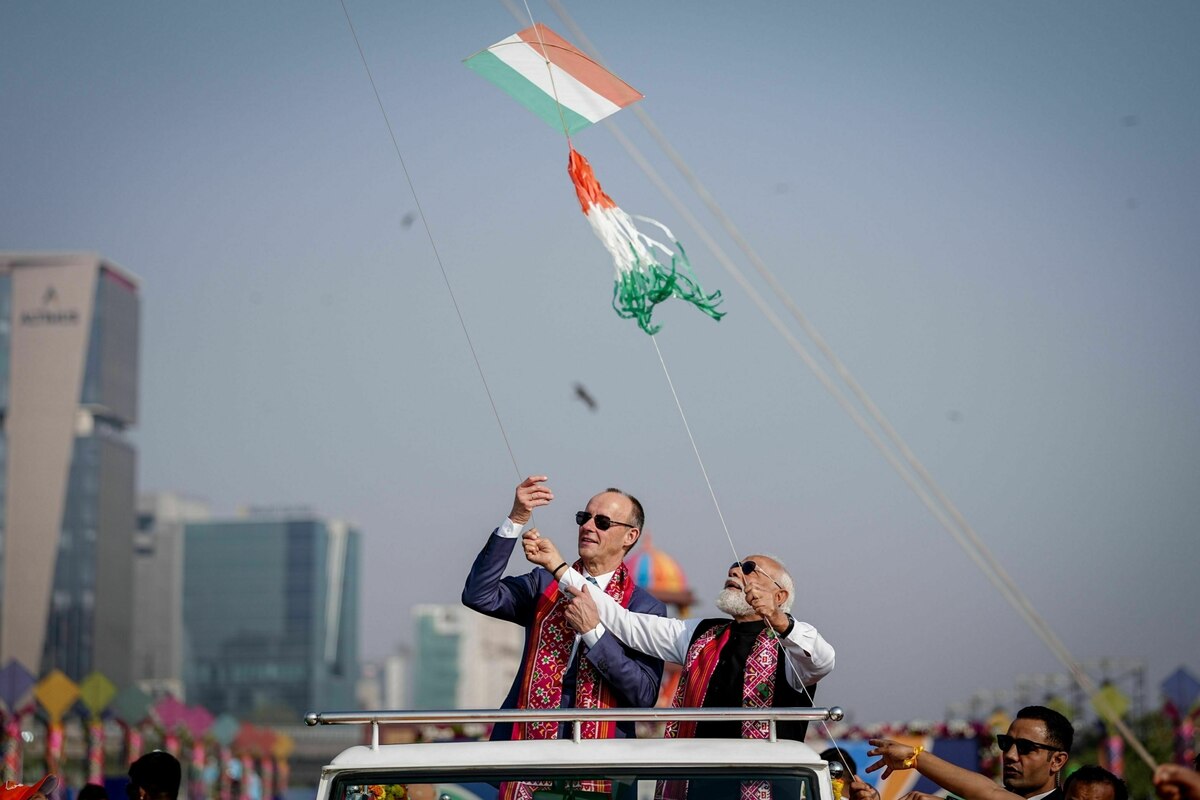
Soldiers have been rehearsing the march over the past few days. Everything should go smoothly at the 77th Republic Day parade in the Indian capital Delhi on Monday. This year’s guests of honor were also carefully chosen: EU Council President António Costa and EU Commission President Ursula von der Leyen travel.
The mood is one of unity: von der Leyen declared before her departure on X that “the mother of all trade agreements” between India and the EU is imminent. She used a term from Indian Commerce Minister Piyush Goyal, who speaks of a “great deal” for India’s export sector.
The EU President was already optimistic during her visit in spring 2025. At that time, tensions in relations with the USA were probably expected in Brussels, Berlin and Delhi. However, the extent is surprising. The time now seems to have come all the more to deepen other partnerships.
India and the EU have been negotiating a comprehensive free trade agreement since 2007. After delayed Mercosur agreement A breakthrough is expected to be recorded on Tuesday at the 16th India-EU summit with Prime Minister Narendra Modi of the Hindu nationalist People’s Party BJP. In addition to the agreement, a security and defense partnership and around 100 other projects are on the agenda, according to Brussels.
India is strategically important for the EU
India has long since become more important for Europe, which is also reflected in the number of high-ranking visits. EU representatives emphasize the strategic importance: “It is a central building block for diversifying supply chains and reducing dependencies,” a high-ranking EU representative from Brussels told media professionals. “The agreement opens new markets, strengthens our economic resilience and forms a strategic foundation for the future.”
For the EU, it is not just about better access to the Indian market, which includes 1.4 billion people and a growing economy. The message is not to rely solely on the USA in times of growing protectionism and at the same time to reduce dependence on China. Federal Chancellor Friedrich Merz emphasized this line during his recent inaugural visit to India.
Sensitive issues remain. The Russian war of aggression against Ukraine is excluded. In Brussels it is accepted that India views the war differently. In the long term, Moscow cannot compete with the attractiveness of Europe. Agriculture and dairy products are likely to be excluded or only included to a limited extent in trade. The CO₂ border adjustment (CBAM), tariffs and quotas for cars, steel and wine from the EU are also up for debate. India hopes to gain better access for exports such as petroleum products, textiles, electronics, gems and jewelry.
In view of the 50 percent US tariffs that have been in effect since mid-2025, Delhi is quickly moving forward with the ninth agreement in four years. German experts point out that recent agreements with Australia or Great Britain, for example, are less profound than the EU agreements with New Zealand or Indonesia, but time is of the essence. Meanwhile, India’s bilateral trade in goods with the EU reached $136.53 billion – with a slight trade surplus in favor of the EU of around $15 billion.
Opportunities for diversification
The summit offers the opportunity to advance Europe’s diversification strategy. Not just to promote tariff reductions, but to establish broader supply chains and industrial cooperation, for example in the hydrogen economy, the solar industry, mechanical engineering or pharmaceutical intermediate products.
Also Skilled workers are on the agenda, but the EU states decide on quotas. In Delhi, the advantages are also seen and pointed out Garima MohanIndian-born scientist at the German Marshall Fund: “In a world of broken alliances and partnerships, Europe and India need each other like never before.”