

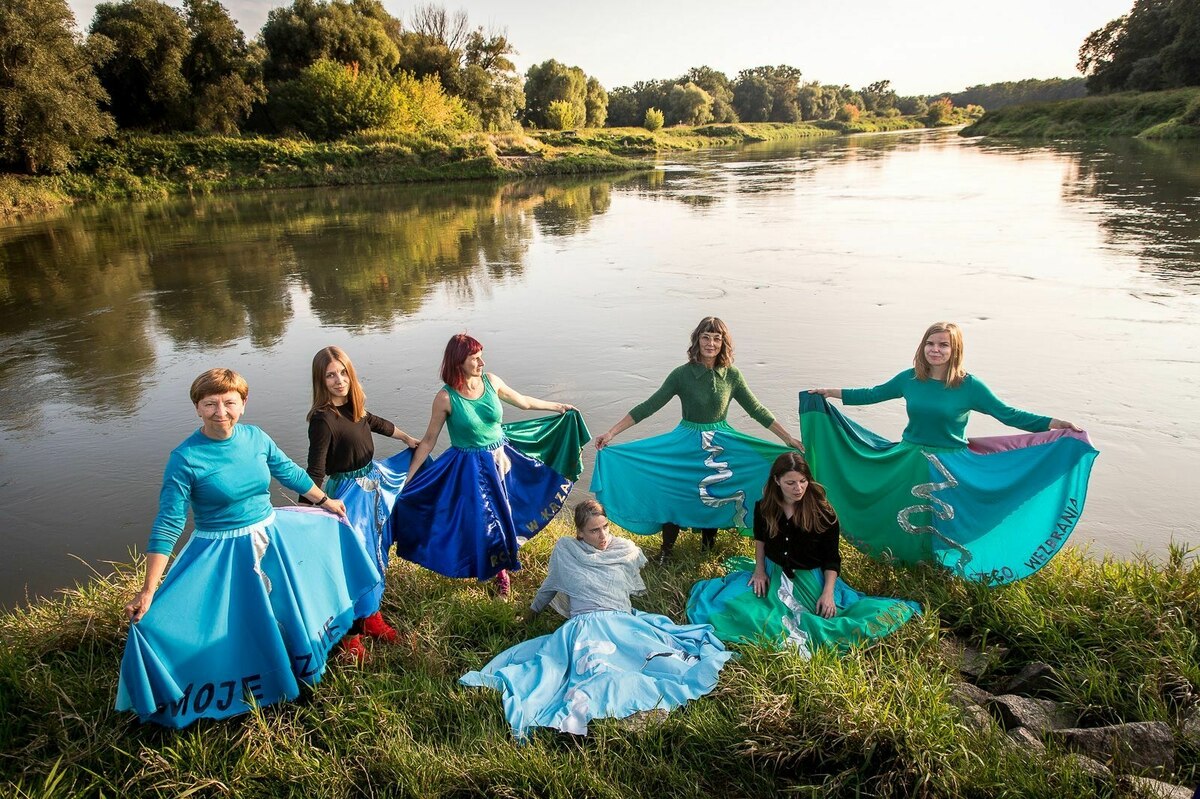
The dancers celebrate the return of the water with wide, flowing skirts. Most of the skirts are blue, as blue as the Oder, which has gained 600 hectares of additional flood plain near the Leubus monastery. A dike had previously been removed. The artist and activist Cecylia Malik calls it a “beautiful and optimistic example of the liberation of a river.”
Malik has worked with the “Flussschwestern – Sisters of the River“caused a lot of uproar in Poland. Most recently, the activists who want to give rivers in Poland a voice demonstrated against the mass death of fish on the Oder border between Poland and Germany in June 2023. They had previously appeared in Leubus at World River Day with the happening “Skirts celebrating the Rising Waters”. Their slogan: “Przestrzeń rzekom” – “Give the rivers more space”.
Some of these skirts are now in the Gallery of the Polish Institute on Burgstrasse at Hackescher Markt. “Art can influence realities,” says Marta Smolińska. “That’s why I brought Cecylia Malik to Berlin with her work.”
Smolińska teaches as an art historian at the University of the Arts in Poznan and curated the exhibition “Pulse of the Oder” for the Polish Institute. Malik’s film documentary “Give space to the rivers, give people security” about World River Day and her performance at Leubus Monastery will also be shown. It also has its say Piotr Nieznański vom WWF Polen. For Smolińska, this is an indication that ecology and feminism have now entered into an “ecofeminist” alliance.
Patriarchy has exploited women and nature
Marta Smolińska, Curator
Is the Or female? Until now, as Marta Smolińska also emphasizes, in both the German and Polish perceptions it was primarily a border river. “But it was never the Oder that formed this border,” emphasizes the curator. “The people alone made the border.”
And not only that. Over the centuries, the Oder was also diked, pushed into a bed and straightened. According to Smolińska, the draining of the Oderbruch alone shortened the course of the Oder by 200 kilometers in the 18th century. “Patriarchy has exploited women and nature,” she says. With her exhibition she now wants to show that this is not the last word in the history of the river.
The work of the Photographer and artist Tom Kretschmerwhich contrast Malik’s performances with a completely different visual language. In his cycle “Atrium Sacrum” from 2025, Kretschmer photographically mapped the interiors of Deadwood in the Oder floodplains.
For Kretschmer, dead wood is “not an end, but a source of new life”. Atrium Sacrum, the holy forecourt, reveals how the seemingly dead becomes the breeding ground for the new. “As we live, we decay. And in decay, new things are born.”
Natural rivers never flow straight. Their coils create biodiversity, resilience and beauty
Tom Kretschmer, photographer
Fascinating is a work that Kretschmer calls “Meander Vitae” – “Windows of Life”. You can see a tracking shot on the surface of the water. “Just above the surface of the water, an immersive, almost surreal journey of reflections, organic shapes and flowing shadows emerges,” writes Kretschmer himself about the project. “Natural rivers never flow straight. Their meanders create biodiversity, resilience and beauty – but we have straightened them to save time and money.”
For curator Smolińska, this work is also an answer to the question: “How does water behave when you give it freedom?”
Questions like these show how our image of rivers has changed. It became apparent soon after the end of the division of Europe that the Oder was more than just a border. New narratives of the river emerged: the Oder as a bridge between Germany and Poland, its catchment area a narrative space in which people tell each other their stories, including those from the dark sides of history.
One person who continued to spin such stories back then was Olga Tokarczuk, who later won the Nobel Prize in Literature. Born in Sulechów on the Oder, the river was already full of mysteries for her, a place of unexpected turns. Ecofeminism is probably a term that also applies quite well to Tokarczuk’s later literary work.

What does the water do when it frees itself? Perhaps it is like the exhibition itself: meandering, surprising, unpredictable. At least Cecylia Malik wants that for the future of the Oder. She tirelessly calls, supported by Olga Tokarczuk, for the “return” of undeveloped floodplains to the rivers in order to minimize the risk of flooding.
A message that unfortunately hasn’t gotten through yet, because art can also bounce off reality. Especially on the Polish side, the Oder is being further hemmed in by upgrading and building new groynes. This is the patriarchal treatment of nature that curator Smolińska complains about.
The Oder itself, that is the message of the exhibition, is female. And she defends herself. Together with the river sisters. Giving them more space: This worked at the Polish Institute.
The pulse of the Oder. Until February 27th. Tuesday to Thursday 1 p.m. to 6 p.m. Friday 1 p.m. to 5 p.m. Burgstrasse 27. 10179 Berlin