

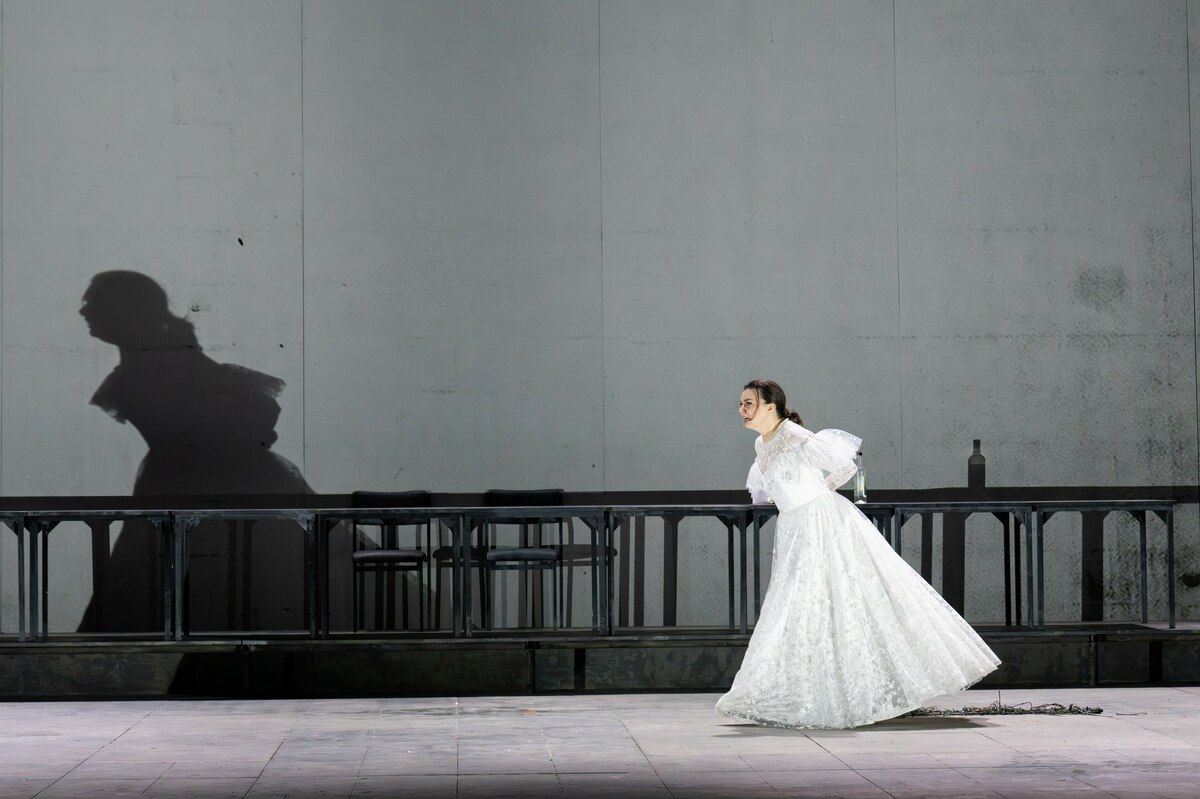
Sometimes the human voice is not enough. When the betrayed Katerina Ismailovna has committed her final murder – not of the faithless lover, but of her rival – the soprano Ambur Braid’s mouth opens into a desolate, long-lasting scream, which does not come from herself, but whose ultimate despair breaks out with the concentrated sound power of the orchestra.
It is an incredibly powerful stage moment – a succinct expression of the madness into which the title heroine has fallen, and at the same time a picture of the relationship between the orchestra and the singers on which this opera is based, in which the latter are not supported or accompanied by the instrumental sound body, but on the contrary are mostly driven by it. In “Lady Macbeth of Mtsensk”. Schostakowitsch the instinctual nature of human nature is poured into music.
This once proved to be his downfall, as Stalin apparently missed the composer’s satirical intention when he attended a performance in 1936 – two years after the acclaimed premiere – only to then declare the music to be “chaos” and the content to be indecent. The successful opera disappeared into obscurity for decades. After Stalin’s death, Shostakovich made a version that was toned down (including a crucial sex scene), but it was only after his own death that the original score was performed again in the late 1970s – in Western countries.
In Barry Koskys The stage is devoid of any eye-warming decorations. Bare gray walls correspond to the desolate coldness of the human relationships depicted. The title heroine, married to an impotent bore, suffers from the lovelessness of her existence and the stalking of her even more virile, dictatorial father-in-law. Hungry for sensual experiences, she falls for the servant Sergei – who in this stage version is more than just a philanderer, but a rapist.
Comedy of exaggeration
Kosky takes the terrible male characters, which are already satirical in nature, and turns them even further into the unbearable. But there is always comic potential in exaggeration. The sex scene between Sergei and Katerina is staged somewhere between horror and satire – as a half-rape, scary at first, but then a laugh track because the actual act takes place under the bed, the mattress bouncing up and down funny. If there weren’t always these moments of redemptive comedy, the human rawness depicted would be difficult to endure.
The scene in which Katerina’s father-in-law dies, poisoned by a mushroom dish that she served him, is also wonderfully dramatic. Dmitry Ulyanov puts in all his physical effort, loses absolutely nothing of his impressive stage presence even when he dies, even falls off the table, onto which he then throws himself again to take his last breath. And while everyone in the audience is still holding their breath, completely under the spell of this dramatic event, a drunk Pope (Dimitry Ivashchenko) comes onto the stage and radically turns the event into something ridiculous.
Such tipping moments between horror and satire consistently run through the evening. This characteristic ambivalence is reflected in the score and libretto; Neither director nor conductor have to reinvent the wheel, but it is important to take the original with its constantly changing moods seriously. James Gaffigan and the Orchestra of the Comic opera whip the people on stage with circus-like orgies of violence that only happen like that; But when a coitus set to music comes to its relaxed end, the audience laughs are sometimes directed at the music.
The great singers fill the almost always almost empty stage with singing and impressive performance alone; This also applies to the chorus of the Komische Oper, which presents collective states ranging from violent, miserable to ridiculously brilliant. But the outstanding leading actress Ambur Braid, whose voice has dramatic depth of expression in all registers, can never be funny. The fate of the multiple murderer Katerina Ismailovna is too tragic.