

“The Voice of Hind Rajab” is a movie that leaves its viewers emotionally destroyed. No one who knows they have a beating and feeling heart within them will be unmoved by the fate depicted here of the Palestinian girl who was killed as a result of an Israeli attack on her hometown of Gaza City.
The film by the Tunisian director Kaouther Ben Hania is based on the real case of Hind Rajab, who was 5 years old at the time of her deathwho, together with family members, came under fire from the IDF in their car in 2024 – following an order from the Israeli military to flee south – for unknown reasons.
According to consistent reports, the events took place on the night of January 29, 2024 in the Tel al-Hawa district. According to research by international media such as Washington Post The family’s car and a rushing ambulance came under fire from armored Israeli vehicles. The IDF denies responsibility for the shelling and said its troops were not in the area when it happened, a statement that contradicts media investigations.
“The Voice of Hind Rajab”. Director: Kaouther Ben Hania. With Saja Kilani, Motaz Malhees and others Tunisia/France 2025, 89 min.
The now released film “The Voice of Hind Rajab” is less concerned with clarifying the exact circumstances of the family’s death than with an emotionally stirring portrayal of the girl’s desperate fight for survival from the perspective of her rescuers. The film is based on audio recordings of the night in question, which come from the operations center of the Palestinian Red Crescent Society (PRCS) in Ramallah, where the emergency call from the girl and her cousin, who initially survived, was received.
Saviors struggling to keep their composure
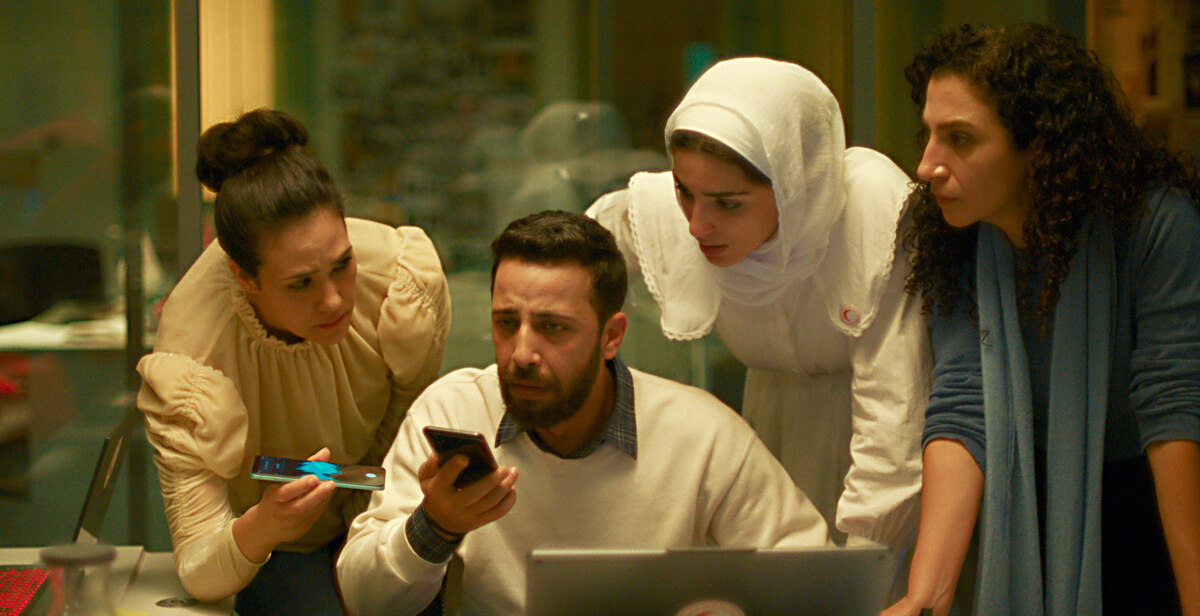
Director Kaouther Ben Hania chooses a half-documentary, half-fictionalized scenario for “The Voice of Hind Rajab”: around the audio documents, the Tunisian creates a dramatized drama that describes the desperate rescue attempts in the local rescue center. A re-enactment of the fateful night from a Palestinian perspective, which places its audience right in the middle of the aid organization’s control center, where dedicated helpers fight for the life of the 5-year-old with the few resources available to them as the almost 90-minute action continues.
The aim of the helpers, including those on duty Omar (Motaz Malhees) and Rana (Saja Kilani): to enable an ambulance mission that will take the girl out of the danger zone. Viewers experience the psychological impact with which the 5-year-old’s sentences spoken into the telephone hit the helpers. “They’re shooting at me,” “They’re all dead,” “There are only corpses left,” we hear the girl say and soon plead, accompanied by close-ups of the faces of the horrified, largely helpless rescuers, who struggle for composure, cry, and sometimes collapse.
The dramaturgical increase in the film consists of a constant turning up of the metaphorical emotional regulator. The situation only becomes more and more desperate for those involved in the operation area over the course of the game. The director gives her viewers little to no scope to think about the scenes or ask themselves further questions.
We would like to show you external content here. You decide whether you also want to see this element:

“The Voice of Hind Rajab” is a film that is intended to vehemently emotionalize, awaken, and shock. A narratively crude, almost blackmailing gesture that requires viewers to share the emotional states of the protagonists through excessive closeness. Ben Hania’s dramatization hardly ever includes a broader focus on Palestinian society.
Overwhelming at the expense of the original material
Only once does an argument between Omar and the head of the emergency center, Mahdi (Amer Hlehel), who relies on cooperation with Israeli authorities to save the child, give an impression of intra-Palestinian conflict. “We are under occupation because of people like you,” Omar accuses his colleague of his collaborative approach.
The perpetrator-victim structure between Israelis and Palestinians is a silent basic assumption Ben Hanias since its premiere at the 2025 Venice Film Festival critically acclaimed drama. Some people also accused the film of being one-sided because it left out the important context of October 7th.
Of course, it is not a written law that a work of art must always include all facets of an event when viewed. A film can be radically one-sided and even biased. The question is rather whether the narrative-aesthetic settings lead to a promising discussion among viewers.
“The Voice of Hind Rajab” hardly allows for this with its overwhelming gesture, but rather achieves its emotional effect at the expense of the original material, which raises the question of whether the voice of a dead girl should be instrumentally dramatized.