

K Hardly a minister in the black-red federal government ignores the state of science as consistently as he does Alois Rainer. The CSU politician who is responsible for agriculture in the cabinet, for example, claims that people have to no less meat and consume milk. The connection is obvious: if less meat and dairy products were eaten, fewer animals would be kept and accordingly fewer greenhouse gases expelled.
According to the Federal Environment Agency, agriculture caused emissions from soil and machinery in 2023 14 percent of emissions in Germany. Around 40 percent According to calculations by the Agora Agrar think tank, this amount in 2020 was accounted for by livestock farming and manure such as manure. In addition, the cultivation of feed contributes, for example, to plant and animal species becoming extinct or the groundwater becoming polluted with pollutants.
Not to mention the fact that people in Germany eat more meat on average than nutritionists consider healthy. But less meat and milk would mean fewer profits for farmers. And Rainer obviously cares about them above all else. In his first year in office, he largely implemented what the agricultural lobby expected of him. That’s why his first Green Week, the world’s largest agricultural trade fair in Berlin, is also a feel-good date for him.

Climate-damaging subsidy
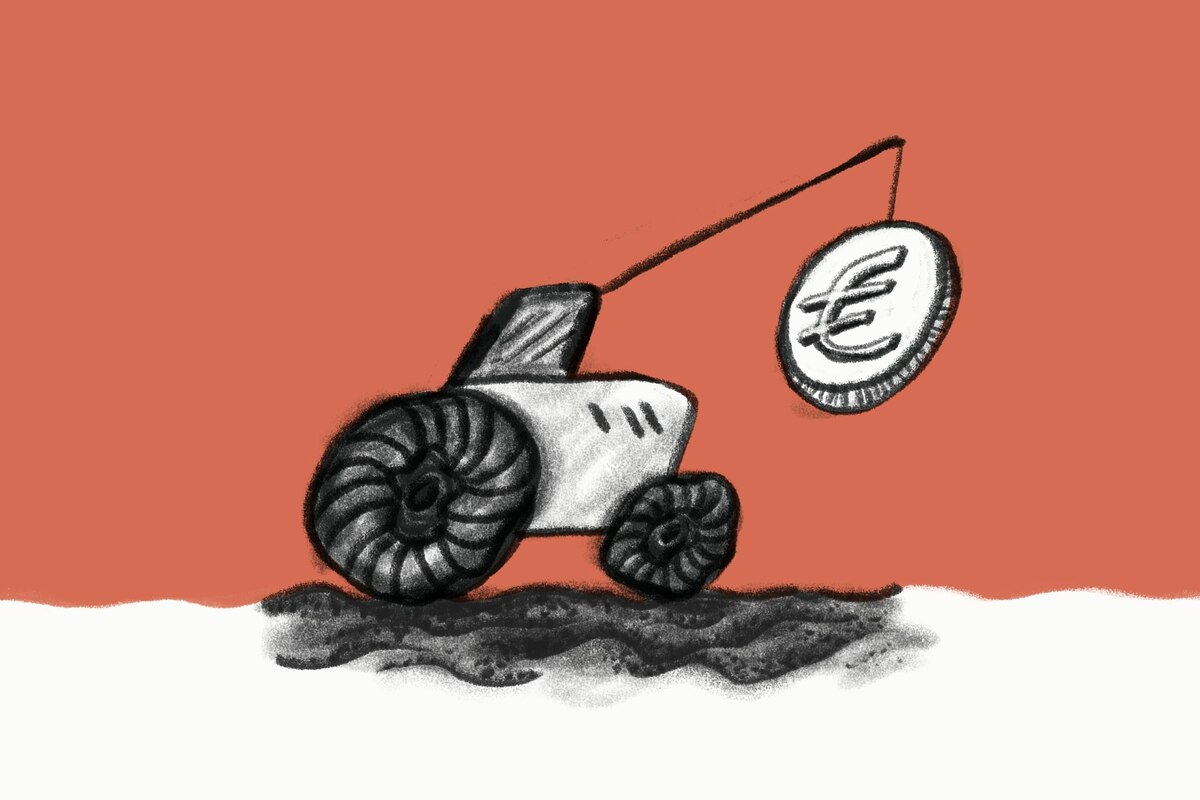
The CDU/CSU-SPD coalition has already done the German Farmers’ Association many favors: Since the beginning of the year, farmers have been able to get almost half of the energy tax on diesel, which they use to power their tractors, for example, refunded. That costs the state 430 million euros per year and reduces incentives to save climate-damaging fuel.
As one of his first official acts, Rainer removed the obligation for many farms, one Material flow balance to set up. She used evidence to show how much nitrogen and phosphorus come onto the farm through fertilizer and how much flows out in the form of products. With this balance it would have been very easy to determine which farms were really fertilizing too much. But the farmers’ association apparently didn’t want that. It is very convenient for him that Rainer wants to weaken the fertilizer regulations even further.
What is needed are stricter rules against over-fertilization, subsidies for better animal husbandry and possibly a pesticide tax
According to figures from his own ministry, agriculture is still making a profit around 70 kilograms of nitrogen more per hectare and year than it binds through plant or animal products. The excess pollutes the groundwater from which most drinking water is derived, creating potential health risks. Too many nutrients from agriculture also contribute to algae growth in the oceans. In the Baltic Sea, this repeatedly leads to fish deaths due to suffocation when the algae decay and deprive the water of oxygen.
Stable conversion program scrapped
Even for the farmers’ association, Rainer was the most important thing Funding program for more animal protection ended in agriculture. The subsidies for stables with phase-outs, for example, as part of the federal program to convert animal husbandry are soon to be eliminated. He had the state labeling of the farming method for pork postponed twice, possibly to St. Nicholas Day. Higher taxes on meat Rainer had even rejected the proposal for animal welfare before he took office.
Most animals in Germany live under conditions that… According to surveys be criticized by many people. For example, most pigs in conventional housing are never exposed to fresh air; part of their tail is cut off and their canine teeth are ground down. Many dairy cows cannot move normally due to a painful leg condition.
Rainer also made the exploitation of “harvest helpers,” for example, easier. Seasonal workers have been allowed since January 1st 90 working days instead of the previous 70 employed without social security contributions being due. As a result, social security funds lose income, while workers often have less protection.
In addition: On Rainer’s initiative, the federal government – not the chemical industry – covers the treatment costs for the occupational disease “Parkinson’s caused by pesticides“ among farmers. To this end, the Ministry of Agriculture is increasing its annual subsidy for agricultural accident insurance by 20 million euros.
The main thing is that agricultural entrepreneurs earn more
The list goes on. It makes it clear: Rainer is pursuing clientele politics for the agricultural lobby. He cares little about the environment, farm workers, taxpayers or animals. The main thing is that farmers – i.e. agricultural entrepreneurs – earn more. This may work in the short term. But in the long term, Rainer’s policies also harm the farmers themselves.
Climate change will increasingly endanger their yields if it is not curbed, including through contributions from agriculture. If many farmers continue to grow too few different types of crops, their risk of crop failure will increase. If German farmers do not focus on more animal protection, they will lose out to cheap competition with their meat and dairy products, which are more expensive due to higher labor costs. If they reduce biodiversity through over-fertilization and pesticides, insects that pollinate farmers’ plants can also suffer.
Therefore, in the interests of farmers, Rainer must change the fertilizer regulations so that they actually prohibit over-fertilization. Most farmers would not have to fear a material flow balance. It would enable the authorities to specifically sanction only the minority that continues to over-fertilize. And preparing the balance sheet is not as complicated as the farmers’ association claims: The National Normenkontrolrat has found that companies only around five hours would have to spend on preparing the balance sheet – per year.
Agricultural subsidies only for the “good” farmers
Privileges such as the reimbursement of energy taxes on diesel for tractors should be eliminated. Not only are they unfair to other industries, but they also subsidize a greenhouse gas-intensive form of propulsion. Systems have been on the market for a long time Tractor tire pressure regulate in such a way that diesel consumption decreases. In fact, many farmers forgo it because they don’t have to pay much for fuel anyway. In addition, electric motors for smaller machines would be more competitive without diesel subsidies.
Instead, there should be support from households for farmers who keep their animals much better than required. Such subsidies should also go to farmers whose animals are particularly healthy in comparison and do not suffer from painful diseases.
The EU – with the support of the Federal Government – should only pay its current annual agricultural subsidies of around 60 billion euros to farmers who do more for the environment and animals than they have to do because of the relevant laws. Rainer must use the right that already exists to use EU funds to support the comparatively species-appropriate keeping of animals on pasture. So far, subsidies have mainly been provided per hectare. The environmental requirements are low.
If this redistribution is not enough, the state could also improve agriculture through taxes on pesticides, mineral fertilizers and meat.
“Farm death” does not mean the end of agriculture
Then won’t all our farmers go bankrupt? Several facts speak against this: the EU protects important markets such as milk and beef through tariffs against cheap imports that may be produced under worse conditions. Even trade agreements with Canada, for example, only grant limited quotas with low or no tariffs.
Denmark has proven with its tax on pesticides that an EU country can take such steps on its own without ruining its agriculture in the face of European competition. It depends on the amount and the interaction with the other framework conditions that the respective state sets.
How little influence agricultural policy has on farm death is impressively demonstrated diagram with the number of farms over time. The curve has been pointing downwards at largely the same, very steep angle since 1950. No matter who ruled. The fact that developments are similar almost everywhere in the world also suggests that politics have a minimal influence: in the EU anyway, in the USA, in Australia, in Japan, even in countries like Norway or Switzerland, which isolate and subsidize their agriculture particularly heavily. Company closures can therefore hardly be explained by environmental or animal welfare requirements.
Incidentally, the “dying of farms” does not lead to significantly less food being produced in this country. Although the number of farms has fallen sharply, the area used for agriculture remains at approximately 17 million hectares stable. The abandoned farms are not replaced by businesses abroad – but by their neighbors.