
Yaoundé, 32 degrees. Every now and then a rain shower falls. “I thank the sovereign people who elected me,” read large posters in the capital of Cameroon. The world’s longest-serving dictator, Paul Biya, 92, looks paternally down on saleswomen who sell delicious roasted peanuts in old whiskey bottles. On mobile phone dealers, kiosk owners between parasols, smelly yellow taxis, fragrant hibiscus flowers on the street – just a few weeks after his presumably rigged election.
In Cameroon there is suspected electoral fraud caused unrest, in the southwest there were demonstrations, tear gas, arrests, deaths. There, on the border of Francophone and Anglophone Cameroon, a civil war has been raging for decades, which has already claimed around 14,000 lives and is largely ignored by the world.
The situation was so heated that the dancer, choreographer and performer Zora Snake moved his Modaperf festival to Jaundé, in the interior of the country, for security reasons – although it otherwise travels to Dschang and Douala, to remote villages and colonial towns on the coast, every two years since 2019. In Jaundé, on the other hand, where the monstrous, UFO-like presidential palace is located in a golf-like complex on one of the seven hills around the capital, is the world of dictators still under control.
I want to use art to create the future and initiate local development, to heal society – and to reconcile it with its history, to connect with traditions that have been destroyed by colonialism. Zora Snake, festival organizer
There is repression and fear
“As long as Jaundé breathes, Cameroon lives,” Paul Biya said as a slogan. The controls here are tough: there are road barriers every few hundred meters, driving licenses, visas and passports have to be shown, and government officials also appear at the festival in civilian clothes. The artists present only talk about the real situation in the country, repression and threats, the arbitrary imprisonment of the opposition activist Anicet Ekane, if they promise not to mention any names.
A kind of collective political resignation had gripped the young generation; Unemployment, corruption, poverty and an increasing drug problem are rampant in Cameroon with its great potential, says the director of the Goethe Institute in Yaoundé, Thekla Worch-Ambara. She believes that the country’s young people – on average 18 years old – were more likely to hope for the dictator’s death than to plan a real coup. Which doesn’t mean that things will get better after that – Biya’s wife Chantal, who is 36 years younger than him, is also in the starting blocks.
Festival for “Dance, Movement and Performance”
Nonetheless. For the seventh time, the internationally sought-after Cameroonian performer and dancer Zora Snake has organized Modaperf, a festival for “dance, movement and performance”, with a close-knit group of friends, for “spiritual and political reasons”, as he says: “Movement can also mean social movement. I want to use art to create the future and initiate local development, to heal society – and to reconcile it with its history, to connect with traditions that have been destroyed by colonialism.”
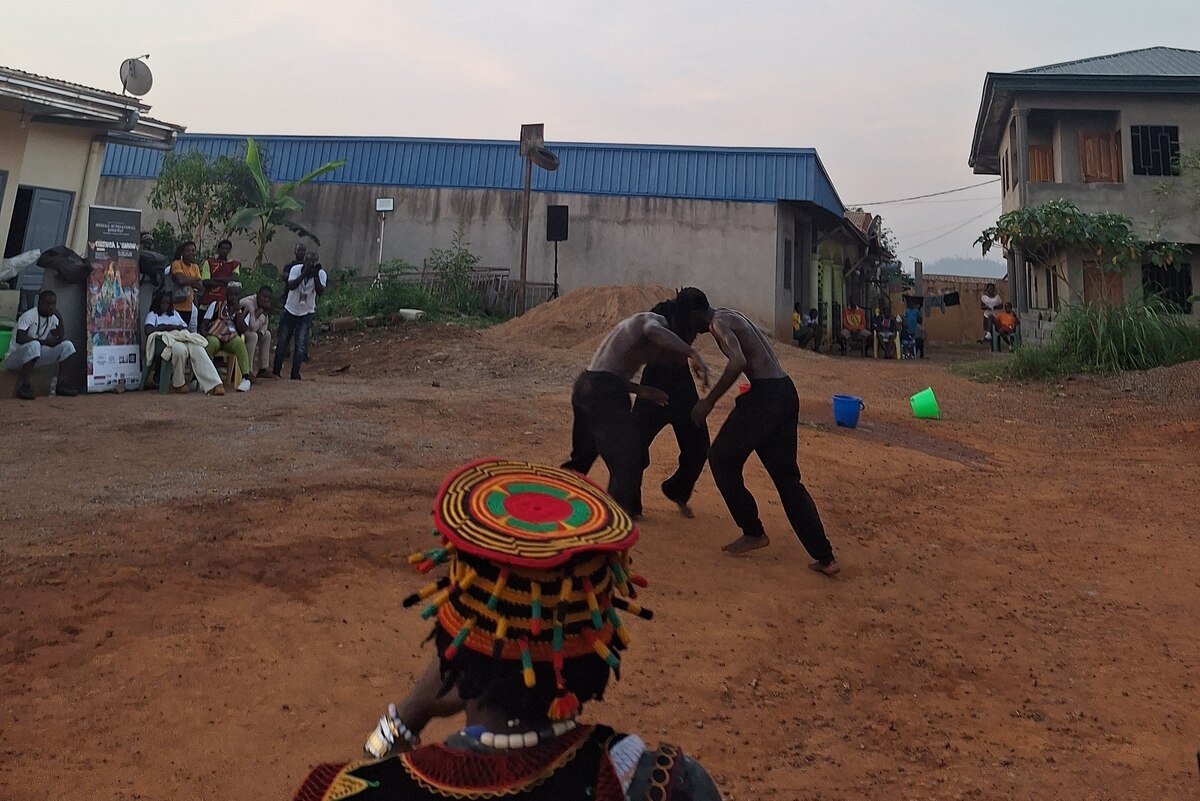
That’s why the performances mostly take place in public spaces; there are hardly any cultural venues in Jaundé anyway: in markets, holy places or village courtyards. Or on busy streets: the Musée de l’art company from the Republic of Congo suddenly runs into the middle of the traffic flow with their fanfare. They stand in front of cars, throw the drums in the air and let them spin. Acrobatics mixes with concert vibes.

The Musée de l’art company from the Republic of Congo suddenly walks into the middle of the traffic flow with their drums
Photo:
Ariel Lasry
Many passers-by start dancing and walk with the performers down the side street to the Afrotopos cultural site with its cozy inner courtyard under a huge mango tree. This was once the private home of priest Pie-Claude Ngumu, who left the Catholic Church to become an ethnomusicologist. After his death he left it to the cultural scene. A colorful mix of artists, residents and festival visitors gather here every day.
Around 300 ethnic groups live here
“Cultiver l’union” is the motto this year, “cultivating unity”. Not easy in a country with around 300 ethnic groups. Zora Snake has great visions – and yet is hardly supported, not even by the Goethe-Institut. Nevertheless, works from Cameroon, Congo-Brazzaville and Burkina Faso will be shown over the five days; only the artists from Ivory Coast did not receive a visa – which is already quite expensive at 160 euros (for Europeans).
Two French guest artists – Karelle Prugnaud and Louise Soulié – give workshops for young dance talent. One of the highlights is a big dance battle in krumping and popping, to which dancers come from all over the country. Zora Snake also learned his art on the street. In any case, he is a phenomenon, an artistic figure who combines spiritual traditions and artistic border crossings, who sometimes burns himself during his performances and throws money into the audience.
At the beginning of the festival, he ceremoniously has himself shaved next to the stage, sometimes sits impishly in the mango tree and gives brilliant speeches from there about the social function of art. At the premiere of “Combat des lianes” at the National Theater in Brussels, he appeared dressed as a tree after the performance.
One of the most magical moments of the festival can be experienced at Chefferie Shell Nsimeyong, a spiritual village unit in the middle of the city that is considered its own regulatory unit. In the middle of dusty Yaoundé, small houses are grouped around a beautiful courtyard.
Art illuminates places
The boss is sitting in the audience, there is beer, grilled bananas and meat skewers, and around 30 children are running around. In quiet concentration, eight performers dance in every corner, climb onto roofs, swing from window shutters or clotheslines, triumphantly carry painted pictures around: art also illuminates places that it would otherwise never reach.
Things get crazy when the French artist Karelle Prugnaud arrives in a taxi as a masked bride, throws rose petals and demands likes, denounces misogyny on the Internet and then strips almost naked – and at the end asks the Chefferie children to destroy dummy cell phones. But the boss lets the foreign western art in the village take its course and at the end blesses all the guests individually.
The artist discussions that take place every morning in Afrotopos are also exciting and extreme: deep insights into Cameroonian conflicts, masterfully moderated by the scientist, performer and Modaperf co-founder Toutou Ditchou, a mixture of heated art criticism, introspection, anger and reconciliation.
Polygamy is an issue and also everyday life
Stark topics are touched on: What it’s like to grow up in a polygamous family – where a constant competitive situation turns concubines and a group of children into enemies in everyday life. At the same time, it is a protective social construct: four of the twelve or so men present know the situation or live it with their own wives.
But there is also a lot of discussion about the situation of women and feminism – which is considered a dirty word and a “Western” concept here. Nevertheless, many of the young dancers bravely talk about how they struggle with their families, see their profession despised, and feel that they have been sorted away as a “diamond” inside the house because this is a spiritual “tradition” – an argument that can also be wonderfully twisted as decolonial “resistance” against the West.
The artist Reine Eben, 29 years old, performs a clear rebellion against this. For her work “L’attache” (a play on the words “chain” and “duty”), she wrapped herself in red and white police tape. She unwraps herself in front of a wooden frame, throws herself on the floor, complains about the men’s gaze on her body, the pressure on a woman that becomes even stronger when she becomes a mother – “When I lost my newborn child, I was accused of dancing too much,” she says, “Now I want to use art to advocate that women can be whatever they want.”
Colonialism and racism
Of course, colonialism is also an issue. The piece “Djabama Land” comes from the Avant-Scène company and was supported with money from Berlin. In historical costumes, an excerpt shows how German colonialists stole art objects and acted racistly during the 32 years of their rule in Cameroon – which, however, was not quite as genocidal as in Namibia. It is also viewed positively by many Cameroonians.
“If the Germans had stayed instead of the French, things would be better for us today,” says one festival visitor. Why do you always have to victimize yourself, criticizes another viewer. It feels like colonialism has been over for ten generations. “We should reflect on our traditions, modernize them carefully – but not complain all the time.”
Repressive final destination for some
And then on the last day of the festival, even in Jaundé, you can feel the great shock, sadness and depression going through the Cameroonian artists. The opposition politician imprisoned shortly after the elections Anicet Ekane, 74 years old, died unexpectedly in prison. He was given it upon arrest his oxygen device was not made available. The newspapers print his portrait and people quietly whisper about it in taxis. Horror and misery, resignation and sadness mix.
As lively, community-building and joyful as the Modaperf festival was, the country with great potential is, for some, a repressive final destination.