

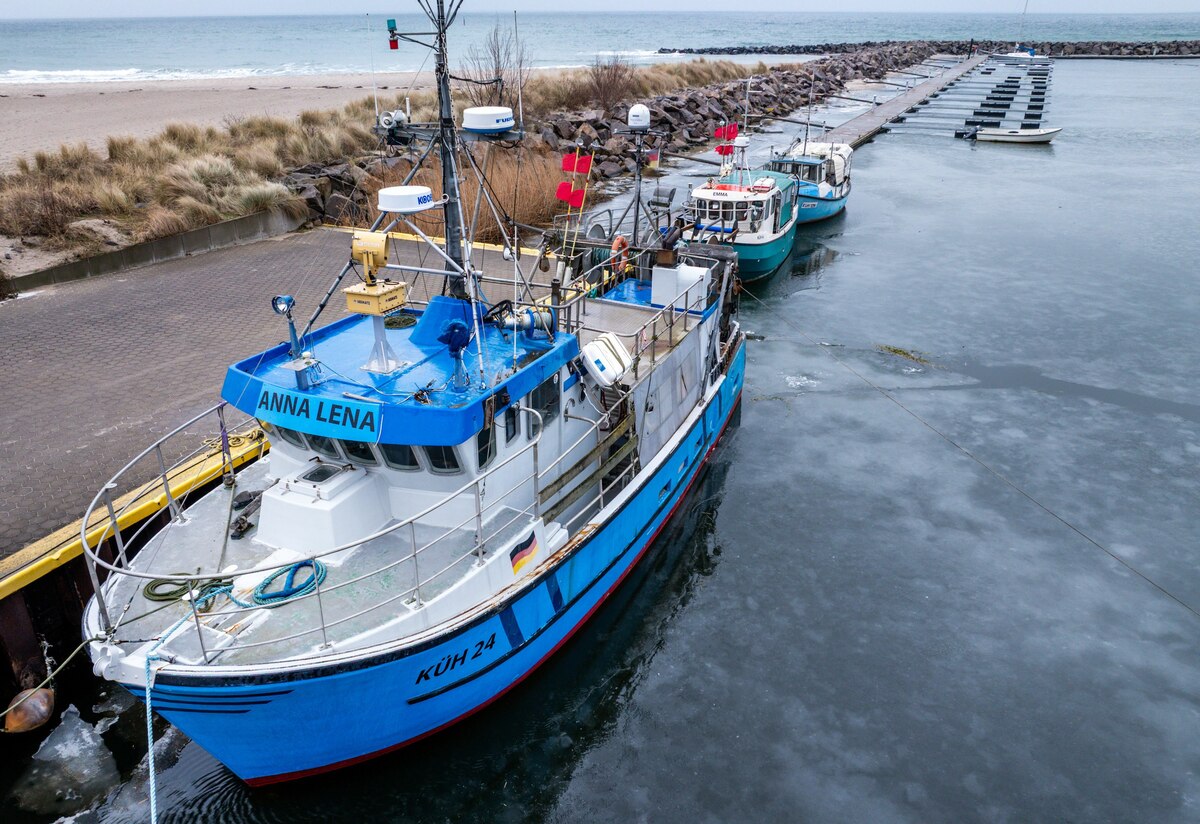
At the beginning of the 1990s, the number of fishing companies on the German Baltic Sea reached four figures. There are now fewer than 300 in full-time employment.
dpa | The precarious conditions for fishing on the German Baltic Sea coast are causing the industry to continue to shrink. According to the latest figures from the relevant state authorities, Schleswig-Holstein and Mecklenburg-Western Pomerania, at the end of 2025 a total of 285 cutter and coastal fishing businesses will still be registered as their main occupation. According to the information, there were 303 a year earlier and 385 at the end of 2021.
According to the Schwerin Fisheries Ministry, the latest decline was expected, but was still comparatively small. One reason why only three fishermen in MV recently gave up their main occupation could be that this year, for the last time, premiums will be paid for temporary closure for mainline businesses. This contributes to its continued existence. Companies would also be compensated for damage or losses caused by seals until the end of 2027.
Ministry speaks of “extremely poor fishing opportunities”
The stocks in the Baltic Sea stand because of climate changeoverfishing and nutrient inputs are under great pressure. Species such as herring and cod, which were once important for the livelihood of local fishermen, are no longer allowed to be caught at all or only in a few exceptions. At the beginning of the 1990s, the number of fishing companies on the Baltic Sea was still in the four digits.
The Schwerin ministry expects a further decline in the number of businesses “due to the persistently extremely poor fishing opportunities, which is reflected in the historically lowest quotas, as well as demographic developments”. The State Office for Agriculture and Sustainable Rural Development in Schleswig-Holstein made a similar statement.
Some of the fishermen would probably switch to part-time employment, it was said from Schwerin. But the numbers there have also been declining for years. Most recently, a total of 281 part-time fishing businesses were registered on the German Baltic Sea coast. At the end of 2024 there were 304.
Together for a free press
As a cooperative, we belong to our readers. And our journalism is not only 100% non-corporate, but also accessible free of charge. We make all articles freely available, without a paywall. Especially in these times, classifications and information must be accessible to everyone. Our readers don’t have to pay anything, but they know that critical, independent journalism doesn’t emerge from nothing. We are very grateful for that. So that we can continue to do our journalism tomorrow, we need more support. Our next goal: 50,000 – and with your participation we can do it. Set an example for the taz and for the future of our journalism. With just 5 euros you are there!
Support now