

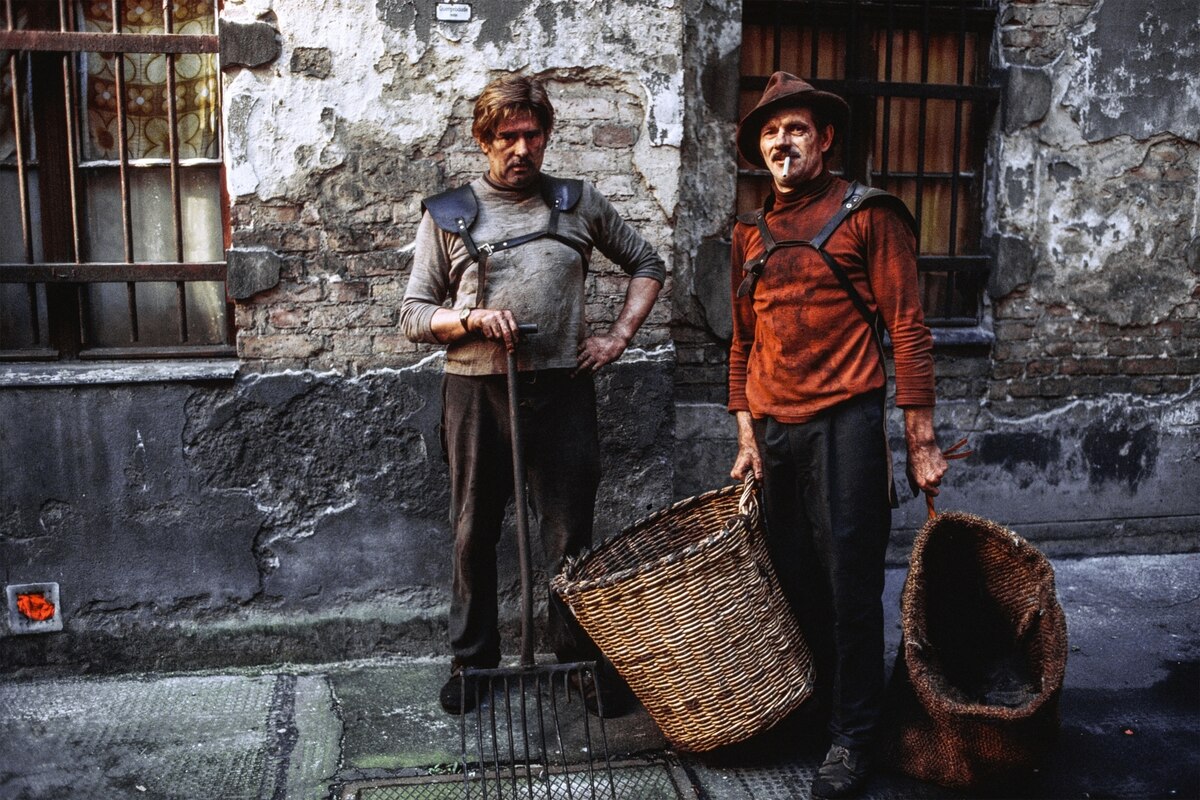
A picture that stands out of the ordinary, an installation of ballroom and shift work: On Berlin’s Oranienburger Strasse, two coal miners stand under a chandelier, black dust and cut glass meet under one roof. The photographer Thomas Hoepker captured the sooty journeymen in 1974 as they delivered their much-coveted goods to East Berlin’s working-class district of Prenzlauer Berg; The ceiling chandelier belongs to the restaurant in whose neighboring room the photo book publisher Buchkunst Berlin is now showing a selection of Hoepker’s photographs from the GDR from 1972 to 1990.
“East Germany Color Works”, the title of the exhibition already suggests what is special: the “working society” of the GDR, like them the sociologist Wolfgang Engler is shown not in black and white, but in color photographs. That doesn’t make the GDR a lost paradise, but Hoepker’s pictures are neither suitable for frivolous denunciation nor for melancholy glorification. They show departure and darkness.
Thomas Gust, the curator, runs Buchkunst Berlin together with his partner, the gallerist and publisher Ana Druga. He comes from Bautzen, the southeastern corner of the GDR near Poland and the Czech Republic. The exhibition is a matter of the heart for him, who works as a photographer himself, as he leads through the room and points out another motif: a quintet of young people gather on Simson mopeds at a historical boundary stone.
The year is 1975; It’s still winter or soon, the gang’s clothing suggests; Bobble hats and anoraks smoke and discuss things, it could be about the evening or the direction. For Thomas Gust, this place in Sorbian will become a place of pilgrimage for his personal church from below: he regularly and loyally visits one nearby Punk disco.
Gust was born in 1972. In the same year, his namesake Thomas Hoepker photographed families who had been separated by the construction of the Wall in 1961 and who were now able to meet again as a result of the Four-Power Agreement, which allowed West Berliners to enter the East and the GDR. The joy of reunion and the moments of warm collectivity are palpable.

Reports for the star
Two years later moves the photographerhe is at Stern made a name for himself in Hamburg, as a technical employee for his wife Eva Windmöller in East Berlin. She is a journalist and is published in several Stern-Reports without foaming at the mouth about everyday life and the rituals of the GDR, he provides the pictures.
One of them shows a couple on the sidelines of an air show in Magdeburg in 1974. The photo is notable for several reasons. It demonstrates Hoepker’s almost somnambulistic yet confident handling of colors. One might think that Hoepker only pulled the trigger because of the fantastic yellow and green tones, which of course is not true. The photo tells more.
The olive-colored truck the two of them are sitting in front of is a W50. The vehicle is omnipresent in the GDR and is used to transport milk and prisoners. In the 1980s the W50 would be exported to Iraq and Iran, on both sides of the Gulf War. So much for proletarian internationalism.
The young man’s light green uniform is one of the Society for Sport and Technology, a pre-military mass organization in the GDR. The wearer makes a very unmilitary impression; his girlfriend is dressed in civilian 1970s yellow. Annette and Axel Heinemann will get married and celebrate their golden wedding anniversary in January 2026.
Her privileged moment, a kiss in the middle of a folk festival in the service of military advertising, is now the cover photo of the exhibition catalog. You come to the finissage.