

Five daring men in leather jackets, with coffee cups in their hands, look coolly at the people strolling in Deribasowska, Odessa’s pedestrian zone. Next to them is their pride and joy: five heavy Harley-Davidson motorcycles. 200 meters away, several dozen people, mostly young people, are standing and listening to two singers.
If you didn’t know that there was war in Ukraine, you wouldn’t notice it here in the pedestrian zone of Odessa. “Odessa is the only Ukrainian city, apart from the occupied territories, with direct access to the sea,” says Anna from Kharkiv. “And that’s why I sometimes come to this beautiful city for a week,” she adds.
She is one of the few in Ukraine who can afford a vacation to Odessa several times a year. You pay between 200 and 400 euros per week for a holiday apartment here.
But the pedestrian zone with its cozy restaurants, bars and cafés, its street music and tourist groups is only a small part of the reality of the port city, which, as the well-known song “Oh Odessa, Pearl by the Sea” says, has seen a lot of suffering.

The large-scale Russian war of aggression against Ukraine began with the invasion on February 24, 2022. The annexation of Crimea took place in March 2014, and shortly afterwards the conflict broke out in the eastern Ukrainian regions.
The majority of its residents cannot afford to eat pizza in the pedestrian zone. As in other Ukrainian cities, in Odessa there is an invisible dividing line between the local property owners and the largely dispossessed internally displaced people. And while more and more Odessites are leaving the city, the number of internally displaced people is also increasing. This also affects the cityscape. The new people from Donbass are dressed more simply.
Donations from Italy
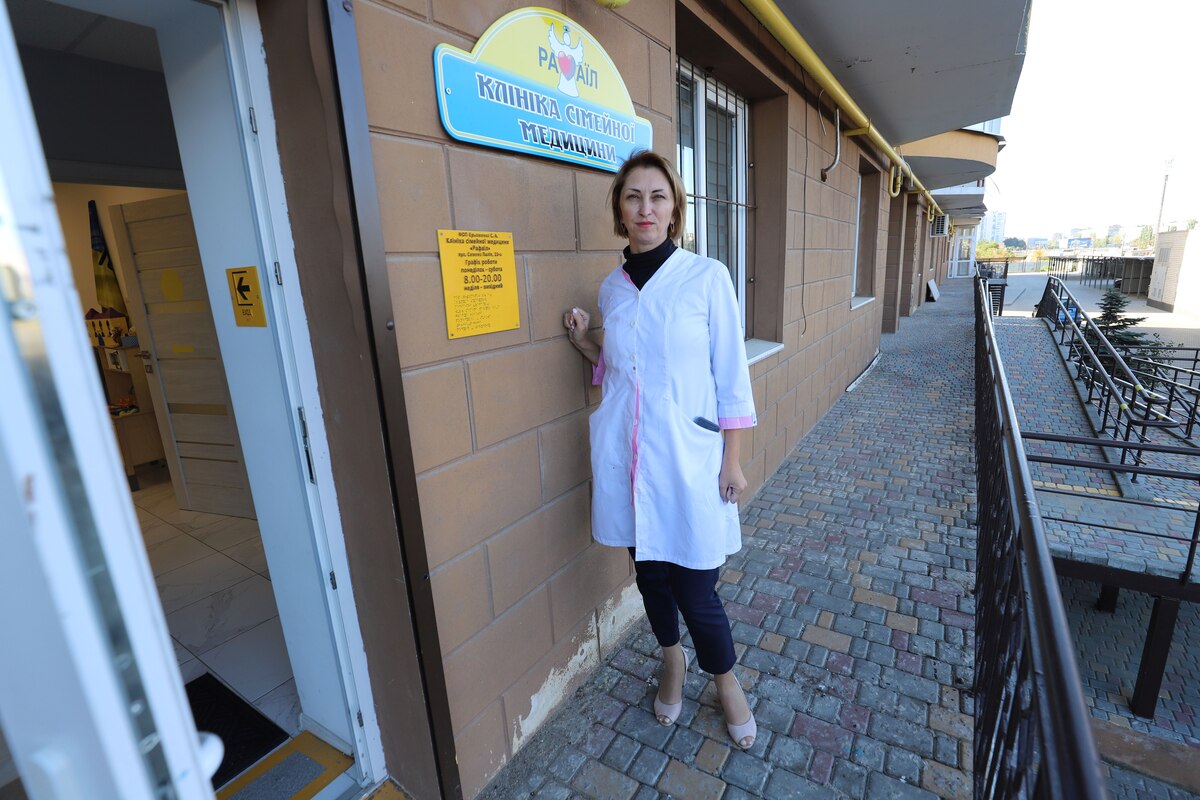
It’s just a 15-minute walk from the pedestrian zone to vulica Pastera, Pasteur Street. There is located the Saint Rafael Clinic.
Anyone sitting here in the waiting rooms of the clinic, which is like a larger practice, is one of those who cannot afford anything in the pedestrian zone. Here, every day from morning to night, patients wait patiently for their turn. The special thing about this clinic, which always has at least two doctors and a nurse present, is that it helps internally displaced people. The usually expensive medications are available here free of charge. The fact that this is possible is due to the collaboration with two Italian Lions Clubs. Much of the medical equipment in the clinic was donated from Italy.
“The Rafael Clinic is a private clinic, but the financial conditions are like those of a state clinic,” reports chief physician Snezhana Eremenko to the taz. “That means I get around one euro for each patient from the state. With 600 patients, that’s around 600 euros a month. Private clinics get ten euros per doctor’s visit.”
The war is present in almost every conversation – whether directly addressed or noticeable in the subtext
Medical help as a lifeline
Many of the patients who visit this clinic have had a long journey. An older woman reports: “I was healthy before the war. But since I fled, I have back pain, my legs hurt, my blood pressure is too high and now I also have diabetes.”
The war is present in almost every conversation – whether directly addressed or noticeable in the subtext. Svitlana, a refugee from Kherson, says: “My son is diabetic, my mother had a stroke. We now live in a building that belongs to a church. And this clinic helps us with medicine, with diapers, with everything. I am so grateful.”

Snezhana Eremenko listens quietly as a young man who recently returned from two years of captivity talks about his sleep problems.
A man named Vova comes into the treatment room, puts his smartphone on the table in front of Snezhana Eremenko and shows her a video. “There you can see the town I come from from a bird’s eye view. Now it’s occupied by the Russians. Look: half of the houses are destroyed. And here, further to the left, you can see my house. It’s still standing.” “Yes, where did you get this video?” Snezhana wants to know. “A friend of mine makes drones,” explains Wowa. “And he flew one of these drones with a camera over my town.”
Wowa doesn’t want to see his real name in the newspaper. “I’m afraid that my stories could harm my relatives. They’re still over there,” he explains. But he is also afraid in Odessa. When he leaves the house, he uses relevant Telegram channels to find out where the men from the TZK military authority are currently located. “They take you straight off the street into the military. And then once they get you, you’re in the trenches in a few weeks.” And he doesn’t want that. “I got my last medication here. The doctors explain everything, listen, that’s not something to be taken for granted,” reports Tetyana Borisywna. She speaks with a trembling voice. Her medical documents are numerous and the list of her illnesses is long.
“Many come because they know that treatment and medication are free with us. If we didn’t exist, they would have to go to pharmacies or see expensive private doctors – hardly anyone can afford that,” says chief doctor Eremenko. “Many young people have gone abroad,” she says, “it’s mostly older people who come to us – with diabetes, cancer, heart problems. The statistics are misleading: it’s not the city that is getting sicker, but demographic change that is changing reality.”
A place of solidarity
What makes this clinic so special is not just the medical services, but also the social commitment. Refugees, the sick, the financially weak – they all feel at home in Snezhana Eremenko’s clinic and find an open ear and a helping hand here.
One patient sums it up like this: “I never thought that people like that existed. That it was possible to get help without money when we have lost everything.”
Sometime after 6 p.m., Snezhhana Eremenko sits alone in the practice and reviews the day’s patients. She reports on her home visits and also talks about what this work does to her. “People deal with the airstrikes very differently. I know a woman who is the morning after an air raidwho tore out an entire entrance to her house with seven floors of apartments, went to work as if nothing had happened. And others are no longer able to work for weeks after such situations.”
Internally displaced people take airstrikes more seriously
“These attacks really don’t bother me psychologically,” the doctor continues. “When I hear drones rattling again at nightI close the window and go back to sleep. Nevertheless, after nights like this, I’m physically exhausted in the morning. Maybe there’s something else in the explosives that we don’t yet know about,” she says. And says that she has recently observed an increase in cancer cases.
Snezhana Eremenko is not in her clinic all day. “When I make a home visit, I first go to the bathroom to wash my hands,” she says. “And when I see that there are pillows and children’s toys in the bathtub, I know that this family fled from a contested area. Because we Odessites don’t take the sirens very seriously. The people from the contested areas, on the other hand, do.”
Authorities and fire departments repeatedly point out the “two-wall rule”. If you don’t go into a shelter in the event of an air alarm, you should stay in a place in your home with two walls separating you from the outside world. This is usually the bathroom.
Big plans for a veterans center
Eremenko starts talking. She has arranged to work with the local veterans center. The center, funded by the regional government, aims to provide comprehensive support to veterans and their families. At some point around 7 p.m. the doctor leaves the clinic and just makes a “very quick” home visit. And sometime after 9 p.m., she collapses into an armchair in her little house, just outside the big city, and briefly reads the latest Telegram news before she gets to dinner.
She received an email from Italy announcing the donation of an ultrasound machine, an incubator for premature babies and wheelchairs. She often receives donations that her clinic has no need for. “I will pass this delivery on to the district hospital,” she says. “They are very happy about it.”