

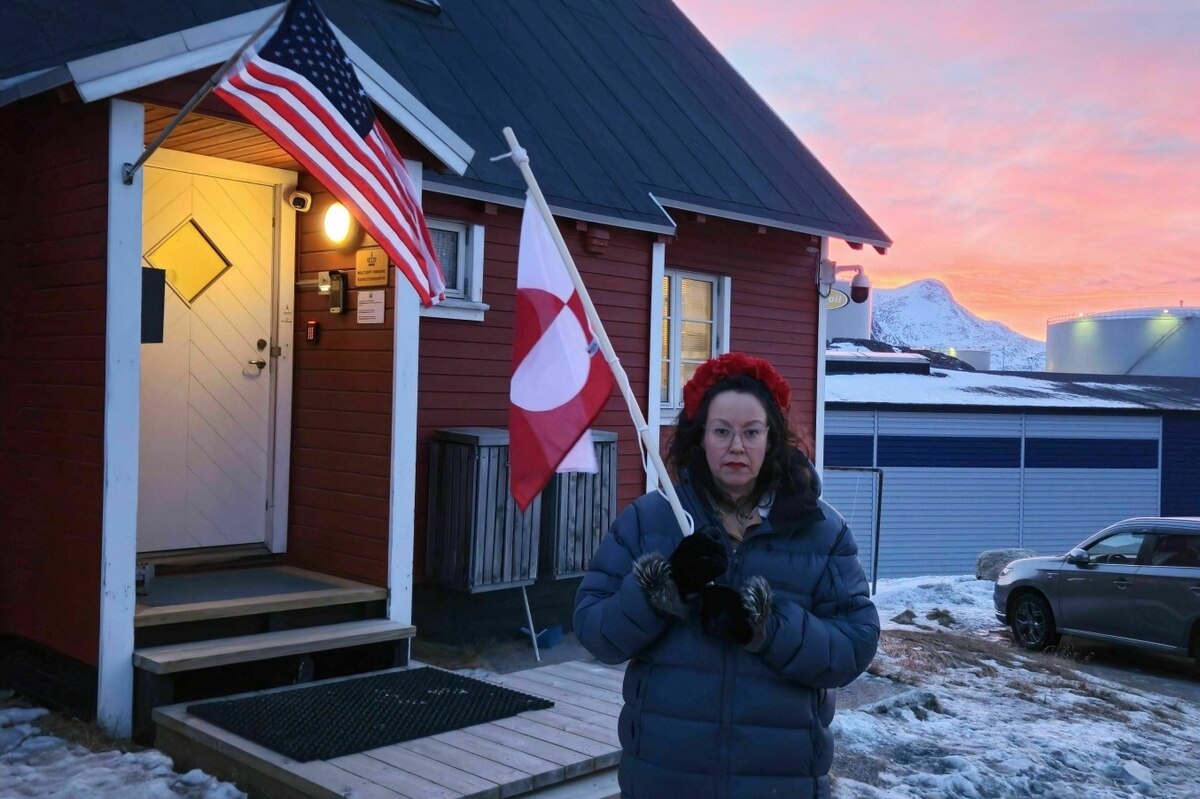
On a Monday morning at the end of January, Aviaq Brandt walks slowly towards the US consulate in Nuuk. It’s just after nine in the capital of Greenland; behind the icy rocks on the outskirts of the city, only a yellowish shimmer announces that the sunrise is approaching. A candle burns in a glass in front of the red wooden cladding of the small consulate building.
Brandt crouches down and sticks a Greenland flag into the frozen snow. She said she put the candle there. In memory of Alex Pretti, the demonstrator, the one a few days earlier in Minneapolis by ICE agents was shot. But also in solidarity with all the others who suffer from the US President’s policies.
“I saw the Americans as our friends,” says Brandt. “But you can’t be friends with someone who pushes you around.” For the past week, the 44-year-old has been coming to the US consulate near the port every morning to demonstrate. This morning she is holding the fort all by herself. Two weeks ago, shortly after Donald Trump loudly announced his takeover plans, thousands of people took to the streets across Greenland, more than ever before in the country’s history. The US President has now at least rhetorically scaled back his violent takeover fantasies.
But the capital only seems quieter at first glance. In reality, the tension is great. Recently, many people followed a call from the Prime Minister and stockpiled food in case of an invasion. “It’s such a surreal time,” activist Aka Hansen wrote on Instagram. “My only comparison to wartime is the Covid quarantine.” Then the apparent all-clear came – and the bars in the city of Nuuk, which has a population of 20,000, were busy again.

This text comes from the weekday. Our weekly newspaper from the left! Every week, wochentaz is about the world as it is – and as it could be. A left-wing weekly newspaper with a voice, attitude and the special taz view of the world. New every Saturday at the kiosk and of course by subscription.
Reporters from all over the world in Nuuk
When the lights suddenly went out across the city around 10:30 p.m. last Saturday, many people’s first thoughts were: Now the USA is bombing us. According to stories about that evening, the people crowded together in the bars. A little later there was a report that storm damage to a line at the nearby Bukse Fjord hydroelectric power station was responsible for the blackout.
In recent weeks, reporters have come to Greenland from all over the world. They all want to know what the residents think of the US President threatening to conquer their country. The mood towards journalists is ambivalent: on the one hand, Greenlanders feel under siege, but on the other hand, they see the need for reporting. It’s their chance to tell their side of what happened.
The soldiers arrived almost at the same time as the reporters. Several European NATO countries have sent additional troops to Greenland in recent weeks. They are intended to strengthen the military presence in the Arctic against Russia as part of Operation “Arctic Endurance”. But it is difficult not to see them as a reaction to the threats from Washington. Denmark sent at least 200 soldiers to Greenland by mid-January. Since there is not enough accommodation in Nuuk, they are staying in the same hotels as the journalists.
In 2026, military personnel are scheduled to rehearse war in the Arctic here. The exercises are coordinated by the Arctic Command of the Danish Armed Forces, whose headquarters are located around a hundred meters from the US Consulate, almost directly at the port of Nuuk. The flags of Denmark, Greenland, the Faroe Islands – and the USA fly in front of the navy blue building.
NATO tested its war equipment in Greenland as early as 2025. Helicopters, transport planes and Danish F-35 fighter jets repeatedly flew over the blue fjord behind Nuuk. Aviaq Brandt says that the training flights disturbed the silence here. Like many Greenlandic Inuit, her family regularly hunts reindeer in the mountains. In order to locate the animals, you have to follow their tracks. But the rumbling from the sky frightens and scares the animals away, says Brandt.

A little candle in memory of Alex Pretti, who was shot by ICE agents in Minneapolis a few days earlier
Photo:
Leon Holly
I oder USA?
As she talks, the door to the US consulate opens. A woman steps out holding a US flag in her hand. She gives a short and friendly greeting and then attaches the flagpole to the holder next to the door. Brandt watches her without saying a word. In her mittens she clutches her red and white Erfalasorput – which means “Our Flag” in Greenlandic.
Many Greenlanders are grateful to the European states for their support during the crisis. It was not until 2024 that EU Commission President Ursula von der Leyen opened an office near the old colonial port in Nuuk. Now the EU is sharpening its focus on Greenland and wants to double its investments in the local economy. Prime Minister Jens Frederik Nielsen was surprisingly open towards the former colonial power Denmark.
“If we have to choose between the United States and Denmark here and now, we choose Denmark,” Nielsen said. Actually, many Greenlanders are in favor of breaking away from Denmark. Politicians from the opposition Naleraq party, which advocates early independence, have repeatedly brought up the USA as a possible partner against Denmark. These sounds have become quieter in recent weeks. But all parties agree: “We don’t want to be Americans, we don’t want to be Danes, we want to be Greenlanders.”
Aviaq Brandt, who worked as a production manager on the Danish television series “Borgen,” is wearing a headband with red artificial roses and red lipstick in front of the US Consulate this morning, a symbol of resistance for Brandt. She says she grew up in an apartheid system in Nuuk. “At school, our parents were given a choice: Either they choose Danish or Greenlandic as their language. And they were told: If you choose Greenlandic, then you have no future.”

The idyll is deceptive: In reality, tension is high in Nuuk, the capital of Greenland
Photo:
Leon Holly
“This is our country”
Brandt says she researched her family history and created a family tree. She discovered that all of her ancestors had Danish names. Only with her and her first name Aviaq did Greenlandic come back. She also gave her children indigenous first names. “I’m taking back what’s ours.” She couldn’t talk to her mother about her childhood.
Only later did she find out that her mother, like so many other Greenlandic children, had been brought to Denmark by the former Danish colonial power with the aim of robbing her of her indigenous identity. “It’s a deep wound,” says Brandt. “A lot of people can’t talk about it. It hurts too much.”
The processing of this story Violence between Greenland and Denmark only recently began. There were reports, for example, about Inuit children who were deported to Denmark in the 1950s as an “experiment” in order to raise them there to become “little Danes”. And practices came to light by Danish doctors who used IUDs on Inuit women in the 1960s and 1970s, often against their will or without their knowledge. Trump stumbled into this situation with his desire for imperial expansion.
“This is our country – and it doesn’t even belong to us,” says Brandt. “We borrow it from our ancestors. We cherish it for our children. No one can take it.