

taz: Mr. Held, if you had the unconscious lying with you on the treatment couch, what mental distress would it complain about?
Tilo Held: Maybe about always being seen as a threat and not with our people-friendly sides: our dreams, memories and mistakes.
Im Interview:
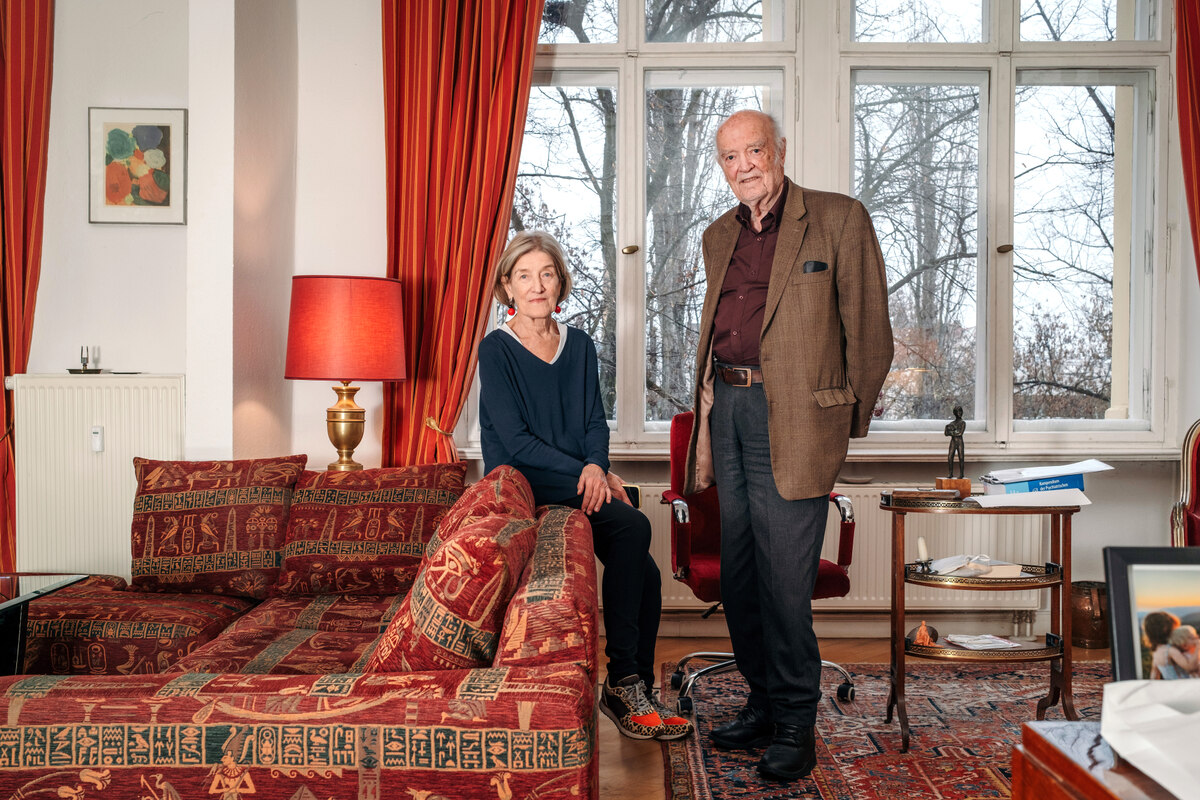
Christina von Braun, born in 1944, is a cultural theorist, author and filmmaker. She was a professor at Humboldt University and headed the Gender Studies program there until 2003.
Tilo Held, born in 1938, has been medical director of the Rheinische Landesklinik in Bonn since 1981. He was the first psychiatric clinic director in Germany who was also a psychoanalyst.
taz: Mistakes, i.e. accidental promises, forgetting, interrogations, which, according to Freud, indicate repressed inner conflicts.
Held: As a rule, we only deal with these things once they have become conscious and have changed our behavior; this is usually perceived as a problem. But the unconscious can also be an ally.
Christina von Braun: And it can be abused. This is shown by the conceptual history of the unconscious. It appears in German Romanticism and reflects the secularization process: The Protestants gave the unconscious attributes that were previously used for God, omnipotent, omniscient… With Freudian psychoanalysis, aspects from the Jewish tradition are added. Freud primarily focused on individual biographies.
taz: Freud valued the unconscious as a creative force, but also perceived it as threatening. He warned that the ego would no longer be “master of its own house” if the unconscious was not contained.
von Braun: Historical developments were also responsible for this assessment: the right to vote gradually became established during the democratization process. The individual thus became a contested terrain: attempts were made to grab voters by their emotions, increasingly with the help of the emerging mass media of film, radio and television. At the same time, the rules of social coexistence developed increasingly from a culture of trust to a system of faith.
taz: What do you mean?
von Braun: Trust systems are based on the fact that there is an unwritten, rather unconscious law about how a society is held together. Marcel Mauss, for example, described the society of the gift: A gift circulates, you have to pass it on or give another one back, otherwise it is a declaration of war. This creates a cohesion that no one controls from above, but that everyone adheres to. I was interested in how this system was gradually replaced by faith institutions and structures that are controlled by consciousness: writing, money, religion. While trust can be given and withdrawn, faith is consciously decreed and recorded in dogmas.

Christina von Braun, Tilo Held: “Battle for the Unconscious: A Society on the Couch”. Structure, Berlin 2025, 736 pages, 34 euros
taz: Was National Socialism such a belief system?
von Braun: Yes, and the Nazis tried to turn psychoanalysis, which actually comes from the trust system, into a belief system. With the active help of representatives like CGJung, it was “Aryanized” and became a means of controlling not only the body but also the psyche.
Held: Faith is not an innate cultural phenomenon like religion. But trust is a fundamental necessity of human coexistence; it is innate. If it is misused, it leaves deep wounds.
taz: You write that children who were sexually abused by relatives or close caregivers sometimes suffer even greater damage than people who had to endure concentration camp imprisonment.
Held: I worked a lot with Holocaust survivors in the 1960s. I found it striking that such terrible crimes did not leave some survivors with such fundamental damage as we analysts suspected.
taz: On behalf of the federal government, you wrote reports on compensation claims for child survivors, people who experienced the Holocaust as children.
Held: I was living in France at the time and was supposed to meet people who didn’t want to travel to Germany for the assessment. To my surprise, the child survivors in particular were much less traumatized than we therapists had feared. Many of them were settled in their lives, had established careers, and had formed relationships.
taz: Was that a dilemma for you – it was about the amount of compensation?
Held: I worded the reports in such a way that the state still had to pay. Because the law measured damage solely according to the degree of earning capacity and not the ability to love. Nevertheless, these cases taught me a lot about the unconscious and gave me professional doubts.
taz: To what extent?
Held: In my psychoanalytic training I learned a lot about trauma. But nothing about these amazing powers of restoration. Today I am certain: traditional psychoanalysis only covers the individual biography and therefore necessarily primarily the negative. But it does not recognize the successful solutions to problems that the many generations before us have passed on to us.
taz: That means we are becoming more and more resilient over time – why do we notice so little of it?
Held: The term was created when it was seen that many of those persecuted by the Nazis had great CVs. At first you thought: some are resilient, others are not. But the development of resilience is linked to the condition that the person who has been expelled from a community is subsequently accepted back into society. It has been seen that the different lives of Auschwitz survivors depended on the country in which they lived after liberation. These were big differences between those in Poland and those in Israel or the USA, where they experienced being Jewish as a positive matter of course.
von Braun: The time afterwards, the experience of being welcomed into one’s community, is crucial for the ability to mobilize one’s own strengths.
Held: We all carry within us diverse potentials of freedom and protection. But circumstances must enable us to activate them. An example from evolution: For a long time, mothers had a high risk of death during childbirth. Children would have died if other people who cared for them had not taken over. This is how men’s brains developed the skills needed to adequately care for a baby.
von Braun: Previous generations already had this in them, it was just never accessed.
Held: Because cultures heavily focused on military force and warfare have prevented men from caring for babies.
von Braun: Due to the rise of authoritarian political and social models, it is to be feared that the focus on mothers will soon take place again.
taz: Can men lose this ability again?
von Braun: No, but you can’t retrieve them. Not because nature “designed it that way,” but because culture forces men and women into certain roles. Have you ever asked yourself why all right-wingers and autocrats hate gender, transsexuality and fluid gender boundaries?
taz: Yes, why?
von Braun: Because these fluid boundaries – between nations or genders – are not compatible with autocratic belief systems and norm-setting. Flexibility offers potential for resistance, also for the future. But the pendulum is currently swinging more towards autocratic clarity.
taz: Towards a new belief system?
von Braun: Exactly. At the same time, social media and artificial intelligence occupy our psyche and emotions to such an extent that one wonders where resistance should even come from.
taz: You talk about bringing people into line through social media.
von Braun: Historically, synchronization always had the collective in mind. The big difference to the mass media of the 1920s and 1930s is that today’s social media is aimed directly at the individual. The AI says: You are wonderful. I understand your question so well. Brexit already made it clear how effective individually tailored election advertising or manipulation is.
taz: We even submit to it voluntarily. Can the unconscious still be saved?
von Braun: We think, yes. The unconscious learns to defend itself. A historical example: Around 1900, the intelligence quotient was defined; the average value was 100. Then it became apparent that the average IQ had to be increased every 10 or 15 years. The ability to decipher images had increased. With the advent of mass media, the individual’s talent to escape the flood of images and to take a literate look at images grew.
taz: So the individual can shield himself?
von Braun: Even in extreme situations. In the concentration camps, people protected their will to live by telling each other their dreams.
Held: Interpersonal relationships can also strengthen the individual. There are numerous therapy apps that create an illusion of relationship. But an AI can never replace the analyst. A real counterpart offers a dialogue, contradicts or makes surprising connections – the AI only repeats what has been said and praises the “patient” for his intelligent questions. It makes you feel good, but it doesn’t lead anywhere.
von Braun: We have nothing as strong as the analogue relationship to make us resilient against a world situation that many perceive as threatening.
taz: In your book you describe that Germany is the only country in the world where psychotherapy is a health insurance benefit. What has led to psychoanalysis being pushed aside because it is comparatively expensive and time-consuming.
Held: I think it’s great that therapy has been open to everyone since 1976. But that also means: the state sets the rules. The conditions of psychotherapy became more and more similar to the wishes of behavioral therapy. Today there is only one chair for psychoanalysis in all of Germany!
taz: What can psychoanalysis do that other forms of therapy cannot?
Held: It can lay the foundations for a change in the psyche by creating a trusting relationship. This is a privilege of psychoanalysis – in behavioral therapy the relationship between doctor and patient does not play such a strong role.
taz: Mr. Held, you support the administration of psychotropic drugs and turn away from psychoanalytic beliefs such as the Oedipus complex. Do you think psychoanalysis itself is no longer up to date?
Held: Well, today, in the second century after Freud, one cannot expect that the entire theoretical framework of psychoanalysis remains unchanged. However, as a method it still has great advantages.