

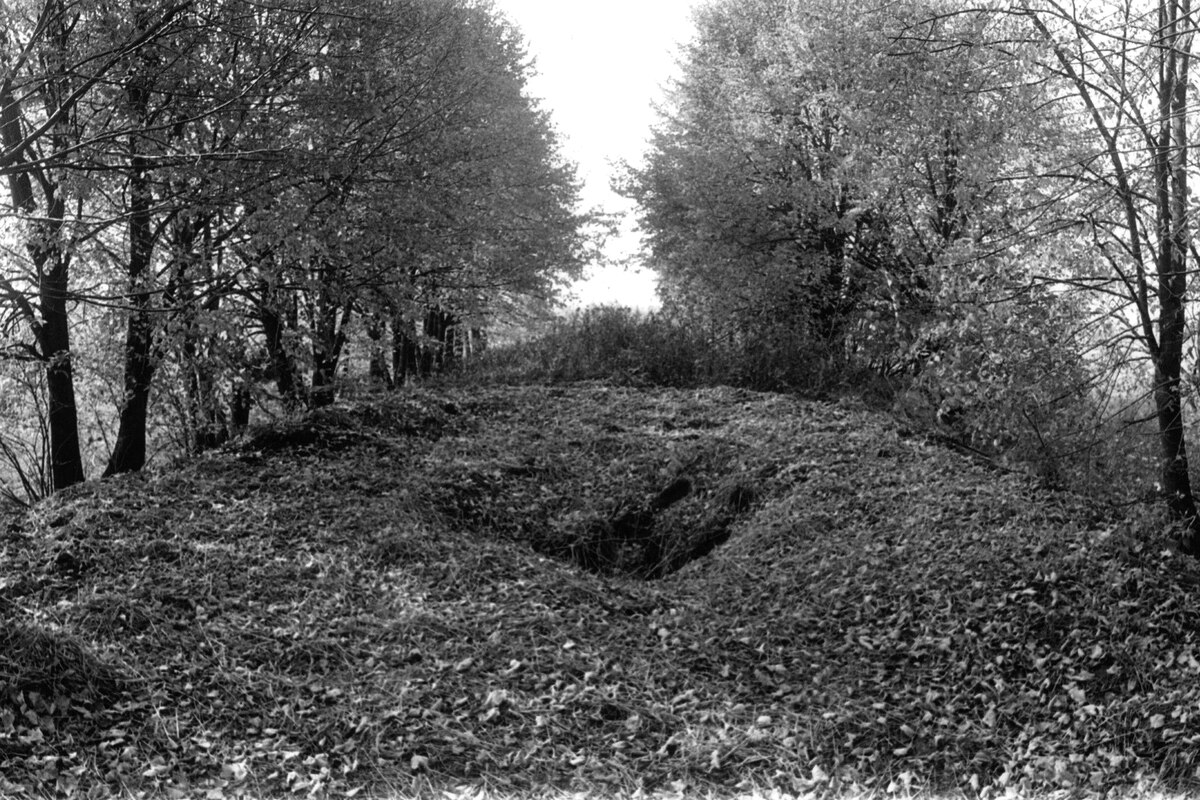
In the wide fields around the small central Ukrainian town of Berdychiv, a slight hill stands out next to a depression. This runs in a straight line, as if cut with a ruler. To the left and right of her, farmers tend their fields. If one of the rare visitors steps on the grass at the valley, it crunches underfoot.
It is not shells from past seas that make this noise, but rather the bones of people. The field at Berdytschiw is one of about 2,000 places in Ukraine where the SS, German police and local helpers first shot their Jewish victims and then buried them in mass graves. Some of these murder sites are decorated with small or large memorials, others, such as the grave in Berdychiv, remain completely unmarked.
In some places the SS formed “Command 1005” The bodies were recovered and burned before the German withdrawal from Ukraine in 1944 so that no memory of the crime would remain. The bones were ground in a specially designed bone mill.
But there were too many murder sites, the retreat was too rapid and Command 1005 couldn’t keep up with the rescue. That’s why many of those murdered still lie today, sometimes unnoticed, in a mass grave somewhere in Ukraine.
Commando 1005 recovered the bodies and burned them so that no memory would remain. The bones were ground in a specially designed bone mill
Murder on the assembly line and by hand
The Nazi leadership made no geographical distinctions in the mass murder of Jews that began in 1941. Whether in Belarus or Ukraine, the Netherlands or Greece – the victims lost their lives indiscriminately. In Eastern Europe, this only happened in rare cases in the murder factories themselves that were built on German-occupied Polish territory, in Auschwitz, Treblinka, Majdanek, Sobibor or Belzec.
In Ukraine, Russia and Belarus, the Holocaust was manual work. Above all, Einsatzgruppen, which were specially formed from SS men and ordinary police officers, killed millions of Jews behind the front in places that could hardly be counted. In some cases the Nazis had previously locked people in ghettos, in others they had not.
In Ukraine, “Operational Group C”, consisting of 700 to 800 people, was primarily responsible for mass murder. There were more than a million victims there alone. When conducting a regional investigation of the Nazi crimes, it should not be forgotten that Ukraine used to have completely different borders than it does today. At that time, the west of the country was still part of Poland, the south was partly under the control of Romania.
Kill efficiently, die painfully
During an interrogation in 1962, the police officer Erwin C. stated that he and his colleagues were “only” responsible for the shooting: “The Jewish victims were placed in rows of about ten at the edge of the pit, and we had to shoot them with carbines on command. Two of us had to shoot at one victim each. When two to three rows had been shot, the next colleagues stepped forward and shot two or three rows again.” Only very few perpetrators were later brought to justice.
The Jews of Berdychiv died in August 1941. Very few were able to hide in time and survived the Holocaust. Shortly afterwards, on September 29th and 30th, 1941, it happened Mass murder in the Babyn Yar Gorge. 33,771 Jews were murdered.
The exact number is known because the Nazis assigned a man to count the victims. From the end of 1941, gas vans were used in the “Reich Commissariat of Ukraine” in which the victims were killed in agony by the exhaust gases from the engine that were led into the interior. Jews from the western part of Ukraine were deported to the Belzec extermination camp and killed there.
Two of us each had to shoot one victim. When two or three rows had been shot, the next colleagues stepped forward and shot two or three rows again
Police officer Erwin C. during an interrogation in 1962
Late memory
After 1945 it was allowed no explicit memory during Soviet times to the Holocaust. The victims were described as “peaceful Soviet citizens,” without reference to their religion. Joint Jewish commemoration was strictly forbidden. This only changed in 1991.
The “Preserve Memory” initiative has enabled dignified remembrance at some of the murder sites. People from the nearest villages ensure that the memorials are maintained. Because Ukraine is not immune to looters either. There have already been cases in which “Holocaust bones” have been offered for sale, a rabbi reported in 2019.
Archaeologists investigating mass graves also reported repeated looting, especially before the start of the current war with Russia. Apparently grave robbers are hoping to find gold. The anti-Semitic myth of the rich Jew could be behind this.