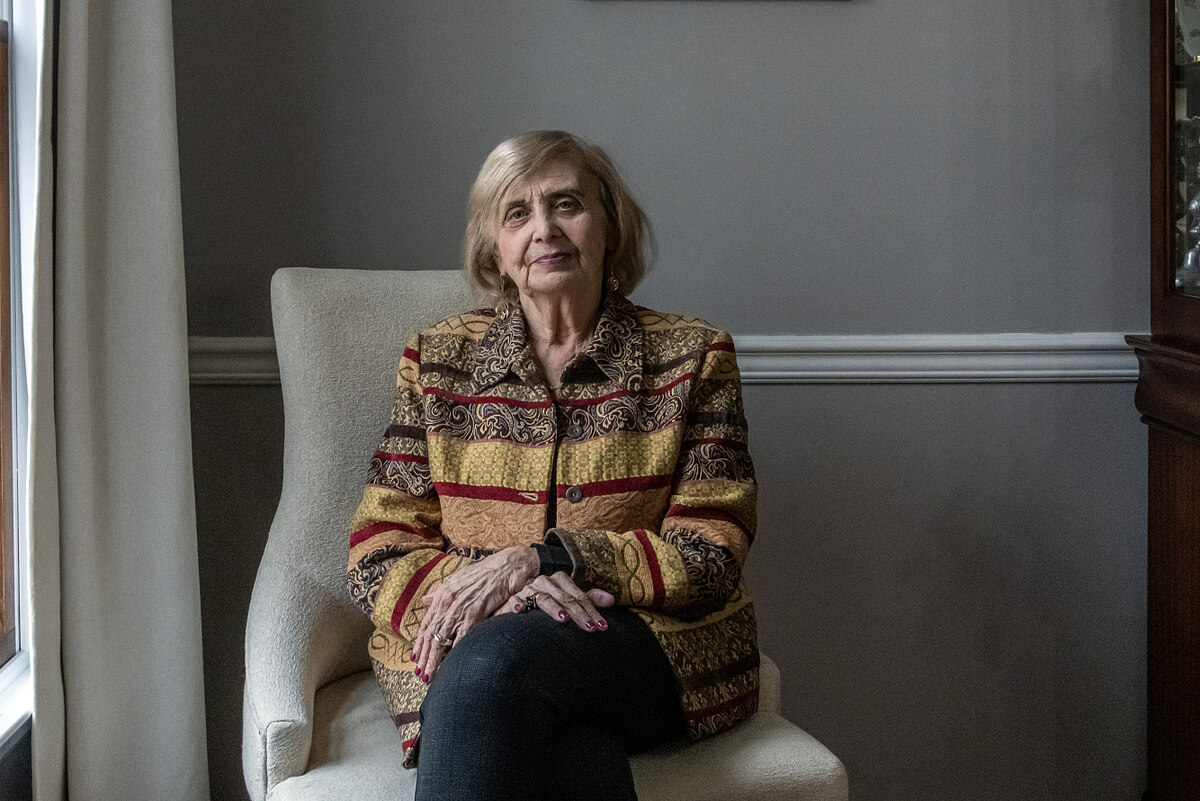
“No child should see what I saw,” Tova Friedman wrote in her memoirs a few years ago, looking back at the time of the Shoah when she was still a little girl. But the world should know what she, the survivor, saw, smelled and tasted after being sent to the Tomaszów Mazowiecki ghetto at the age of two and to Auschwitz-Birkenau at the age of five.
In the ghetto, she grew up with the “sounds of genocide,” “well-oiled firing pins that hissed smoothly through gun barrels. Guttural imprecations and curses before the murder.” Later, in the Auschwitz extermination camp, she is surrounded by the “sulfurous, foul stench like rotten eggs: burning hair mixed with burnt human flesh.” Your readers should be able to get a painfully accurate picture of all of this. About the deportations, the shootings, the gas chambers. So that it never happens again.
The Jew Tova Friedman will speak at the memorial hour for the victims of National Socialism in the German Bundestag on Wednesday, and she will certainly find just as urgent and penetrating words as in her biography, which was published in German in early 2023 (“I was the girl from Auschwitz”). Friedman is now 87 years old and lives in New Jersey, where she long worked as director, social worker and therapist at the regional Jewish Family Service. She gave therapy sessions there until the end.
Tova Friedman today dedicates her life to remembering the Shoah and fighting anti-Semitism. She runs it with her grandson Aron Goodman a Tiktok channelin which she primarily explains the crimes and methods of National Socialism. Over 500,000 people follow them on the platform. In short clips, Friedman explains, among other things, what happened in Auschwitz, Majdanek, Chełmno, Treblinka, Bełzec and Sobibor.
Her own mother’s family was almost completely murdered during the Nazi era; she lost 150 relatives. Saving the dead and their relatives from oblivion is one of their goals, Tova Friedman said three years ago in an interview with the taz: “I have to talk about them to keep their memory alive. As long as I talk about them, they are not dead.”
This is the second time she has traveled to the country of the perpetrators, even though she didn’t actually want to. “For 75 years I refused to return to Germany. I didn’t want to hear the German voices, I was afraid of seeing German Shepherds on the street,” she recently said in a Tiktok clip. German shepherd dogs – for her a reminder of the time in Auschwitz. At the same time, she feels it is an honor and an obligation to talk to young people about the Nazis and hatred of Jews, at a time when anti-Semitism is “spreading like wildfire in Europe.”
As a child in the extermination camp
Tova Friedman was born – as Tola Grossman – in 1938 in Gdynia near Danzig. A year before the outbreak of war, two months before the November pogroms. When she was two and a quarter years old, she and her parents were taken to the Tomaszów Mazowiecki ghetto. She later reconstructs this time with the help of a Yizkor book, a document in which Jewish life in the area was documented and for which her father wrote a lot. “Life was a litany of disasters, disappearances, massacres and the constant struggle for food,” says her biography.
Typhus is spreading in the camp, ghetto residents are being shot, Tola Grossman is starving. She licks the walls and later explains it by saying that she intuitively tried to suck calcium out of the wall paint. Her father is employed by the Nazis as a Jewish police officer in the ghetto; If he is too kind to the inmates, he is beaten bloody and later has to take his own parents for deportation.
As part of “Aktion Reinhardt”, the extermination of all Jews on Polish territory, a total of 15,000 people are said to have been deported from Tomaszów Mazowiecki to Treblinka. Tola Grossman and her parents are among the last remaining in the ghetto. When it is dissolved, they are sent to the Starachowice labor camp, where their mother and father are used as forced laborers in the ammunition factory. From here they were deported to Auschwitz in 1944.
Grossman appears to be on the way to certain death in Auschwitz in the fall of 1944. She is sent to the gas chamber with a group of children, sitting naked, miserable and freezing in the anteroom. They wait and wait there, but something isn’t going according to plan that day. Finally, the group is sent back – they still don’t know exactly why. She later escapes the death march because her mother hides her among corpses.
Tola Grossman survives. Her parents Machel and Reizel Grossman also survive. Because of skill – and probably also a lot of luck. After the war they were sent to a displaced persons camp.
New beginnings in the USA
In 1950, when she was eleven, Tola Grosmann emigrated to the USA with her parents. She pursued an academic career, earning bachelor’s and master’s degrees in psychology, black literature and social work. In 1960 she married Maier Friedman, whom she met as a child in the USA; they celebrate a traditional Jewish wedding. She takes the surname Friedman.
Seven years later, the couple went to Netanya, Israel, where she was supposed to teach at the Hebrew University of Jerusalem. In Israel, she first renamed herself “Tova” “because it sounded more Israeli, but also because it sounded similar to Tema – my maternal grandmother’s name,” she writes in her memoirs. Ten years later, for professional reasons, the couple returned to the USA, where Tova Friedman joined the Jewish Family Service.
As a psychologist and as a survivor, Friedman is of course familiar with “Survivor’s Syndrome,” but she doesn’t believe that she suffers from it – and instead coins another term for herself: Survivor’s Growth. Survival growth. She wants to do something meaningful in her life to remember the Shoah. She first tells her life story to the writer and journalist Milton John Nieuwsma, who reports about it in his book “Children’s Camp” (1998). It was only many years later, in 2022, that Friedman published her own biography in English, probably also prompted by the commitment of her grandson Aron, who founded the Tiktok channel with her the year before.
In the book she also deals with the incomprehensible routine and everydayness of murder, with what Hannah Arendt referred to as the banality of evil. “What I still don’t understand, even after all these years, is the complete lack of conscience and the casualness with which harmless civilians were murdered, as casually as eating and drinking,” Friedman writes.
What concerns them is that the majority of the accomplices remained unpunished and that very few of the administrators of the genocide were brought to trial very late. “Somewhere in the Third Reich, in an office, sat a clever statistician with perverted thinking who calculated how many additional tracks, stopping points and signals were needed to ensure that the death trains ran smoothly,” she writes. And further: “Psychopaths alone would not have brought about the Holocaust. They depended on an entire army of willing accomplices, as well as on well-trained academics who made the everyday logistics of industrial murder work.”
Reading Tova Friedman and speaking to her means pausing and trying to understand how a system of internment, harassment and killing develops and takes on a life of its own. And above all, to understand what this means for the victims. “Auschwitz stays with me for life, always remains part of my body and my mind,” said Tova Friedman in the interview at the time, giving two examples: “Sometimes the word ‘selection’ appears on menus in restaurants. When I read that, I always cringe. Because I think of ‘selection’ in the camp. Or when I hear the German word ‘Halt’, I often feel physical fear. ‘Halt’ in Auschwitz often meant that people were stopped and shot.”
Listen to Friedman, maybe even remember what he was saying happened last year on Remembrance Day in the Bundestag, that should mark this year’s Auschwitz Remembrance Day. “I implore you: do not repeat the story I endured,” Friedman writes. She will certainly find similarly apt words at the speaker’s podium on Wednesday.